Patrick Schara, Tankut Türel, Berend Eling, Željko Tomović
{"title":"Revival of Polyester-Based Polyurethane Technology: High-Yield Monomer Recovery Using Scalable, Basic Chemical Processes","authors":"Patrick Schara, Tankut Türel, Berend Eling, Željko Tomović","doi":"10.1021/acssuschemeng.4c10512","DOIUrl":null,"url":null,"abstract":"Polyurethanes (PUs) offer exceptional versatility due to their tunable thermal and mechanical properties, enabling their use across various applications, from foams and compact materials to adhesives. However, the disposal of PU waste presents significant environmental challenges, as current recycling processes are complex, requiring harsh conditions and large excesses of reactants. Moreover, such processes yield mixtures of monomers and oligomers that are challenging to purify. This study introduces a dual-pathway approach for the closed-loop recycling of conventional polyester polyol-based polyurethanes into high-purity monomers using base-catalyzed depolymerization methods. Two recycling strategies were explored: a one-pot hydrolysis method and a two-step depolymerization. The one-pot hydrolysis yielded adipic acid, monoethylene glycol (MEG), and 4,4′-methylenedianiline (4,4′-MDA). Alternatively, the two-step process first targeted the cleavage of the ester linkages utilizing methanol, producing dimethyl adipate and MEG, followed by hydrolysis of the urethane bond releasing 4,4′-MDA and additional MEG. Both recycling approaches achieved depolymerization of a model polyurethane material into well-defined monomers with high yields and purities. Our findings highlight that despite the recent preference of the industry for polyether polyols, polyester polyols hold great potential for closed-loop recycling, tremendously increasing the recyclability of PU waste. This work demonstrates that the innovative extension of established chemistries can enable practical, scalable recycling solutions, supporting a shift toward circular, polyester polyol-based PU systems wherever feasible.","PeriodicalId":25,"journal":{"name":"ACS Sustainable Chemistry & Engineering","volume":"39 1","pages":""},"PeriodicalIF":7.3000,"publicationDate":"2025-03-10","publicationTypes":"Journal Article","fieldsOfStudy":null,"isOpenAccess":false,"openAccessPdf":"","citationCount":"0","resultStr":null,"platform":"Semanticscholar","paperid":null,"PeriodicalName":"ACS Sustainable Chemistry & Engineering","FirstCategoryId":"92","ListUrlMain":"https://doi.org/10.1021/acssuschemeng.4c10512","RegionNum":1,"RegionCategory":"化学","ArticlePicture":[],"TitleCN":null,"AbstractTextCN":null,"PMCID":null,"EPubDate":"","PubModel":"","JCR":"Q1","JCRName":"CHEMISTRY, MULTIDISCIPLINARY","Score":null,"Total":0}
引用次数: 0
Abstract
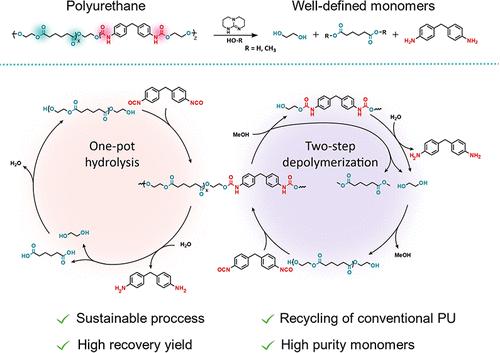
Polyurethanes (PUs) offer exceptional versatility due to their tunable thermal and mechanical properties, enabling their use across various applications, from foams and compact materials to adhesives. However, the disposal of PU waste presents significant environmental challenges, as current recycling processes are complex, requiring harsh conditions and large excesses of reactants. Moreover, such processes yield mixtures of monomers and oligomers that are challenging to purify. This study introduces a dual-pathway approach for the closed-loop recycling of conventional polyester polyol-based polyurethanes into high-purity monomers using base-catalyzed depolymerization methods. Two recycling strategies were explored: a one-pot hydrolysis method and a two-step depolymerization. The one-pot hydrolysis yielded adipic acid, monoethylene glycol (MEG), and 4,4′-methylenedianiline (4,4′-MDA). Alternatively, the two-step process first targeted the cleavage of the ester linkages utilizing methanol, producing dimethyl adipate and MEG, followed by hydrolysis of the urethane bond releasing 4,4′-MDA and additional MEG. Both recycling approaches achieved depolymerization of a model polyurethane material into well-defined monomers with high yields and purities. Our findings highlight that despite the recent preference of the industry for polyether polyols, polyester polyols hold great potential for closed-loop recycling, tremendously increasing the recyclability of PU waste. This work demonstrates that the innovative extension of established chemistries can enable practical, scalable recycling solutions, supporting a shift toward circular, polyester polyol-based PU systems wherever feasible.
期刊介绍:
ACS Sustainable Chemistry & Engineering is a prestigious weekly peer-reviewed scientific journal published by the American Chemical Society. Dedicated to advancing the principles of green chemistry and green engineering, it covers a wide array of research topics including green chemistry, green engineering, biomass, alternative energy, and life cycle assessment.
The journal welcomes submissions in various formats, including Letters, Articles, Features, and Perspectives (Reviews), that address the challenges of sustainability in the chemical enterprise and contribute to the advancement of sustainable practices. Join us in shaping the future of sustainable chemistry and engineering.



 京公网安备 11010802042870号
京ICP备2023020795号-1
京公网安备 11010802042870号
京ICP备2023020795号-1

 分享
分享
 求助内容:
求助内容: 应助结果提醒方式:
 扫码关注我们
