Yejiao Shi, Gan Luo, Borui Zhen, Zhinan Liu, Sumeng Chen, Zhe Wang, Wuyuan Lu, Honggang Hu, Xiang Li
{"title":"Systematic All-Hydrocarbon Stapling Analysis for Cecropin A Generates a Potent and Stable Antimicrobial Peptide","authors":"Yejiao Shi, Gan Luo, Borui Zhen, Zhinan Liu, Sumeng Chen, Zhe Wang, Wuyuan Lu, Honggang Hu, Xiang Li","doi":"10.1021/acs.jmedchem.4c02852","DOIUrl":null,"url":null,"abstract":"As an evolutionarily conserved family of antimicrobial peptides (AMPs), cecropins play an important role in innate immunity. But their inevitable weaknesses, including poor proteolytic stability and unpredictable cytotoxicity, severely hindered their clinical applications. Considering their two-helical structure, all-hydrocarbon stapling was performed on cecropin A, successfully generating 27 (<i>i</i>, <i>i</i> + 4) stapled derivatives. By evaluating antimicrobial and hemolytic activities, CEC-2–9 with the <i>C</i>-terminus threonine and lysine being stapled was identified as the optimal one. It exerted significantly enhanced antibacterial potency with more severe bacterial membrane damage capacity. Compared to cecropin A, its increased helicity and hydrophobicity as well as the decreased net charge also enabled its improved stability and biocompatibility, facilitating its enhanced antibacterial and anti-inflammatory efficacy for the effective treatment of mice with peritonitis sepsis. These results have proven that the systematic all-hydrocarbon stapling of AMPs was a feasible approach for the future development of antibacterial therapeutics.","PeriodicalId":46,"journal":{"name":"Journal of Medicinal Chemistry","volume":"86 1","pages":""},"PeriodicalIF":6.8000,"publicationDate":"2025-03-10","publicationTypes":"Journal Article","fieldsOfStudy":null,"isOpenAccess":false,"openAccessPdf":"","citationCount":"0","resultStr":null,"platform":"Semanticscholar","paperid":null,"PeriodicalName":"Journal of Medicinal Chemistry","FirstCategoryId":"3","ListUrlMain":"https://doi.org/10.1021/acs.jmedchem.4c02852","RegionNum":1,"RegionCategory":"医学","ArticlePicture":[],"TitleCN":null,"AbstractTextCN":null,"PMCID":null,"EPubDate":"","PubModel":"","JCR":"Q1","JCRName":"CHEMISTRY, MEDICINAL","Score":null,"Total":0}
引用次数: 0
Abstract
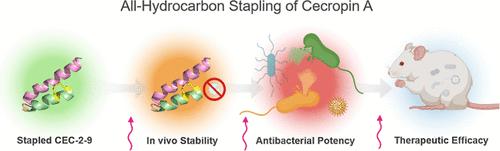
As an evolutionarily conserved family of antimicrobial peptides (AMPs), cecropins play an important role in innate immunity. But their inevitable weaknesses, including poor proteolytic stability and unpredictable cytotoxicity, severely hindered their clinical applications. Considering their two-helical structure, all-hydrocarbon stapling was performed on cecropin A, successfully generating 27 (i, i + 4) stapled derivatives. By evaluating antimicrobial and hemolytic activities, CEC-2–9 with the C-terminus threonine and lysine being stapled was identified as the optimal one. It exerted significantly enhanced antibacterial potency with more severe bacterial membrane damage capacity. Compared to cecropin A, its increased helicity and hydrophobicity as well as the decreased net charge also enabled its improved stability and biocompatibility, facilitating its enhanced antibacterial and anti-inflammatory efficacy for the effective treatment of mice with peritonitis sepsis. These results have proven that the systematic all-hydrocarbon stapling of AMPs was a feasible approach for the future development of antibacterial therapeutics.
抗菌肽作为一个进化保守的抗菌肽家族,在先天免疫中发挥着重要作用。但它们不可避免的缺点,包括蛋白水解稳定性差和不可预测的细胞毒性,严重阻碍了它们的临床应用。考虑到其双螺旋结构,对cecropin A进行了全烃钉接,成功地合成了27个(i, i + 4)钉接衍生物。通过对抗菌和溶血活性的评价,确定c端苏氨酸和赖氨酸连接的CEC-2-9为最佳选择。抗菌效力显著增强,细菌膜损伤能力较强。与天蚕素A相比,其螺旋度和疏水性的增加以及净电荷的降低也提高了其稳定性和生物相容性,从而增强了其抗菌和抗炎作用,可有效治疗小鼠腹膜炎败血症。这些结果证明,系统的全烃缝合抗菌肽是未来抗菌药物开发的可行途径。
期刊介绍:
The Journal of Medicinal Chemistry is a prestigious biweekly peer-reviewed publication that focuses on the multifaceted field of medicinal chemistry. Since its inception in 1959 as the Journal of Medicinal and Pharmaceutical Chemistry, it has evolved to become a cornerstone in the dissemination of research findings related to the design, synthesis, and development of therapeutic agents.
The Journal of Medicinal Chemistry is recognized for its significant impact in the scientific community, as evidenced by its 2022 impact factor of 7.3. This metric reflects the journal's influence and the importance of its content in shaping the future of drug discovery and development. The journal serves as a vital resource for chemists, pharmacologists, and other researchers interested in the molecular mechanisms of drug action and the optimization of therapeutic compounds.




 京公网安备 11010802042870号
京ICP备2023020795号-1
京公网安备 11010802042870号
京ICP备2023020795号-1

 分享
分享
 求助内容:
求助内容: 应助结果提醒方式:
 扫码关注我们
