{"title":"Chiral Gold Nanostructure Monolayers as SERS Substrates for Ultrasensitive Detection of Enantiomer Biomarkers of Alzheimer's Disease","authors":"Changlong Hao, Dan Meng, Wenxiong Shi, Chuanlai Xu, Qing Wang, Hua Kuang","doi":"10.1002/anie.202502115","DOIUrl":null,"url":null,"abstract":"<p>The early diagnosis of neurodegenerative diseases, such as Alzheimer's disease (AD), requires the identification of sensitive and specific biomarkers. Detecting chiral molecules at concentrations relevant to disease states remains challenging. Herein, a new type of chiral gold nanostructure induced by D-/L-cysteine–leucine dipeptides with a <i>g</i>-factor of 0.1 was successfully synthesized for enantiomer biomarker detection. To enhance the discrimination performance, the chiral gold nanostructures were assembled into D-/L-Au monolayers. As surface-enhanced Raman scattering (SERS) substrates, the D-/L-Au monolayers simultaneously deliver molecular structural specificity and enantioselectivity within a single spectrum, which can be a versatile, label-free chiral discrimination strategy for the detection of D-/L-kynurenine (Kyn). The mechanism was unveiled to involve high enantioselective adsorption energies between L- and D-Kyn on the lattice plane (221), resulting in enantioselective sensing. The results showed that the L-Au monolayer reached a limit of detection (LOD) of 3.7 n<span>m</span> for L-Kyn, while the D-Au monolayer reached an LOD of 3.6 nM for D-Kyn. Notably, there was a significant difference in D-Kyn levels between AD patients and healthy individuals in serum samples, a distinction not observed for L-Kyn, which positioned D-Kyn as a potential novel biomarker for clinical prediagnosis of AD patients, marking the first report of its kind worldwide. This study provides a robust tool for advancing biomedical science and clinical diagnostics.</p>","PeriodicalId":125,"journal":{"name":"Angewandte Chemie International Edition","volume":"64 21","pages":""},"PeriodicalIF":16.9000,"publicationDate":"2025-03-10","publicationTypes":"Journal Article","fieldsOfStudy":null,"isOpenAccess":false,"openAccessPdf":"","citationCount":"0","resultStr":null,"platform":"Semanticscholar","paperid":null,"PeriodicalName":"Angewandte Chemie International Edition","FirstCategoryId":"92","ListUrlMain":"https://onlinelibrary.wiley.com/doi/10.1002/anie.202502115","RegionNum":1,"RegionCategory":"化学","ArticlePicture":[],"TitleCN":null,"AbstractTextCN":null,"PMCID":null,"EPubDate":"","PubModel":"","JCR":"Q1","JCRName":"CHEMISTRY, MULTIDISCIPLINARY","Score":null,"Total":0}
引用次数: 0
Abstract
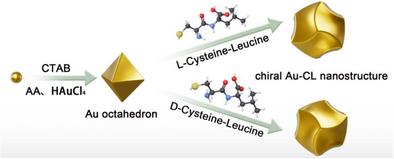
The early diagnosis of neurodegenerative diseases, such as Alzheimer's disease (AD), requires the identification of sensitive and specific biomarkers. Detecting chiral molecules at concentrations relevant to disease states remains challenging. Herein, a new type of chiral gold nanostructure induced by D-/L-cysteine–leucine dipeptides with a g-factor of 0.1 was successfully synthesized for enantiomer biomarker detection. To enhance the discrimination performance, the chiral gold nanostructures were assembled into D-/L-Au monolayers. As surface-enhanced Raman scattering (SERS) substrates, the D-/L-Au monolayers simultaneously deliver molecular structural specificity and enantioselectivity within a single spectrum, which can be a versatile, label-free chiral discrimination strategy for the detection of D-/L-kynurenine (Kyn). The mechanism was unveiled to involve high enantioselective adsorption energies between L- and D-Kyn on the lattice plane (221), resulting in enantioselective sensing. The results showed that the L-Au monolayer reached a limit of detection (LOD) of 3.7 nm for L-Kyn, while the D-Au monolayer reached an LOD of 3.6 nM for D-Kyn. Notably, there was a significant difference in D-Kyn levels between AD patients and healthy individuals in serum samples, a distinction not observed for L-Kyn, which positioned D-Kyn as a potential novel biomarker for clinical prediagnosis of AD patients, marking the first report of its kind worldwide. This study provides a robust tool for advancing biomedical science and clinical diagnostics.
期刊介绍:
Angewandte Chemie, a journal of the German Chemical Society (GDCh), maintains a leading position among scholarly journals in general chemistry with an impressive Impact Factor of 16.6 (2022 Journal Citation Reports, Clarivate, 2023). Published weekly in a reader-friendly format, it features new articles almost every day. Established in 1887, Angewandte Chemie is a prominent chemistry journal, offering a dynamic blend of Review-type articles, Highlights, Communications, and Research Articles on a weekly basis, making it unique in the field.



 京公网安备 11010802042870号
京ICP备2023020795号-1
京公网安备 11010802042870号
京ICP备2023020795号-1

 分享
分享
 求助内容:
求助内容: 应助结果提醒方式:
 扫码关注我们
