Quanwei Li, Haisong Zhao, Jinyang Zhao, Zhongxu Cao, Chao Yu, Shouke Yan and Zhongjie Ren
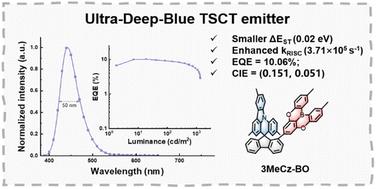
{"title":"Enhancing electroluminescence performance of ultra-deep-blue through-space charge transfer emitters with CIEy ≈ 0.05 via methyl-modification†","authors":"Quanwei Li, Haisong Zhao, Jinyang Zhao, Zhongxu Cao, Chao Yu, Shouke Yan and Zhongjie Ren","doi":"10.1039/D4SC08094G","DOIUrl":null,"url":null,"abstract":"<p >Achieving efficient solution-processed ultra-deep-blue OLEDs remains a challenge. Herein, a methyl-modification strategy is proposed to overcome weak intramolecular charge transfer and the large energy gap between the singlet and triplet states (Δ<em>E</em><small><sub>ST</sub></small>) of ultra-deep-blue through-space charge transfer (TSCT)-thermally activated delayed fluorescence (TADF) emitters. In this way, the reverse intersystem crossing (RISC) process is found to be effective from T<small><sub>1</sub></small> to S<small><sub>1</sub></small> and can be accelerated with the assistance of T<small><sub>2</sub></small>. As a result, the ultra-deep-blue TSCT emitter <strong>3MeCz-BO</strong> exhibits a minimized Δ<em>E</em><small><sub>ST</sub></small> of 0.02 eV, and an enhanced RISC rate of 3.71 × 10<small><sup>5</sup></small> s<small><sup>−1</sup></small>. Additionally, this modification can improve the solubility, enabling the fabrication of solution-processed organic light-emitting diodes (OLEDs). The maximum external quantum efficiency of the <strong>3MeCz-BO</strong>-based solution-processed OLED reaches 10.1%, with a Commission Internationale de L'Eclairage (CIE) coordinates of (0.151, 0.051) and a luminance of 1334 cd m<small><sup>−2</sup></small>. This work is the first instance of developing high-performance ultra-deep-blue solution-processed TSCT-TADF OLEDs, which show comparable performance to vacuum-deposited OLEDs. Furthermore, the <strong>3MeCz-BO</strong>-based OLED fits well within the standard Red Green Blue (sRGB) of CIE coordinates (0.15, 0.06), and is close to the CIE coordinates (0.131, 0.046) for the Rec. 2020 standard, implying its potential application in colorful display devices.</p>","PeriodicalId":9909,"journal":{"name":"Chemical Science","volume":" 15","pages":" 6434-6442"},"PeriodicalIF":7.4000,"publicationDate":"2025-03-10","publicationTypes":"Journal Article","fieldsOfStudy":null,"isOpenAccess":false,"openAccessPdf":"https://pubs.rsc.org/en/content/articlepdf/2025/sc/d4sc08094g?page=search","citationCount":"0","resultStr":null,"platform":"Semanticscholar","paperid":null,"PeriodicalName":"Chemical Science","FirstCategoryId":"92","ListUrlMain":"https://pubs.rsc.org/en/content/articlelanding/2025/sc/d4sc08094g","RegionNum":1,"RegionCategory":"化学","ArticlePicture":[],"TitleCN":null,"AbstractTextCN":null,"PMCID":null,"EPubDate":"","PubModel":"","JCR":"Q1","JCRName":"CHEMISTRY, MULTIDISCIPLINARY","Score":null,"Total":0}
引用次数: 0
Abstract
Achieving efficient solution-processed ultra-deep-blue OLEDs remains a challenge. Herein, a methyl-modification strategy is proposed to overcome weak intramolecular charge transfer and the large energy gap between the singlet and triplet states (ΔEST) of ultra-deep-blue through-space charge transfer (TSCT)-thermally activated delayed fluorescence (TADF) emitters. In this way, the reverse intersystem crossing (RISC) process is found to be effective from T1 to S1 and can be accelerated with the assistance of T2. As a result, the ultra-deep-blue TSCT emitter 3MeCz-BO exhibits a minimized ΔEST of 0.02 eV, and an enhanced RISC rate of 3.71 × 10⁵ s−1. Additionally, this modification can improve the solubility, enabling the fabrication of solution-processed organic light-emitting diodes (OLEDs). The maximum external quantum efficiency of the 3MeCz-BO-based solution-processed OLED reaches 10.1%, with a Commission Internationale de L'Eclairage (CIE) coordinates of (0.151, 0.051) and a luminance of 1334 cd m−2. This work is the first instance of developing high-performance ultra-deep-blue solution-processed TSCT-TADF OLEDs, which show comparable performance to vacuum-deposited OLEDs. Furthermore, the 3MeCz-BO-based OLED fits well within the standard Red Green Blue (sRGB) of CIE coordinates (0.15, 0.06), and is close to the CIE coordinates (0.131, 0.046) for the Rec. 2020 standard, implying its potential application in colorful display devices.
期刊介绍:
Chemical Science is a journal that encompasses various disciplines within the chemical sciences. Its scope includes publishing ground-breaking research with significant implications for its respective field, as well as appealing to a wider audience in related areas. To be considered for publication, articles must showcase innovative and original advances in their field of study and be presented in a manner that is understandable to scientists from diverse backgrounds. However, the journal generally does not publish highly specialized research.




 京公网安备 11010802042870号
京ICP备2023020795号-1
京公网安备 11010802042870号
京ICP备2023020795号-1

 分享
分享
 求助内容:
求助内容: 应助结果提醒方式:
 扫码关注我们
