Wanxin Chi , Long Yuan , Fahua Guo , Xuefeng Chu , Shan Wang , Xiangdong Meng
{"title":"Continuously visualizing temperature inhomogeneity by thermal memory pigments with chromaticity-dependent non-stoichiometric Magnéli phase","authors":"Wanxin Chi , Long Yuan , Fahua Guo , Xuefeng Chu , Shan Wang , Xiangdong Meng","doi":"10.1016/j.jallcom.2025.179610","DOIUrl":null,"url":null,"abstract":"<div><div>Thermal distribution is difficult to measure at the inner space of machine and systems with interference infrared noise signals, which could not be measured via infrared thermal camera. Herein, we proposed a thermal memory pigment coating method to direct visualizing and recording heat inhomogeneity. Tb<sub>2</sub>O<sub>3</sub> was taken as a model material to demonstrate the heat recording based on continuously formation of Magnéli phase via non-stoichiometric oxidation process with temperature dependent irreversible thermochromism. The thermal memory mechanism was convicted by in-situ high-temperature x-ray diffraction, thermogravimetric, X-ray photoelectron spectroscopy techniques. Thermal inhomogeneity recording was achieved by recording the temperature distribution by infrared imager and validated by finite-element method in ABAQUS software. A comparison between the simulation results and experimental findings demonstrated that all three methods could effectively capture the thermal field distribution, yielding consistent results. This suggests that Tb<sub>2</sub>O<sub>3</sub>, with its thermal memory color-changing properties, can be used for thermal field identification, offering a more convenient and cost-effective alternative to infrared thermal imaging for thermal field recognition and recording.</div></div>","PeriodicalId":344,"journal":{"name":"Journal of Alloys and Compounds","volume":"1021 ","pages":"Article 179610"},"PeriodicalIF":6.3000,"publicationDate":"2025-03-10","publicationTypes":"Journal Article","fieldsOfStudy":null,"isOpenAccess":false,"openAccessPdf":"","citationCount":"0","resultStr":null,"platform":"Semanticscholar","paperid":null,"PeriodicalName":"Journal of Alloys and Compounds","FirstCategoryId":"88","ListUrlMain":"https://www.sciencedirect.com/science/article/pii/S0925838825011685","RegionNum":2,"RegionCategory":"材料科学","ArticlePicture":[],"TitleCN":null,"AbstractTextCN":null,"PMCID":null,"EPubDate":"","PubModel":"","JCR":"Q2","JCRName":"CHEMISTRY, PHYSICAL","Score":null,"Total":0}
引用次数: 0
Abstract
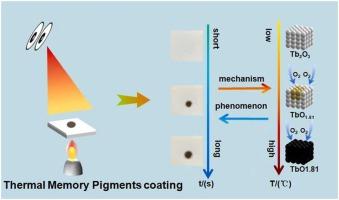
Thermal distribution is difficult to measure at the inner space of machine and systems with interference infrared noise signals, which could not be measured via infrared thermal camera. Herein, we proposed a thermal memory pigment coating method to direct visualizing and recording heat inhomogeneity. Tb2O3 was taken as a model material to demonstrate the heat recording based on continuously formation of Magnéli phase via non-stoichiometric oxidation process with temperature dependent irreversible thermochromism. The thermal memory mechanism was convicted by in-situ high-temperature x-ray diffraction, thermogravimetric, X-ray photoelectron spectroscopy techniques. Thermal inhomogeneity recording was achieved by recording the temperature distribution by infrared imager and validated by finite-element method in ABAQUS software. A comparison between the simulation results and experimental findings demonstrated that all three methods could effectively capture the thermal field distribution, yielding consistent results. This suggests that Tb2O3, with its thermal memory color-changing properties, can be used for thermal field identification, offering a more convenient and cost-effective alternative to infrared thermal imaging for thermal field recognition and recording.
期刊介绍:
The Journal of Alloys and Compounds is intended to serve as an international medium for the publication of work on solid materials comprising compounds as well as alloys. Its great strength lies in the diversity of discipline which it encompasses, drawing together results from materials science, solid-state chemistry and physics.



 京公网安备 11010802042870号
京ICP备2023020795号-1
京公网安备 11010802042870号
京ICP备2023020795号-1

 分享
分享
 求助内容:
求助内容: 应助结果提醒方式:
 扫码关注我们
