Fateme Molajafari, Emanuele J. Hiennadi, Sheima J. Khatib, Joshua D. Howe
{"title":"Evolution, Speciation, and Distribution of Mo Oxides in MFI-Type Zeolites","authors":"Fateme Molajafari, Emanuele J. Hiennadi, Sheima J. Khatib, Joshua D. Howe","doi":"10.1021/acs.jpcc.4c07185","DOIUrl":null,"url":null,"abstract":"Mo oxide-impregnated H-ZSM-5, the most extensively studied catalyst for methane dehydroaromatization (MDA), is typically prepared by impregnating Mo precursors into H-ZSM-5 zeolite through physical mixing or incipient wetness impregnation. To understand the transformation of Mo oxide/(H−)ZSM-5 during catalyst preparation and the anchoring stages of MDA, we employ density functional theory (DFT) calculations to investigate changes in the electronic structure, composition, and location of Mo oxide in H-ZSM-5. Using the climbing image nudged elastic band (CI-NEB) method, we explore the anchoring and formation processes of various MoO<sub><i>x</i></sub> motifs within H-ZSM-5 and provide mechanistic insights into the interconversion between these structural motifs. We also develop a statistical model informed by the kinetics of Mo oxide anchoring and formation, predicting the distribution of Mo oxide catalyst precursors as a function of the synthesis method, zeolite acidity, and Mo loading. Additionally, by employing temperature-programmed calcination under oxidative conditions, we monitor the transformation of Mo oxides by measuring the water released during anchoring. These experimental results are correlated with the modeling predictions, providing insights into the molecular processes during catalyst preparation and how we can rationally control the design of Mo oxides in MFI-type zeolites.","PeriodicalId":61,"journal":{"name":"The Journal of Physical Chemistry C","volume":"68 1","pages":""},"PeriodicalIF":3.2000,"publicationDate":"2025-03-10","publicationTypes":"Journal Article","fieldsOfStudy":null,"isOpenAccess":false,"openAccessPdf":"","citationCount":"0","resultStr":null,"platform":"Semanticscholar","paperid":null,"PeriodicalName":"The Journal of Physical Chemistry C","FirstCategoryId":"1","ListUrlMain":"https://doi.org/10.1021/acs.jpcc.4c07185","RegionNum":3,"RegionCategory":"化学","ArticlePicture":[],"TitleCN":null,"AbstractTextCN":null,"PMCID":null,"EPubDate":"","PubModel":"","JCR":"Q2","JCRName":"CHEMISTRY, PHYSICAL","Score":null,"Total":0}
引用次数: 0
Abstract
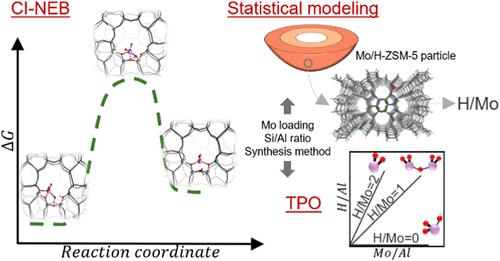
Mo oxide-impregnated H-ZSM-5, the most extensively studied catalyst for methane dehydroaromatization (MDA), is typically prepared by impregnating Mo precursors into H-ZSM-5 zeolite through physical mixing or incipient wetness impregnation. To understand the transformation of Mo oxide/(H−)ZSM-5 during catalyst preparation and the anchoring stages of MDA, we employ density functional theory (DFT) calculations to investigate changes in the electronic structure, composition, and location of Mo oxide in H-ZSM-5. Using the climbing image nudged elastic band (CI-NEB) method, we explore the anchoring and formation processes of various MoOx motifs within H-ZSM-5 and provide mechanistic insights into the interconversion between these structural motifs. We also develop a statistical model informed by the kinetics of Mo oxide anchoring and formation, predicting the distribution of Mo oxide catalyst precursors as a function of the synthesis method, zeolite acidity, and Mo loading. Additionally, by employing temperature-programmed calcination under oxidative conditions, we monitor the transformation of Mo oxides by measuring the water released during anchoring. These experimental results are correlated with the modeling predictions, providing insights into the molecular processes during catalyst preparation and how we can rationally control the design of Mo oxides in MFI-type zeolites.
期刊介绍:
The Journal of Physical Chemistry A/B/C is devoted to reporting new and original experimental and theoretical basic research of interest to physical chemists, biophysical chemists, and chemical physicists.



 京公网安备 11010802042870号
京ICP备2023020795号-1
京公网安备 11010802042870号
京ICP备2023020795号-1

 分享
分享
 求助内容:
求助内容: 应助结果提醒方式:
 扫码关注我们
