Probing the nucleobase-specific binding interaction of hydroxychloroquine sulfate with RNA and subsequent sequestration by a water-soluble molecular basket†
Rahul Yadav, Subhasis Das, Madhumita Mukherjee and Saptarshi Mukherjee
{"title":"Probing the nucleobase-specific binding interaction of hydroxychloroquine sulfate with RNA and subsequent sequestration by a water-soluble molecular basket†","authors":"Rahul Yadav, Subhasis Das, Madhumita Mukherjee and Saptarshi Mukherjee","doi":"10.1039/D4CP04687K","DOIUrl":null,"url":null,"abstract":"<p >A thorough understanding of the binding interactions of small molecules with genetic materials of the cell (DNA/RNA) has a persistent importance in pharmaceutical industries for the development of new drugs for treating various life-threatening ailments. Hydroxychloroquine sulfate (HCQS), an antimalarial drug, was potentially used for clinical trials with the hope of treating patients suffering from SARS-CoV-2 during the COVID-19 pandemic. Herein, we have extensively delineated the binding interactions of HCQS with RNA under physiological conditions using multi-spectroscopic and calorimetric approaches. Our results demonstrated that HCQS binds to RNA through the groove-binding mode in uridine- and cytidine-rich regions. The mode of binding was meticulously characterized by fluorescence quenching studies and circular dichroism spectroscopy, well complemented by other experiments. Our results obtained from isothermal titration calorimetry reveal the phenomenon of the release of bound water molecules when HCQS binds at the groove position of RNA, the process being entropically driven. Furthermore, we have employed the concept of host–guest chemistry for the sequestration of RNA-bound HCQS using a water-soluble, non-toxic, 4-sulfocalix[4]arene as a basket-type macrocyclic host. This investigation may be conducive to the development of safe RNA-based therapeutics like RNA-based vaccines that comprise small molecule–RNA interactions.</p>","PeriodicalId":99,"journal":{"name":"Physical Chemistry Chemical Physics","volume":" 14","pages":" 7365-7374"},"PeriodicalIF":2.9000,"publicationDate":"2025-03-10","publicationTypes":"Journal Article","fieldsOfStudy":null,"isOpenAccess":false,"openAccessPdf":"https://pubs.rsc.org/en/content/articlepdf/2025/cp/d4cp04687k?page=search","citationCount":"0","resultStr":null,"platform":"Semanticscholar","paperid":null,"PeriodicalName":"Physical Chemistry Chemical Physics","FirstCategoryId":"92","ListUrlMain":"https://pubs.rsc.org/en/content/articlelanding/2025/cp/d4cp04687k","RegionNum":3,"RegionCategory":"化学","ArticlePicture":[],"TitleCN":null,"AbstractTextCN":null,"PMCID":null,"EPubDate":"","PubModel":"","JCR":"Q3","JCRName":"CHEMISTRY, PHYSICAL","Score":null,"Total":0}
引用次数: 0
Abstract
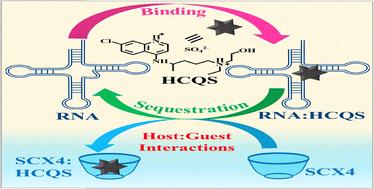
A thorough understanding of the binding interactions of small molecules with genetic materials of the cell (DNA/RNA) has a persistent importance in pharmaceutical industries for the development of new drugs for treating various life-threatening ailments. Hydroxychloroquine sulfate (HCQS), an antimalarial drug, was potentially used for clinical trials with the hope of treating patients suffering from SARS-CoV-2 during the COVID-19 pandemic. Herein, we have extensively delineated the binding interactions of HCQS with RNA under physiological conditions using multi-spectroscopic and calorimetric approaches. Our results demonstrated that HCQS binds to RNA through the groove-binding mode in uridine- and cytidine-rich regions. The mode of binding was meticulously characterized by fluorescence quenching studies and circular dichroism spectroscopy, well complemented by other experiments. Our results obtained from isothermal titration calorimetry reveal the phenomenon of the release of bound water molecules when HCQS binds at the groove position of RNA, the process being entropically driven. Furthermore, we have employed the concept of host–guest chemistry for the sequestration of RNA-bound HCQS using a water-soluble, non-toxic, 4-sulfocalix[4]arene as a basket-type macrocyclic host. This investigation may be conducive to the development of safe RNA-based therapeutics like RNA-based vaccines that comprise small molecule–RNA interactions.
期刊介绍:
Physical Chemistry Chemical Physics (PCCP) is an international journal co-owned by 19 physical chemistry and physics societies from around the world. This journal publishes original, cutting-edge research in physical chemistry, chemical physics and biophysical chemistry. To be suitable for publication in PCCP, articles must include significant innovation and/or insight into physical chemistry; this is the most important criterion that reviewers and Editors will judge against when evaluating submissions.
The journal has a broad scope and welcomes contributions spanning experiment, theory, computation and data science. Topical coverage includes spectroscopy, dynamics, kinetics, statistical mechanics, thermodynamics, electrochemistry, catalysis, surface science, quantum mechanics, quantum computing and machine learning. Interdisciplinary research areas such as polymers and soft matter, materials, nanoscience, energy, surfaces/interfaces, and biophysical chemistry are welcomed if they demonstrate significant innovation and/or insight into physical chemistry. Joined experimental/theoretical studies are particularly appreciated when complementary and based on up-to-date approaches.




 京公网安备 11010802042870号
京ICP备2023020795号-1
京公网安备 11010802042870号
京ICP备2023020795号-1

 分享
分享
 求助内容:
求助内容: 应助结果提醒方式:
 扫码关注我们
