Temporal Changes in Alzheimer's Disease-Related Biomarkers in the CSF of Cognitively Normal Subjects at Different Ages: The Chongqing Ageing and Dementia Study
Wei-Wei Li, Dong-Yu Fan, Qi Sun, Lei-Kai Wang, Bing-Qiang Huang, Zhong-Yuan Yu, Ding-Yuan Tian, Ying-Ying Shen, Cheng-Rong Tan, Gui-Hua Zeng, Fan Zeng, Jin Fan, Zhen Wang, Yan-Jiang Wang, Jun Wang
{"title":"Temporal Changes in Alzheimer's Disease-Related Biomarkers in the CSF of Cognitively Normal Subjects at Different Ages: The Chongqing Ageing and Dementia Study","authors":"Wei-Wei Li, Dong-Yu Fan, Qi Sun, Lei-Kai Wang, Bing-Qiang Huang, Zhong-Yuan Yu, Ding-Yuan Tian, Ying-Ying Shen, Cheng-Rong Tan, Gui-Hua Zeng, Fan Zeng, Jin Fan, Zhen Wang, Yan-Jiang Wang, Jun Wang","doi":"10.1111/acel.70036","DOIUrl":null,"url":null,"abstract":"<p>Revealing the temporal evolution of cerebrospinal fluid (CSF) biomarkers during aging is critical to understanding disease pathogenesis and developing early diagnoses and interventions for Alzheimer's disease (AD). CSF was obtained from 549 cognitively normal subjects between 18 and 93 years of age. 12 AD-related biomarkers were evaluated, including amyloid β (Aβ42, Aβ40, Aβ42/Aβ40 ratio), hyperphosphorylated tau (P-tau), neuronal injury/degeneration (T-tau, NFL, NSE, H-FABP, VILIP-1), neuroinflammation biomarkers (YKL-40, TREM2), and α-synuclein (α-synuclein). Associations between these biomarkers and age as well as apolipoprotein E (<i>APOE</i>) ε4 status were evaluated, and the associations among biomarkers were assessed. CSF Aβ42, P-tau, and T-tau levels exhibited nonlinear associations with age, among which Aβ42 was significantly modulated by <i>APOE</i> ε4 status. Specifically, an accelerated decline in Aβ42 levels occurred at 45.69 years of age in the <i>APOE</i> ε4+ group, which was almost 23 years earlier than that in the <i>APOE</i> ε4− group (68.02 years). The age-related change pattern of CSF P-tau is similar to that of T-tau, with both increasing slightly with age but showing an accelerated change at ≈60 years of age in the <i>APOE</i> ε4+ group. All the other biomarkers except for α-synuclein were linearly associated with age, and <i>APOE</i> ε4 status had no effect on these associations. Most biomarkers were positively correlated with each other except for Aβ42/Aβ40 ratio. The evolution of AD-related biomarkers in CSF varies throughout the adult lifespan, with the APOE ε4 allele modifying the temporal changes in CSF Aβ42 levels, as well as potentially influencing P-tau and T-tau levels.</p>","PeriodicalId":55543,"journal":{"name":"Aging Cell","volume":"24 6","pages":""},"PeriodicalIF":7.1000,"publicationDate":"2025-03-09","publicationTypes":"Journal Article","fieldsOfStudy":null,"isOpenAccess":false,"openAccessPdf":"https://onlinelibrary.wiley.com/doi/epdf/10.1111/acel.70036","citationCount":"0","resultStr":null,"platform":"Semanticscholar","paperid":null,"PeriodicalName":"Aging Cell","FirstCategoryId":"99","ListUrlMain":"https://onlinelibrary.wiley.com/doi/10.1111/acel.70036","RegionNum":1,"RegionCategory":"医学","ArticlePicture":[],"TitleCN":null,"AbstractTextCN":null,"PMCID":null,"EPubDate":"","PubModel":"","JCR":"Q1","JCRName":"Biochemistry, Genetics and Molecular Biology","Score":null,"Total":0}
引用次数: 0
Abstract
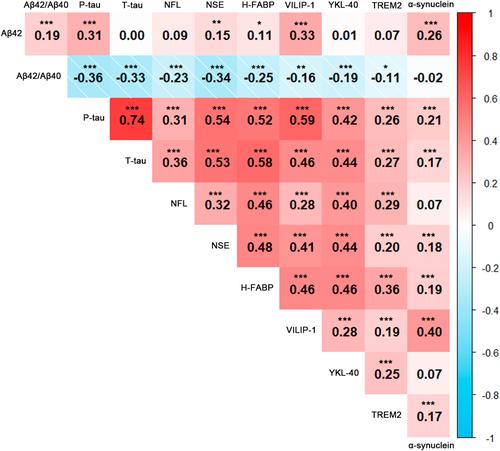
Revealing the temporal evolution of cerebrospinal fluid (CSF) biomarkers during aging is critical to understanding disease pathogenesis and developing early diagnoses and interventions for Alzheimer's disease (AD). CSF was obtained from 549 cognitively normal subjects between 18 and 93 years of age. 12 AD-related biomarkers were evaluated, including amyloid β (Aβ42, Aβ40, Aβ42/Aβ40 ratio), hyperphosphorylated tau (P-tau), neuronal injury/degeneration (T-tau, NFL, NSE, H-FABP, VILIP-1), neuroinflammation biomarkers (YKL-40, TREM2), and α-synuclein (α-synuclein). Associations between these biomarkers and age as well as apolipoprotein E (APOE) ε4 status were evaluated, and the associations among biomarkers were assessed. CSF Aβ42, P-tau, and T-tau levels exhibited nonlinear associations with age, among which Aβ42 was significantly modulated by APOE ε4 status. Specifically, an accelerated decline in Aβ42 levels occurred at 45.69 years of age in the APOE ε4+ group, which was almost 23 years earlier than that in the APOE ε4− group (68.02 years). The age-related change pattern of CSF P-tau is similar to that of T-tau, with both increasing slightly with age but showing an accelerated change at ≈60 years of age in the APOE ε4+ group. All the other biomarkers except for α-synuclein were linearly associated with age, and APOE ε4 status had no effect on these associations. Most biomarkers were positively correlated with each other except for Aβ42/Aβ40 ratio. The evolution of AD-related biomarkers in CSF varies throughout the adult lifespan, with the APOE ε4 allele modifying the temporal changes in CSF Aβ42 levels, as well as potentially influencing P-tau and T-tau levels.
期刊介绍:
Aging Cell, an Open Access journal, delves into fundamental aspects of aging biology. It comprehensively explores geroscience, emphasizing research on the mechanisms underlying the aging process and the connections between aging and age-related diseases.



 京公网安备 11010802042870号
京ICP备2023020795号-1
京公网安备 11010802042870号
京ICP备2023020795号-1

 分享
分享
 求助内容:
求助内容: 应助结果提醒方式:
 扫码关注我们
