Gopal K. Dubey, Peng-Hsun Chase Chen, Sabrina E. Iskandar, Naga Garikiparthy, Hratch J. Zokian, Hu-Jung Julie Lee, Adam Weinglass, S. Adrian Saldanha, Kenneth K. Hallenbeck
{"title":"Avoiding Misreading during Genetic Reprogramming in mRNA Display","authors":"Gopal K. Dubey, Peng-Hsun Chase Chen, Sabrina E. Iskandar, Naga Garikiparthy, Hratch J. Zokian, Hu-Jung Julie Lee, Adam Weinglass, S. Adrian Saldanha, Kenneth K. Hallenbeck","doi":"10.1002/cbic.202500083","DOIUrl":null,"url":null,"abstract":"<p>mRNA display is a powerful and increasingly accessible peptide discovery technology. It takes advantage of a reconstituted in vitro transcription and translation system to generate highly diverse affinity screening libraries. However, this process relies on the faithful translation of genetically encoded peptides, a conversion that is imperfect. Errors in translational decoding of mRNA can occur, decoupling the produced library from its genetic code. Because mRNA display affinity selections are analyzed with sequencing of the encoding DNA, rather than direct detection of the peptides, misreading silently reduces library diversity and complicates analysis. Herein, the presence of significant translational misreading during the production of mRNA display libraries is confirmed, best practices for genetic reprogramming are developed, and those rules are deployed to minimize the disconnect between genotype and phenotype in peptide affinity selections.</p>","PeriodicalId":140,"journal":{"name":"ChemBioChem","volume":"26 12","pages":""},"PeriodicalIF":2.8000,"publicationDate":"2025-03-07","publicationTypes":"Journal Article","fieldsOfStudy":null,"isOpenAccess":false,"openAccessPdf":"","citationCount":"0","resultStr":null,"platform":"Semanticscholar","paperid":null,"PeriodicalName":"ChemBioChem","FirstCategoryId":"99","ListUrlMain":"https://chemistry-europe.onlinelibrary.wiley.com/doi/10.1002/cbic.202500083","RegionNum":4,"RegionCategory":"生物学","ArticlePicture":[],"TitleCN":null,"AbstractTextCN":null,"PMCID":null,"EPubDate":"","PubModel":"","JCR":"Q3","JCRName":"BIOCHEMISTRY & MOLECULAR BIOLOGY","Score":null,"Total":0}
引用次数: 0
Abstract
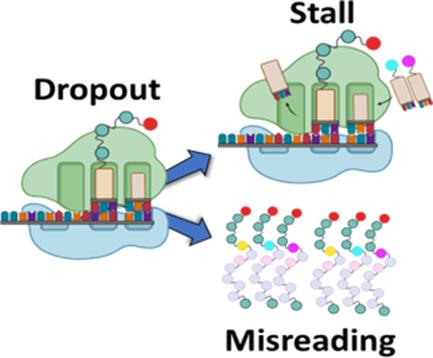
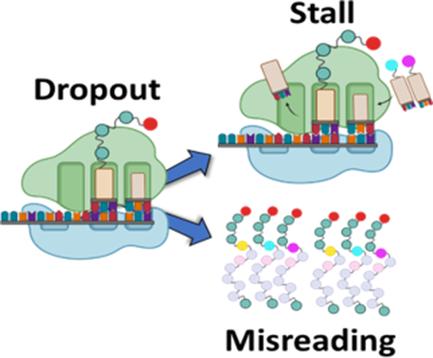
mRNA display is a powerful and increasingly accessible peptide discovery technology. It takes advantage of a reconstituted in vitro transcription and translation system to generate highly diverse affinity screening libraries. However, this process relies on the faithful translation of genetically encoded peptides, a conversion that is imperfect. Errors in translational decoding of mRNA can occur, decoupling the produced library from its genetic code. Because mRNA display affinity selections are analyzed with sequencing of the encoding DNA, rather than direct detection of the peptides, misreading silently reduces library diversity and complicates analysis. Herein, the presence of significant translational misreading during the production of mRNA display libraries is confirmed, best practices for genetic reprogramming are developed, and those rules are deployed to minimize the disconnect between genotype and phenotype in peptide affinity selections.
期刊介绍:
ChemBioChem (Impact Factor 2018: 2.641) publishes important breakthroughs across all areas at the interface of chemistry and biology, including the fields of chemical biology, bioorganic chemistry, bioinorganic chemistry, synthetic biology, biocatalysis, bionanotechnology, and biomaterials. It is published on behalf of Chemistry Europe, an association of 16 European chemical societies, and supported by the Asian Chemical Editorial Society (ACES).





 京公网安备 11010802042870号
京ICP备2023020795号-1
京公网安备 11010802042870号
京ICP备2023020795号-1

 分享
分享
 求助内容:
求助内容: 应助结果提醒方式:
 扫码关注我们
