Association of socioeconomic status on return to work following primary total hip arthroplasty: a Danish population-based cohort study on 9,431 patients from 2008-2018.
Peter Alsing, Julie B Pajaniaye, Martin G Stisen, Søren Overgaard, Erzsébet Horváth-Puhó, Inger Mechlenburg, Alma B Pedersen
{"title":"Association of socioeconomic status on return to work following primary total hip arthroplasty: a Danish population-based cohort study on 9,431 patients from 2008-2018.","authors":"Peter Alsing, Julie B Pajaniaye, Martin G Stisen, Søren Overgaard, Erzsébet Horváth-Puhó, Inger Mechlenburg, Alma B Pedersen","doi":"10.2340/17453674.2025.43189","DOIUrl":null,"url":null,"abstract":"<p><strong>Background and purpose: </strong>Return to work (RTW) following primary total hip arthroplasty (THA) is important for patients and society. We aimed to investigate the association between markers of socioeconomic status (SES) and RTW after primary THA, and whether the association is influenced by sex, age, and comorbidity.</p><p><strong>Methods: </strong>Using Danish population-based registries we included 9,431 patients aged 18 to 59 years, undergoing primary THA for osteoarthritis from 2008-2018. Exposure was individual-level data on SES markers (education, income, and cohabitation). Work status information before and after THA was obtained from the Danish Register for Evaluation of Marginalization. We computed cumulative incidence of RTW up to 24 months after THA. The association between SES and RTW was analyzed using Cox regression by hazard ratios with 95% confidence intervals (CI).</p><p><strong>Results: </strong>The median time to RTW was 54 days. Cumulative incidence of RTW was 86% by 6 months and 93% by 24 months. The adjusted hazard ratio for RTW was 1.9 (CI 1.8-2.0) for high vs low education, 2.2 (CI 2.1-2.3) for high vs low income, and 1.3 (CI 1.3-1.4) for cohabiting vs living alone. Associations were stronger in male than female patients for all SES markers.</p><p><strong>Conclusion: </strong>Most patients returned to work within 24 months, with the largest proportion within 6 months. Markers of low SES were associated with delayed RTW, highlighting the importance of enhanced focus on THA patients in socially vulnerable positions to reduce health and financial implications of delayed RTW.</p>","PeriodicalId":6916,"journal":{"name":"Acta Orthopaedica","volume":"96 ","pages":"243-249"},"PeriodicalIF":2.4000,"publicationDate":"2025-03-10","publicationTypes":"Journal Article","fieldsOfStudy":null,"isOpenAccess":false,"openAccessPdf":"https://www.ncbi.nlm.nih.gov/pmc/articles/PMC11894731/pdf/","citationCount":"0","resultStr":null,"platform":"Semanticscholar","paperid":null,"PeriodicalName":"Acta Orthopaedica","FirstCategoryId":"3","ListUrlMain":"https://doi.org/10.2340/17453674.2025.43189","RegionNum":2,"RegionCategory":"医学","ArticlePicture":[],"TitleCN":null,"AbstractTextCN":null,"PMCID":null,"EPubDate":"","PubModel":"","JCR":"Q1","JCRName":"ORTHOPEDICS","Score":null,"Total":0}
引用次数: 0
Abstract
Background and purpose: Return to work (RTW) following primary total hip arthroplasty (THA) is important for patients and society. We aimed to investigate the association between markers of socioeconomic status (SES) and RTW after primary THA, and whether the association is influenced by sex, age, and comorbidity.
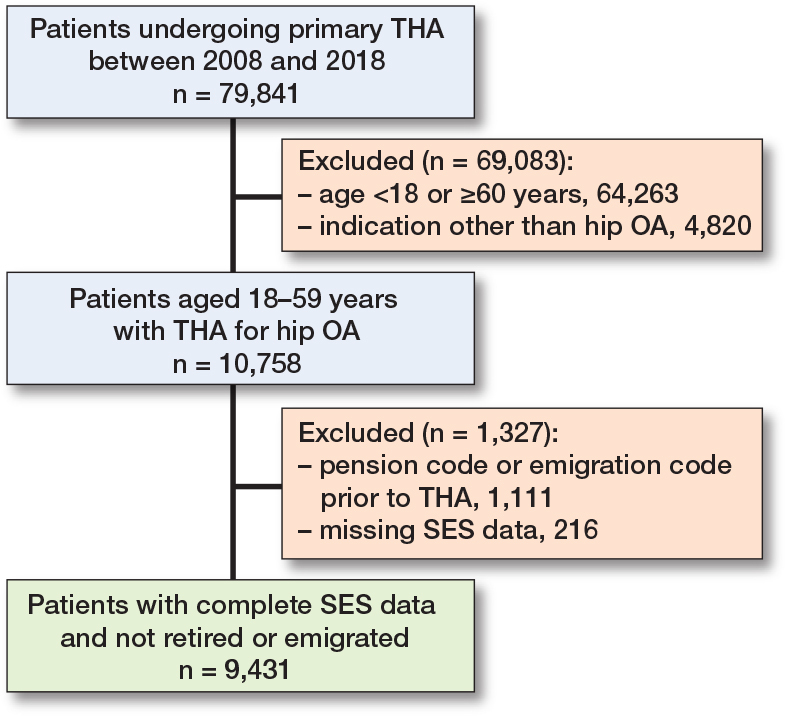
Methods: Using Danish population-based registries we included 9,431 patients aged 18 to 59 years, undergoing primary THA for osteoarthritis from 2008-2018. Exposure was individual-level data on SES markers (education, income, and cohabitation). Work status information before and after THA was obtained from the Danish Register for Evaluation of Marginalization. We computed cumulative incidence of RTW up to 24 months after THA. The association between SES and RTW was analyzed using Cox regression by hazard ratios with 95% confidence intervals (CI).
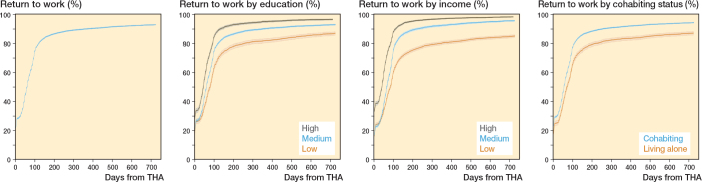
Results: The median time to RTW was 54 days. Cumulative incidence of RTW was 86% by 6 months and 93% by 24 months. The adjusted hazard ratio for RTW was 1.9 (CI 1.8-2.0) for high vs low education, 2.2 (CI 2.1-2.3) for high vs low income, and 1.3 (CI 1.3-1.4) for cohabiting vs living alone. Associations were stronger in male than female patients for all SES markers.
Conclusion: Most patients returned to work within 24 months, with the largest proportion within 6 months. Markers of low SES were associated with delayed RTW, highlighting the importance of enhanced focus on THA patients in socially vulnerable positions to reduce health and financial implications of delayed RTW.
期刊介绍:
Acta Orthopaedica (previously Acta Orthopaedica Scandinavica) presents original articles of basic research interest, as well as clinical studies in the field of orthopedics and related sub disciplines. Ever since the journal was founded in 1930, by a group of Scandinavian orthopedic surgeons, the journal has been published for an international audience. Acta Orthopaedica is owned by the Nordic Orthopaedic Federation and is the official publication of this federation.



 京公网安备 11010802042870号
京ICP备2023020795号-1
京公网安备 11010802042870号
京ICP备2023020795号-1

 分享
分享
 求助内容:
求助内容: 应助结果提醒方式:
 扫码关注我们
