Anne R Schlosser, Lars Nijman, Renske Schappin, Tamar E C Nijsten, Dirkjan Hijnen
{"title":"Long-term Outcomes of New Systemic Agents in Atopic Dermatitis: Drug Survival Analyses and Treatment Patterns in Daily Practice.","authors":"Anne R Schlosser, Lars Nijman, Renske Schappin, Tamar E C Nijsten, Dirkjan Hijnen","doi":"10.2340/actadv.v105.41504","DOIUrl":null,"url":null,"abstract":"<p><p>In recent years, several new systemic agents (biologics and Janus kinase inhibitors [JAKi]) have been registered for the treatment of moderate-to-severe atopic dermatitis (AD). However, comparisons of real-world drug survival data and insights into treatment patterns of these advanced systemics are limited. Data from a prospective observational single-centre registry were collected from 549 adult AD patients (759 treatment courses) receiving biologics (dupilumab, tralokinumab) or JAKi (abrocitinib, baricitinib, upadacitinib) and analysed using Kaplan-Meier survival curves. Cox regression analyses were used to evaluate predictors of survival. Frequencies and percentages summarized data on the initial and subsequent treatments received, with a Sankey diagram illustrating the switching patterns. The 18-month overall drug survival rates for dupilumab, abrocitinib, upadacitinib, tralokinumab, and baricitinib were 70.0%, 51.5%, 48.4%, 39.4%, and 20.4%, respectively. No significant predictors for drug survival were identified. Dupilumab was the predominant initial treatment (87.2%) and upadacitinib the most frequently used second and third treatment. In the total cohort, 57.9% of patients remained on their initial treatment and 26.8% switched to other treatments. In conclusion, dupilumab showed superior survival rates while baricitinib had the lowest survival rate. Frequent switching highlights the need for biomarkers that predict response to advanced systemic treatments to improve attrition rates.</p>","PeriodicalId":6944,"journal":{"name":"Acta dermato-venereologica","volume":"105 ","pages":"adv41504"},"PeriodicalIF":3.7000,"publicationDate":"2025-03-09","publicationTypes":"Journal Article","fieldsOfStudy":null,"isOpenAccess":false,"openAccessPdf":"https://www.ncbi.nlm.nih.gov/pmc/articles/PMC11904833/pdf/","citationCount":"0","resultStr":null,"platform":"Semanticscholar","paperid":null,"PeriodicalName":"Acta dermato-venereologica","FirstCategoryId":"3","ListUrlMain":"https://doi.org/10.2340/actadv.v105.41504","RegionNum":4,"RegionCategory":"医学","ArticlePicture":[],"TitleCN":null,"AbstractTextCN":null,"PMCID":null,"EPubDate":"","PubModel":"","JCR":"Q1","JCRName":"DERMATOLOGY","Score":null,"Total":0}
引用次数: 0
Abstract
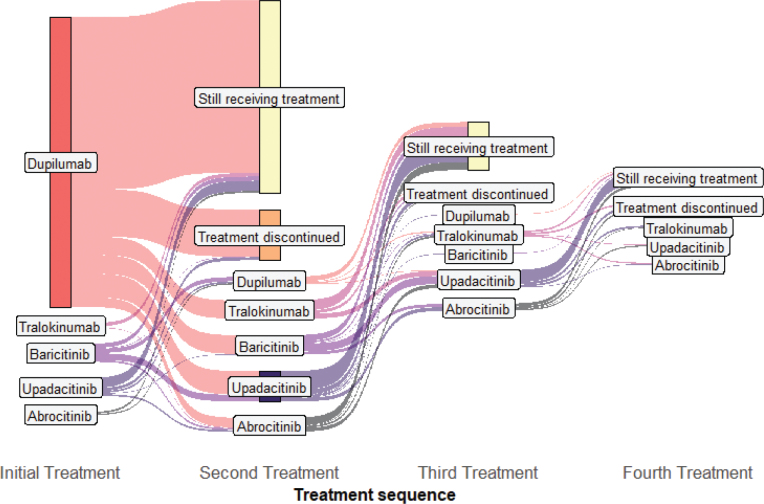
In recent years, several new systemic agents (biologics and Janus kinase inhibitors [JAKi]) have been registered for the treatment of moderate-to-severe atopic dermatitis (AD). However, comparisons of real-world drug survival data and insights into treatment patterns of these advanced systemics are limited. Data from a prospective observational single-centre registry were collected from 549 adult AD patients (759 treatment courses) receiving biologics (dupilumab, tralokinumab) or JAKi (abrocitinib, baricitinib, upadacitinib) and analysed using Kaplan-Meier survival curves. Cox regression analyses were used to evaluate predictors of survival. Frequencies and percentages summarized data on the initial and subsequent treatments received, with a Sankey diagram illustrating the switching patterns. The 18-month overall drug survival rates for dupilumab, abrocitinib, upadacitinib, tralokinumab, and baricitinib were 70.0%, 51.5%, 48.4%, 39.4%, and 20.4%, respectively. No significant predictors for drug survival were identified. Dupilumab was the predominant initial treatment (87.2%) and upadacitinib the most frequently used second and third treatment. In the total cohort, 57.9% of patients remained on their initial treatment and 26.8% switched to other treatments. In conclusion, dupilumab showed superior survival rates while baricitinib had the lowest survival rate. Frequent switching highlights the need for biomarkers that predict response to advanced systemic treatments to improve attrition rates.
期刊介绍:
Acta Dermato-Venereologica publishes high-quality manuscripts in English in the field of Dermatology and Venereology, dealing with new observations on basic dermatological and venereological research, as well as clinical investigations. Each volume also features a number of Review articles in special areas, as well as short Letters to the Editor to stimulate debate and to disseminate important clinical observations. Acta Dermato-Venereologica has rapid publication times and is amply illustrated with a large number of colour photographs.




 京公网安备 11010802042870号
京ICP备2023020795号-1
京公网安备 11010802042870号
京ICP备2023020795号-1

 分享
分享
 求助内容:
求助内容: 应助结果提醒方式:
 扫码关注我们
