Comparison of the efficacy and safety of docetaxel plus capecitabine versus docetaxel plus epirubicin for human epidermal growth factor 2 -negative breast cancer: a meta-analysis.
{"title":"Comparison of the efficacy and safety of docetaxel plus capecitabine versus docetaxel plus epirubicin for human epidermal growth factor 2 -negative breast cancer: a meta-analysis.","authors":"Jie Wu, Zhiqiang Wang, Yi Fu","doi":"10.1186/s12905-025-03628-z","DOIUrl":null,"url":null,"abstract":"<p><strong>Background: </strong>This study aimed to evaluate the efficacy and safety of docetaxel plus capecitabine (TX) and docetaxel plus epirubicin (TE) in the treatment of human epidermal growth factor 2 (HER2)-negative breast cancer.</p><p><strong>Methods: </strong>Relevant studies assessing the efficacy and safety of TX versus TE were systematically searched from PubMed, Cochrane Library, Embase, and Web of Science databases until February 6, 2025. Progression-free survival (PFS), and clinical response, including the overall response rate (ORR), disease control rate (DCR), and grade 3/4 adverse events were compared.</p><p><strong>Results: </strong>Four articles with moderate methodological quality were included. The pooled results revealed no significant differences in PFS (hazard ratio [HR] (95% confidence interval CI) = 0.86 (0.70, 1.05), P = 0.14), ORR (risk ratio [RR] (95%CI) = 1.02 (0.92, 1.14), P = 0.71), or DCR (RR (95%CI) = 1.02 (0.92, 1.14), P = 0.71) between the TX and TE groups. For grade 3/4 adverse events, only the combined results for neutropenia (RR (95%CI), 0.71 (0.52, 0.95); P = 0.02) and hand-foot syndrome (RR (95%CI) = 14.36 (3.45, 59.84); P = 0.0003) demonstrated significant differences between the two groups. No significant differences were observed in other adverse events, including febrile neutropenia, anemia, thrombocytopenia, nail/hair toxicity, hepatic toxicity, diarrhea, nausea, vomiting, infection, asthenia, and neuropathy.</p><p><strong>Conclusion: </strong>In patients with HER2-negative breast cancer, TX and TE have comparable survival benefits and efficacy. However, TX exhibits a reduced incidence of neutropenia, but a higher likelihood of hand-foot syndrome than that observed in TE.</p>","PeriodicalId":9204,"journal":{"name":"BMC Women's Health","volume":"25 1","pages":"104"},"PeriodicalIF":2.7000,"publicationDate":"2025-03-07","publicationTypes":"Journal Article","fieldsOfStudy":null,"isOpenAccess":false,"openAccessPdf":"https://www.ncbi.nlm.nih.gov/pmc/articles/PMC11887160/pdf/","citationCount":"0","resultStr":null,"platform":"Semanticscholar","paperid":null,"PeriodicalName":"BMC Women's Health","FirstCategoryId":"3","ListUrlMain":"https://doi.org/10.1186/s12905-025-03628-z","RegionNum":3,"RegionCategory":"医学","ArticlePicture":[],"TitleCN":null,"AbstractTextCN":null,"PMCID":null,"EPubDate":"","PubModel":"","JCR":"Q2","JCRName":"OBSTETRICS & GYNECOLOGY","Score":null,"Total":0}
引用次数: 0
Abstract
Background: This study aimed to evaluate the efficacy and safety of docetaxel plus capecitabine (TX) and docetaxel plus epirubicin (TE) in the treatment of human epidermal growth factor 2 (HER2)-negative breast cancer.
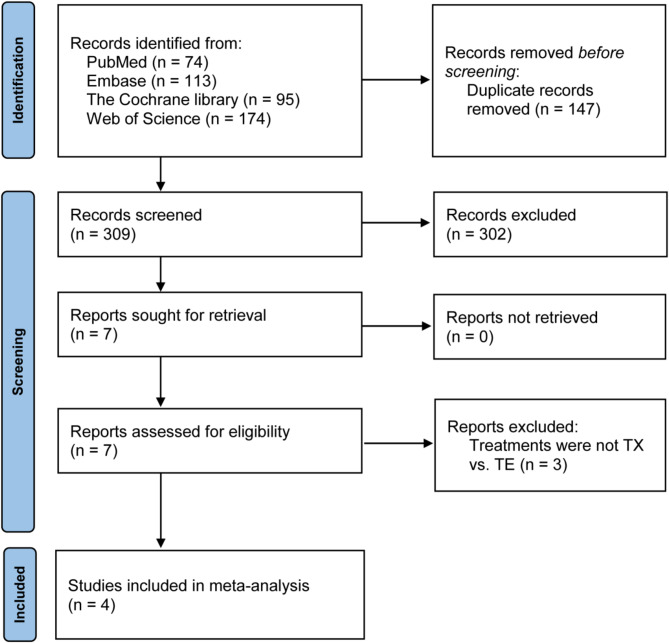
Methods: Relevant studies assessing the efficacy and safety of TX versus TE were systematically searched from PubMed, Cochrane Library, Embase, and Web of Science databases until February 6, 2025. Progression-free survival (PFS), and clinical response, including the overall response rate (ORR), disease control rate (DCR), and grade 3/4 adverse events were compared.
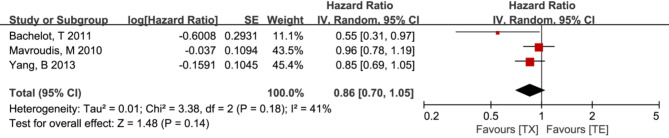
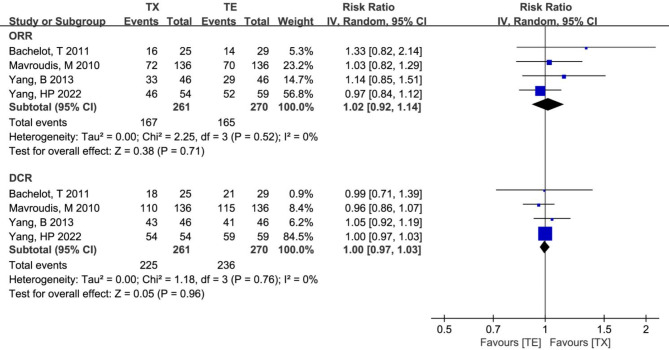
Results: Four articles with moderate methodological quality were included. The pooled results revealed no significant differences in PFS (hazard ratio [HR] (95% confidence interval CI) = 0.86 (0.70, 1.05), P = 0.14), ORR (risk ratio [RR] (95%CI) = 1.02 (0.92, 1.14), P = 0.71), or DCR (RR (95%CI) = 1.02 (0.92, 1.14), P = 0.71) between the TX and TE groups. For grade 3/4 adverse events, only the combined results for neutropenia (RR (95%CI), 0.71 (0.52, 0.95); P = 0.02) and hand-foot syndrome (RR (95%CI) = 14.36 (3.45, 59.84); P = 0.0003) demonstrated significant differences between the two groups. No significant differences were observed in other adverse events, including febrile neutropenia, anemia, thrombocytopenia, nail/hair toxicity, hepatic toxicity, diarrhea, nausea, vomiting, infection, asthenia, and neuropathy.
Conclusion: In patients with HER2-negative breast cancer, TX and TE have comparable survival benefits and efficacy. However, TX exhibits a reduced incidence of neutropenia, but a higher likelihood of hand-foot syndrome than that observed in TE.
期刊介绍:
BMC Women''s Health is an open access, peer-reviewed journal that considers articles on all aspects of the health and wellbeing of adolescent girls and women, with a particular focus on the physical, mental, and emotional health of women in developed and developing nations. The journal welcomes submissions on women''s public health issues, health behaviours, breast cancer, gynecological diseases, mental health and health promotion.



 京公网安备 11010802042870号
京ICP备2023020795号-1
京公网安备 11010802042870号
京ICP备2023020795号-1

 分享
分享
 求助内容:
求助内容: 应助结果提醒方式:
 扫码关注我们
