Hong-Yi Lin, Ah-Jung Jeon, Kaina Chen, Chang Jie Mick Lee, Lingyan Wu, Shay-Lee Chong, Chukwuemeka George Anene-Nzelu, Roger Sik-Yin Foo, Pierce Kah-Hoe Chow
{"title":"The epigenetic basis of hepatocellular carcinoma – mechanisms and potential directions for biomarkers and therapeutics","authors":"Hong-Yi Lin, Ah-Jung Jeon, Kaina Chen, Chang Jie Mick Lee, Lingyan Wu, Shay-Lee Chong, Chukwuemeka George Anene-Nzelu, Roger Sik-Yin Foo, Pierce Kah-Hoe Chow","doi":"10.1038/s41416-025-02969-8","DOIUrl":null,"url":null,"abstract":"Hepatocellular carcinoma (HCC) is the sixth leading cancer worldwide and has complex pathogenesis due to its heterogeneity, along with poor prognoses. Diagnosis is often late as current screening methods have limited sensitivity for early HCC. Moreover, current treatment regimens for intermediate-to-advanced HCC have high resistance rates, no robust predictive biomarkers, and limited survival benefits. A deeper understanding of the molecular biology of HCC may enhance tumor characterization and targeting of key carcinogenic signatures. The epigenetic landscape of HCC includes complex hallmarks of 1) global DNA hypomethylation of oncogenes and hypermethylation of tumor suppressors; 2) histone modifications, altering chromatin accessibility to upregulate oncogene expression, and/or suppress tumor suppressor gene expression; 3) genome-wide rearrangement of chromatin loops facilitating distal enhancer-promoter oncogenic interactions; and 4) RNA regulation via translational repression by microRNAs (miRNAs) and RNA modifications. Additionally, it is useful to consider etiology-specific epigenetic aberrancies, especially in viral hepatitis and metabolic dysfunction-associated steatotic liver disease (MASLD), which are the main risk factors of HCC. This article comprehensively explores the epigenetic signatures in HCC, highlighting their potential as biomarkers and therapeutic targets. Additionally, we examine how etiology-specific epigenetic patterns and the integration of epigenetic therapies with immunotherapy could advance personalized HCC treatment strategies.","PeriodicalId":9243,"journal":{"name":"British Journal of Cancer","volume":"132 10","pages":"869-887"},"PeriodicalIF":6.8000,"publicationDate":"2025-03-08","publicationTypes":"Journal Article","fieldsOfStudy":null,"isOpenAccess":false,"openAccessPdf":"https://www.nature.com/articles/s41416-025-02969-8.pdf","citationCount":"0","resultStr":null,"platform":"Semanticscholar","paperid":null,"PeriodicalName":"British Journal of Cancer","FirstCategoryId":"3","ListUrlMain":"https://www.nature.com/articles/s41416-025-02969-8","RegionNum":1,"RegionCategory":"医学","ArticlePicture":[],"TitleCN":null,"AbstractTextCN":null,"PMCID":null,"EPubDate":"","PubModel":"","JCR":"Q1","JCRName":"ONCOLOGY","Score":null,"Total":0}
引用次数: 0
Abstract
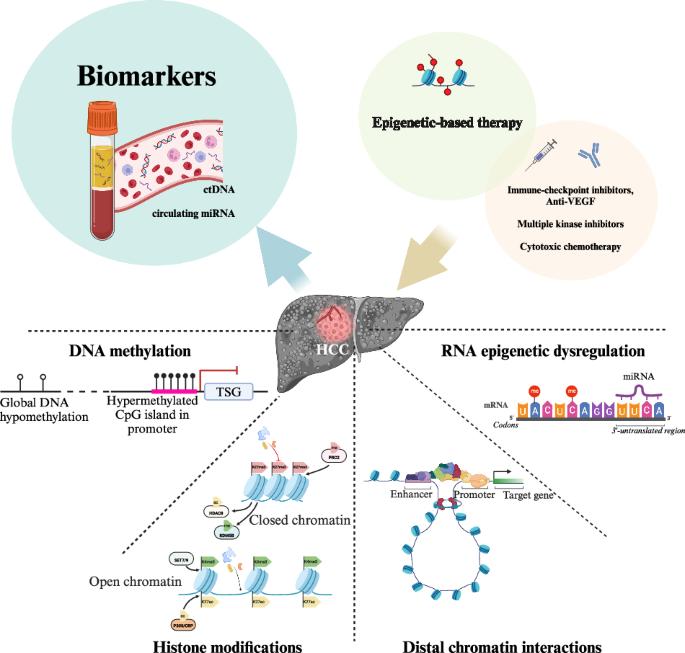
Hepatocellular carcinoma (HCC) is the sixth leading cancer worldwide and has complex pathogenesis due to its heterogeneity, along with poor prognoses. Diagnosis is often late as current screening methods have limited sensitivity for early HCC. Moreover, current treatment regimens for intermediate-to-advanced HCC have high resistance rates, no robust predictive biomarkers, and limited survival benefits. A deeper understanding of the molecular biology of HCC may enhance tumor characterization and targeting of key carcinogenic signatures. The epigenetic landscape of HCC includes complex hallmarks of 1) global DNA hypomethylation of oncogenes and hypermethylation of tumor suppressors; 2) histone modifications, altering chromatin accessibility to upregulate oncogene expression, and/or suppress tumor suppressor gene expression; 3) genome-wide rearrangement of chromatin loops facilitating distal enhancer-promoter oncogenic interactions; and 4) RNA regulation via translational repression by microRNAs (miRNAs) and RNA modifications. Additionally, it is useful to consider etiology-specific epigenetic aberrancies, especially in viral hepatitis and metabolic dysfunction-associated steatotic liver disease (MASLD), which are the main risk factors of HCC. This article comprehensively explores the epigenetic signatures in HCC, highlighting their potential as biomarkers and therapeutic targets. Additionally, we examine how etiology-specific epigenetic patterns and the integration of epigenetic therapies with immunotherapy could advance personalized HCC treatment strategies.
期刊介绍:
The British Journal of Cancer is one of the most-cited general cancer journals, publishing significant advances in translational and clinical cancer research.It also publishes high-quality reviews and thought-provoking comment on all aspects of cancer prevention,diagnosis and treatment.



 京公网安备 11010802042870号
京ICP备2023020795号-1
京公网安备 11010802042870号
京ICP备2023020795号-1

 分享
分享
 求助内容:
求助内容: 应助结果提醒方式:
 扫码关注我们
