Optimization of Supercritical Extraction Process, Compositional Analysis and Anti-Inflammatory and Analgesic Effects of Zanthoxylum schinifolium Essential Oil
Youfeng Wang, Changyan Xu, Xirong Luo, Hong Wu, Juan Yang, Yanfang Yan, Mei Peng, Tingfei Deng, Xiaosheng Yang, Zhongsheng Luo, Ronggui Qin
{"title":"Optimization of Supercritical Extraction Process, Compositional Analysis and Anti-Inflammatory and Analgesic Effects of Zanthoxylum schinifolium Essential Oil","authors":"Youfeng Wang, Changyan Xu, Xirong Luo, Hong Wu, Juan Yang, Yanfang Yan, Mei Peng, Tingfei Deng, Xiaosheng Yang, Zhongsheng Luo, Ronggui Qin","doi":"10.1002/cbdv.202403306","DOIUrl":null,"url":null,"abstract":"<div>\n \n <p><i>Zanthoxylum schinifolium</i> is used traditionally as a herbal medicine and spice and flavouring agent, with its essential oil (<i>Z. schinifolium</i> essential oil [ZEO]) having potential anti-inflammatory and analgesic activity. In this study, the ZEO was extracted using supercritical CO<sub>2</sub> (Sup-CO<sub>2</sub>), and the extraction process was optimized using response surface methodology (RSM). The composition of the ZEO was analysed using gas chromatography–mass spectrometry (GC–MS), whereas the role of the ZEO in inhibiting the release of inflammatory factors from lipopolysaccharide (LPS)-stimulated RAW264.7 cells was investigated. In addition, classical pharmacological experiments were conducted to examine its anti-inflammatory and analgesic effects. The study found that the best conditions for Sup-CO<sub>2</sub> extraction of EO from <i>Z. schinifolium</i> were a pressure of 14 MPa, CO<sub>2</sub> flow rate of 18 L/h, extraction time of 1.5 h, temperature of 55°C and granularity of 40 mesh. The yield of ZEO under these conditions was 9.40%. Analysis of the ZEO revealed 18 components, with linalool (72.44%), <span>d</span>-limonene (4.94%) and 4,6-dimethyldodecane (3.74%) being the most abundant. The ZEO showed significant inhibitory effects on mouse ear swelling, foot swelling, hot plate analgesia and writhing response. In addition, the ZEO reduced the production of inflammatory markers in macrophages. These findings suggested that the ZEO extracted by Sup-CO<sub>2</sub> has potential pharmaceutical applications due to its anti-inflammatory and analgesic effects.</p>\n </div>","PeriodicalId":9878,"journal":{"name":"Chemistry & Biodiversity","volume":"22 7","pages":""},"PeriodicalIF":2.5000,"publicationDate":"2025-03-10","publicationTypes":"Journal Article","fieldsOfStudy":null,"isOpenAccess":false,"openAccessPdf":"","citationCount":"0","resultStr":null,"platform":"Semanticscholar","paperid":null,"PeriodicalName":"Chemistry & Biodiversity","FirstCategoryId":"92","ListUrlMain":"https://onlinelibrary.wiley.com/doi/10.1002/cbdv.202403306","RegionNum":3,"RegionCategory":"化学","ArticlePicture":[],"TitleCN":null,"AbstractTextCN":null,"PMCID":null,"EPubDate":"","PubModel":"","JCR":"Q3","JCRName":"BIOCHEMISTRY & MOLECULAR BIOLOGY","Score":null,"Total":0}
引用次数: 0
Abstract
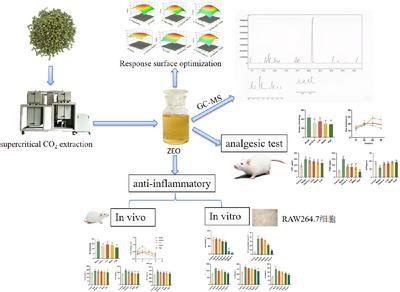
Zanthoxylum schinifolium is used traditionally as a herbal medicine and spice and flavouring agent, with its essential oil (Z. schinifolium essential oil [ZEO]) having potential anti-inflammatory and analgesic activity. In this study, the ZEO was extracted using supercritical CO2 (Sup-CO2), and the extraction process was optimized using response surface methodology (RSM). The composition of the ZEO was analysed using gas chromatography–mass spectrometry (GC–MS), whereas the role of the ZEO in inhibiting the release of inflammatory factors from lipopolysaccharide (LPS)-stimulated RAW264.7 cells was investigated. In addition, classical pharmacological experiments were conducted to examine its anti-inflammatory and analgesic effects. The study found that the best conditions for Sup-CO2 extraction of EO from Z. schinifolium were a pressure of 14 MPa, CO2 flow rate of 18 L/h, extraction time of 1.5 h, temperature of 55°C and granularity of 40 mesh. The yield of ZEO under these conditions was 9.40%. Analysis of the ZEO revealed 18 components, with linalool (72.44%), d-limonene (4.94%) and 4,6-dimethyldodecane (3.74%) being the most abundant. The ZEO showed significant inhibitory effects on mouse ear swelling, foot swelling, hot plate analgesia and writhing response. In addition, the ZEO reduced the production of inflammatory markers in macrophages. These findings suggested that the ZEO extracted by Sup-CO2 has potential pharmaceutical applications due to its anti-inflammatory and analgesic effects.
期刊介绍:
Chemistry & Biodiversity serves as a high-quality publishing forum covering a wide range of biorelevant topics for a truly international audience. This journal publishes both field-specific and interdisciplinary contributions on all aspects of biologically relevant chemistry research in the form of full-length original papers, short communications, invited reviews, and commentaries. It covers all research fields straddling the border between the chemical and biological sciences, with the ultimate goal of broadening our understanding of how nature works at a molecular level.
Since 2017, Chemistry & Biodiversity is published in an online-only format.



 京公网安备 11010802042870号
京ICP备2023020795号-1
京公网安备 11010802042870号
京ICP备2023020795号-1

 分享
分享
 求助内容:
求助内容: 应助结果提醒方式:
 扫码关注我们
