{"title":"Advances in S100 protein family for gynecological malignancies.","authors":"Shenglong Wu, Junfen Xu","doi":"10.1007/s12672-025-02028-x","DOIUrl":null,"url":null,"abstract":"<p><p>The S100 protein family comprises more than 20 structurally related members with diverse functions. These proteins regulate cellular responses by acting both as intracellular Ca<sup>2+</sup> binding receptors and extracellular factors. Gynecological malignancies, characterized by tumors in the female reproductive system, like ovarian cancer (OC), cervical cancer (CC), and endometrial cancer (EC), cause significant harm to women's health. Dysregulated expression of certain S100 proteins is implicated not only in benign diseases but also in gynecological malignancies. Emerging in vitro evidence indicates these proteins play a key role in the occurrence and progression of such malignancies. Abnormal expression of specific S100 proteins contributes to malignancy progression by promoting proliferation, invasion, migration, and drug resistance. Furthermore, abnormal levels of some S100 proteins in serum and tissues are associated with diagnosis and prognosis, making them potential biomarkers. This review provides an overview of recent findings on the involvement of the S100 protein family in gynecological malignancies and explores their regulatory mechanisms.</p>","PeriodicalId":11148,"journal":{"name":"Discover. Oncology","volume":"16 1","pages":"287"},"PeriodicalIF":2.9000,"publicationDate":"2025-03-09","publicationTypes":"Journal Article","fieldsOfStudy":null,"isOpenAccess":false,"openAccessPdf":"https://www.ncbi.nlm.nih.gov/pmc/articles/PMC11891126/pdf/","citationCount":"0","resultStr":null,"platform":"Semanticscholar","paperid":null,"PeriodicalName":"Discover. Oncology","FirstCategoryId":"3","ListUrlMain":"https://doi.org/10.1007/s12672-025-02028-x","RegionNum":4,"RegionCategory":"医学","ArticlePicture":[],"TitleCN":null,"AbstractTextCN":null,"PMCID":null,"EPubDate":"","PubModel":"","JCR":"Q3","JCRName":"ENDOCRINOLOGY & METABOLISM","Score":null,"Total":0}
引用次数: 0
Abstract
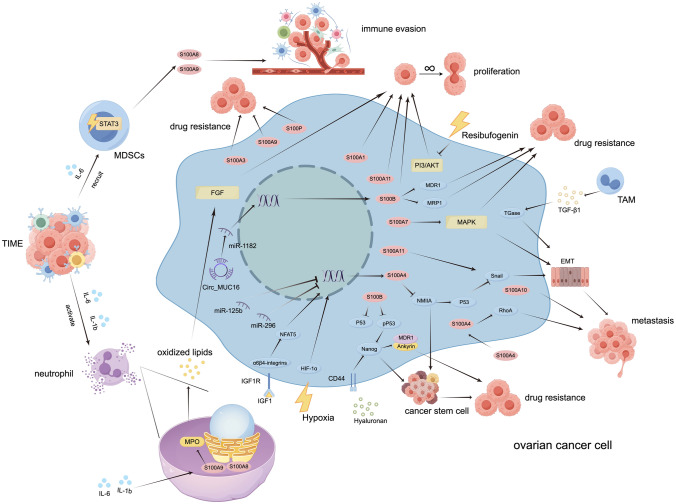
The S100 protein family comprises more than 20 structurally related members with diverse functions. These proteins regulate cellular responses by acting both as intracellular Ca2+ binding receptors and extracellular factors. Gynecological malignancies, characterized by tumors in the female reproductive system, like ovarian cancer (OC), cervical cancer (CC), and endometrial cancer (EC), cause significant harm to women's health. Dysregulated expression of certain S100 proteins is implicated not only in benign diseases but also in gynecological malignancies. Emerging in vitro evidence indicates these proteins play a key role in the occurrence and progression of such malignancies. Abnormal expression of specific S100 proteins contributes to malignancy progression by promoting proliferation, invasion, migration, and drug resistance. Furthermore, abnormal levels of some S100 proteins in serum and tissues are associated with diagnosis and prognosis, making them potential biomarkers. This review provides an overview of recent findings on the involvement of the S100 protein family in gynecological malignancies and explores their regulatory mechanisms.






 京公网安备 11010802042870号
京ICP备2023020795号-1
京公网安备 11010802042870号
京ICP备2023020795号-1

 分享
分享
 求助内容:
求助内容: 应助结果提醒方式:
 扫码关注我们
