Catherine Ollagnier, Maria-Rita Mellino, Nicolas Pradervand, Marco Tretola, Sebastien Dubois, Stephane Durosoy, Olivier Desrues, Johana Bellon
{"title":"Feed supplementation with potentiated zinc and/or tannin-rich extracts reduces ETEC infection severity and antimicrobial resistance genes in pig.","authors":"Catherine Ollagnier, Maria-Rita Mellino, Nicolas Pradervand, Marco Tretola, Sebastien Dubois, Stephane Durosoy, Olivier Desrues, Johana Bellon","doi":"10.3389/fvets.2025.1494103","DOIUrl":null,"url":null,"abstract":"<p><p>Most antimicrobials used in pig production are prescribed to treat post-weaning diarrhea (PWD), which constitutes a major health issue in pig production. With the spread of multidrug-resistant pathogens, finding solutions to diminish the severity of PWD without antibiotics has become increasingly critical. Potentiated forms of zinc oxide (ZnO) and plant-based bioactive compounds like tannins have been shown to alleviate the severity of diarrhea, thus reducing the need for antibiotic treatment. The aim of this project was to test whether a potentiated form of ZnO (pZnO), alone (study 1) or in combination with tannin-rich extract (study 2), can be used in starter diets for weaned piglets infected by enterotoxigenic <i>Escherichia coli</i> (ETEC) to reduce PWD severity. At 26 ± 1.6 days of age (average body weight 7.8 ± 1.02 kg), 160 piglets (study 1, <i>n</i> = 72; study 2, <i>n</i> = 88) were randomly and equally assigned to four dietary treatments (study 1 = 18; study 2 = 22 pigs/group) and orally infected 4 days after weaning with a solution containing 10<sup>10</sup> ETEC F4. Study 1 compared the effect of 150 mg Zn/kg pZnO (pZnO-150) and 300 mg Zn/kg pZnO (pZnO-300) to a negative control (C) and a positive control, 3,000 mg Zn/kg ZnO (C-3000). In study 2, a combination of 7.5 g/kg tannin extract (quebracho and chestnut) and 150 mg Zn/kg pZnO (TAN+pZnO-150) was compared to pZnO-150 and 7.5 g/kg tannin-rich extract (TAN) alone and to a negative control (C). The fecal score, bodyweight, daily food intake per pen, fecal F4 ETEC and Zn levels were analyzed. The small intestine content was sampled 9 days after infection to analyze the number of antimicrobial resistance genes. Regardless of the inclusion level, TAN+pZnO-150, TAN and pZnO led to a reduction in antibiotic treatment (<i>p</i> < 0.05), but only TAN and TAN+pZnO-150 reduced the fecal score (<i>p</i> < 0.05). C-3000 improved the average daily gain (<i>p</i> < 0.05). Tannin-rich extract and potentiated zinc oxide (pZnO) in starter diets effectively reduce the need for antibiotics in ETEC-challenged piglets. Traditional high-dose ZnO improved growth rates, but lower-dose alternatives with tannins provided health benefits without high zinc levels. These findings highlight sustainable dietary strategies to manage post-weaning diarrhea, supporting reduced antibiotic use in pig production.</p>","PeriodicalId":12772,"journal":{"name":"Frontiers in Veterinary Science","volume":"12 ","pages":"1494103"},"PeriodicalIF":2.9000,"publicationDate":"2025-02-21","publicationTypes":"Journal Article","fieldsOfStudy":null,"isOpenAccess":false,"openAccessPdf":"https://www.ncbi.nlm.nih.gov/pmc/articles/PMC11887510/pdf/","citationCount":"0","resultStr":null,"platform":"Semanticscholar","paperid":null,"PeriodicalName":"Frontiers in Veterinary Science","FirstCategoryId":"97","ListUrlMain":"https://doi.org/10.3389/fvets.2025.1494103","RegionNum":2,"RegionCategory":"农林科学","ArticlePicture":[],"TitleCN":null,"AbstractTextCN":null,"PMCID":null,"EPubDate":"2025/1/1 0:00:00","PubModel":"eCollection","JCR":"Q1","JCRName":"VETERINARY SCIENCES","Score":null,"Total":0}
引用次数: 0
Abstract
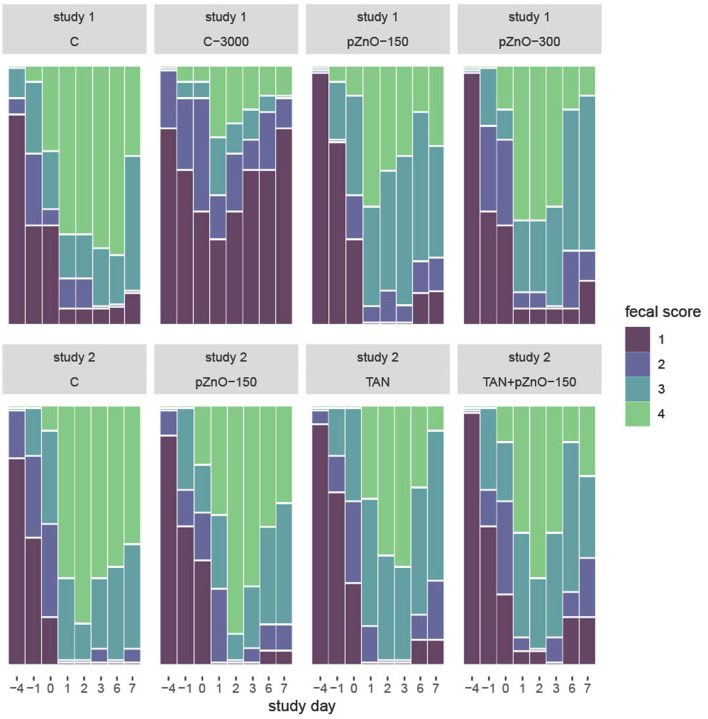
Most antimicrobials used in pig production are prescribed to treat post-weaning diarrhea (PWD), which constitutes a major health issue in pig production. With the spread of multidrug-resistant pathogens, finding solutions to diminish the severity of PWD without antibiotics has become increasingly critical. Potentiated forms of zinc oxide (ZnO) and plant-based bioactive compounds like tannins have been shown to alleviate the severity of diarrhea, thus reducing the need for antibiotic treatment. The aim of this project was to test whether a potentiated form of ZnO (pZnO), alone (study 1) or in combination with tannin-rich extract (study 2), can be used in starter diets for weaned piglets infected by enterotoxigenic Escherichia coli (ETEC) to reduce PWD severity. At 26 ± 1.6 days of age (average body weight 7.8 ± 1.02 kg), 160 piglets (study 1, n = 72; study 2, n = 88) were randomly and equally assigned to four dietary treatments (study 1 = 18; study 2 = 22 pigs/group) and orally infected 4 days after weaning with a solution containing 1010 ETEC F4. Study 1 compared the effect of 150 mg Zn/kg pZnO (pZnO-150) and 300 mg Zn/kg pZnO (pZnO-300) to a negative control (C) and a positive control, 3,000 mg Zn/kg ZnO (C-3000). In study 2, a combination of 7.5 g/kg tannin extract (quebracho and chestnut) and 150 mg Zn/kg pZnO (TAN+pZnO-150) was compared to pZnO-150 and 7.5 g/kg tannin-rich extract (TAN) alone and to a negative control (C). The fecal score, bodyweight, daily food intake per pen, fecal F4 ETEC and Zn levels were analyzed. The small intestine content was sampled 9 days after infection to analyze the number of antimicrobial resistance genes. Regardless of the inclusion level, TAN+pZnO-150, TAN and pZnO led to a reduction in antibiotic treatment (p < 0.05), but only TAN and TAN+pZnO-150 reduced the fecal score (p < 0.05). C-3000 improved the average daily gain (p < 0.05). Tannin-rich extract and potentiated zinc oxide (pZnO) in starter diets effectively reduce the need for antibiotics in ETEC-challenged piglets. Traditional high-dose ZnO improved growth rates, but lower-dose alternatives with tannins provided health benefits without high zinc levels. These findings highlight sustainable dietary strategies to manage post-weaning diarrhea, supporting reduced antibiotic use in pig production.
期刊介绍:
Frontiers in Veterinary Science is a global, peer-reviewed, Open Access journal that bridges animal and human health, brings a comparative approach to medical and surgical challenges, and advances innovative biotechnology and therapy.
Veterinary research today is interdisciplinary, collaborative, and socially relevant, transforming how we understand and investigate animal health and disease. Fundamental research in emerging infectious diseases, predictive genomics, stem cell therapy, and translational modelling is grounded within the integrative social context of public and environmental health, wildlife conservation, novel biomarkers, societal well-being, and cutting-edge clinical practice and specialization. Frontiers in Veterinary Science brings a 21st-century approach—networked, collaborative, and Open Access—to communicate this progress and innovation to both the specialist and to the wider audience of readers in the field.
Frontiers in Veterinary Science publishes articles on outstanding discoveries across a wide spectrum of translational, foundational, and clinical research. The journal''s mission is to bring all relevant veterinary sciences together on a single platform with the goal of improving animal and human health.




 京公网安备 11010802042870号
京ICP备2023020795号-1
京公网安备 11010802042870号
京ICP备2023020795号-1

 分享
分享
 求助内容:
求助内容: 应助结果提醒方式:
 扫码关注我们
