Replicating the real-world evidence methods available in human health to assess burden and outcomes for dogs with chronic kidney disease, their owners, and the veterinary healthcare system in the United States of America.
Andrea Wright, Dean Taylor, Mollie Lowe, Sophie Barlow, James Jackson
{"title":"Replicating the real-world evidence methods available in human health to assess burden and outcomes for dogs with chronic kidney disease, their owners, and the veterinary healthcare system in the United States of America.","authors":"Andrea Wright, Dean Taylor, Mollie Lowe, Sophie Barlow, James Jackson","doi":"10.3389/fvets.2025.1502933","DOIUrl":null,"url":null,"abstract":"<p><strong>Introduction: </strong>Chronic kidney disease (CKD) in canines is a progressive condition characterized by a gradual decline in kidney function. There are significant gaps in understanding how CKD is managed in canines and the full extent of its impact. This study aimed to characterize disease management of CKD and its impact on dogs, their owners and the veterinary healthcare system in the United States of America (United States).</p><p><strong>Methods: </strong>Data were drawn from the Adelphi Real World Canine CKD Disease Specific Programme™, a cross-sectional survey of veterinarians, pet owners and their dogs with CKD in the United States from December 2022 to January 2024. Veterinarians reported demographic, diagnostic, treatment, and healthcare utilization data, for dogs with CKD. Owners voluntarily completed questionnaires, providing data about their dog, as well as quality of life and work-related burden using the Dog Owners Quality of Life, and the Work Productivity and Activity Impairment questionnaires. Analyses were descriptive and Cohen's Kappa was used to measure agreement between owners and veterinarians.</p><p><strong>Results: </strong>A total of 117 veterinarians provided data for 308 dogs, of which 68 owners also reported information. Discrepancies in recognizing symptoms of CKD in dogs, particularly excessive water consumption and urination, were identified between veterinary professionals and owners. Interventions for managing CKD in dogs focused on controlling symptoms and supporting kidney function through dietary modifications and medication. Owners of dogs with CKD reported minimal impact to overall work and activity impairment (10 and 14%, respectively). At diagnosis, 78.6% of dogs were International Renal Interest Society Stage I-II, and 21.5% were Stage III-IV. Regardless of CKD stage, owners strongly agreed that ownership provided them with emotional support and companionship. Regarding veterinary healthcare utilization, 95% of dogs were seen in general veterinary practices.</p><p><strong>Discussion: </strong>These findings emphasize the value of real-world evidence in enhancing our understanding of CKD in companion animals and informs future strategy for the real-world diagnosis and treatment of CKD. The results also provide insights to the potential burden experienced by owners of dogs with CKD.</p>","PeriodicalId":12772,"journal":{"name":"Frontiers in Veterinary Science","volume":"12 ","pages":"1502933"},"PeriodicalIF":2.9000,"publicationDate":"2025-02-21","publicationTypes":"Journal Article","fieldsOfStudy":null,"isOpenAccess":false,"openAccessPdf":"https://www.ncbi.nlm.nih.gov/pmc/articles/PMC11886590/pdf/","citationCount":"0","resultStr":null,"platform":"Semanticscholar","paperid":null,"PeriodicalName":"Frontiers in Veterinary Science","FirstCategoryId":"97","ListUrlMain":"https://doi.org/10.3389/fvets.2025.1502933","RegionNum":2,"RegionCategory":"农林科学","ArticlePicture":[],"TitleCN":null,"AbstractTextCN":null,"PMCID":null,"EPubDate":"2025/1/1 0:00:00","PubModel":"eCollection","JCR":"Q1","JCRName":"VETERINARY SCIENCES","Score":null,"Total":0}
引用次数: 0
Abstract
Introduction: Chronic kidney disease (CKD) in canines is a progressive condition characterized by a gradual decline in kidney function. There are significant gaps in understanding how CKD is managed in canines and the full extent of its impact. This study aimed to characterize disease management of CKD and its impact on dogs, their owners and the veterinary healthcare system in the United States of America (United States).
Methods: Data were drawn from the Adelphi Real World Canine CKD Disease Specific Programme™, a cross-sectional survey of veterinarians, pet owners and their dogs with CKD in the United States from December 2022 to January 2024. Veterinarians reported demographic, diagnostic, treatment, and healthcare utilization data, for dogs with CKD. Owners voluntarily completed questionnaires, providing data about their dog, as well as quality of life and work-related burden using the Dog Owners Quality of Life, and the Work Productivity and Activity Impairment questionnaires. Analyses were descriptive and Cohen's Kappa was used to measure agreement between owners and veterinarians.
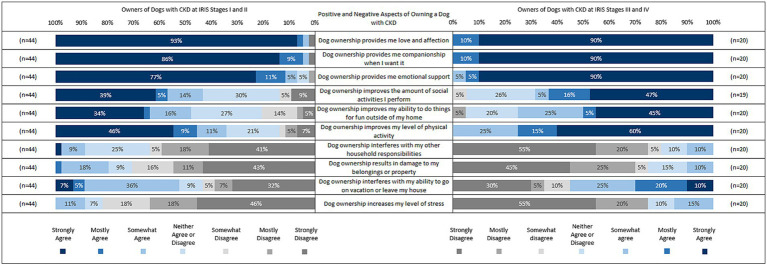
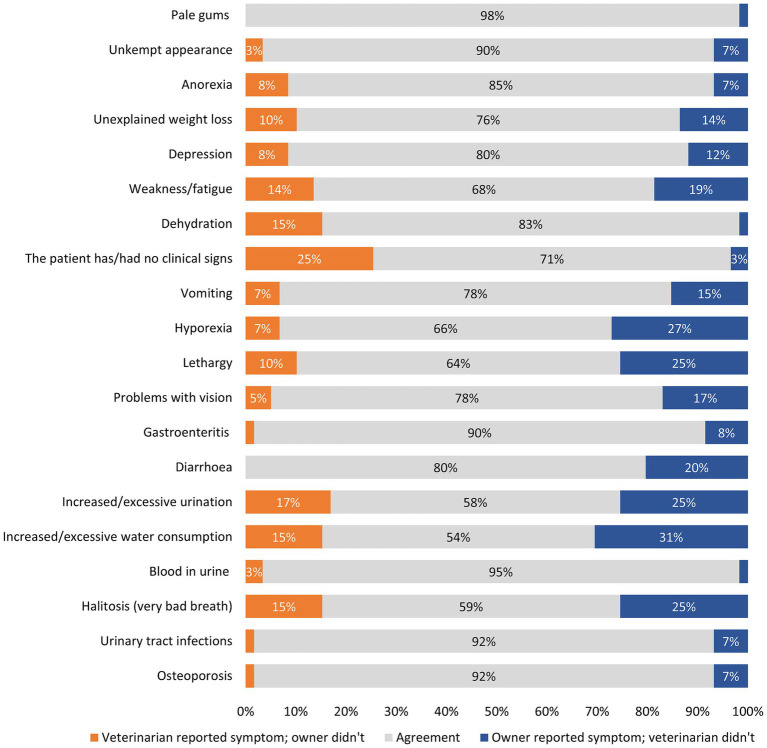
Results: A total of 117 veterinarians provided data for 308 dogs, of which 68 owners also reported information. Discrepancies in recognizing symptoms of CKD in dogs, particularly excessive water consumption and urination, were identified between veterinary professionals and owners. Interventions for managing CKD in dogs focused on controlling symptoms and supporting kidney function through dietary modifications and medication. Owners of dogs with CKD reported minimal impact to overall work and activity impairment (10 and 14%, respectively). At diagnosis, 78.6% of dogs were International Renal Interest Society Stage I-II, and 21.5% were Stage III-IV. Regardless of CKD stage, owners strongly agreed that ownership provided them with emotional support and companionship. Regarding veterinary healthcare utilization, 95% of dogs were seen in general veterinary practices.
Discussion: These findings emphasize the value of real-world evidence in enhancing our understanding of CKD in companion animals and informs future strategy for the real-world diagnosis and treatment of CKD. The results also provide insights to the potential burden experienced by owners of dogs with CKD.
犬类慢性肾脏疾病(CKD)是一种以肾功能逐渐下降为特征的进行性疾病。在了解犬科动物如何管理CKD及其影响的全部程度方面存在重大差距。本研究旨在描述美国CKD的疾病管理及其对狗、其主人和兽医保健系统的影响。方法:数据来自Adelphi Real World Canine CKD Disease Specific program™,这是一项对美国兽医、宠物主人及其患有CKD的狗进行的横断面调查,调查时间为2022年12月至2024年1月。兽医报告了CKD犬的人口统计、诊断、治疗和医疗保健利用数据。狗主人自愿完成调查问卷,使用“狗主人生活质量”和“工作效率和活动障碍”问卷,提供有关他们的狗的数据,以及生活质量和工作负担。分析是描述性的,Cohen’s Kappa用于衡量饲主和兽医之间的一致性。结果:共有117名兽医为308只狗提供了数据,其中68名主人也报告了信息。兽医专业人员和狗主人在识别狗的CKD症状,特别是过度饮水和排尿方面存在差异。管理狗CKD的干预措施侧重于通过饮食调整和药物控制症状和支持肾功能。患有慢性肾病的狗的主人报告对整体工作和活动损害的影响最小(分别为10%和14%)。在诊断时,78.6%的狗为国际肾脏利益协会I-II期,21.5%为III-IV期。无论CKD处于哪个阶段,业主都强烈认为所有权为他们提供了情感支持和陪伴。关于兽医保健的利用,95%的狗在一般兽医诊所看到。讨论:这些发现强调了现实证据在增强我们对伴侣动物CKD的理解方面的价值,并为CKD的现实诊断和治疗提供了未来的策略。研究结果还为CKD狗的主人所经历的潜在负担提供了见解。
期刊介绍:
Frontiers in Veterinary Science is a global, peer-reviewed, Open Access journal that bridges animal and human health, brings a comparative approach to medical and surgical challenges, and advances innovative biotechnology and therapy.
Veterinary research today is interdisciplinary, collaborative, and socially relevant, transforming how we understand and investigate animal health and disease. Fundamental research in emerging infectious diseases, predictive genomics, stem cell therapy, and translational modelling is grounded within the integrative social context of public and environmental health, wildlife conservation, novel biomarkers, societal well-being, and cutting-edge clinical practice and specialization. Frontiers in Veterinary Science brings a 21st-century approach—networked, collaborative, and Open Access—to communicate this progress and innovation to both the specialist and to the wider audience of readers in the field.
Frontiers in Veterinary Science publishes articles on outstanding discoveries across a wide spectrum of translational, foundational, and clinical research. The journal''s mission is to bring all relevant veterinary sciences together on a single platform with the goal of improving animal and human health.




 京公网安备 11010802042870号
京ICP备2023020795号-1
京公网安备 11010802042870号
京ICP备2023020795号-1

 分享
分享
 求助内容:
求助内容: 应助结果提醒方式:
 扫码关注我们
