Danyang Yao, Fang Qian, Tao-Hsin Tung, Huanhuan Shi, Dongjun Bi
{"title":"The effectiveness of web-based grief intervention for adults who lost a loved one: A systematic review and meta-analysis.","authors":"Danyang Yao, Fang Qian, Tao-Hsin Tung, Huanhuan Shi, Dongjun Bi","doi":"10.1186/s12904-025-01679-5","DOIUrl":null,"url":null,"abstract":"<p><strong>Background: </strong>Many bereaved individuals suffer from intense grief, anxiety, depression and post-traumatic stress disorder. To prevent these conditions from worsening, web-based grief interventions have emerged as a promising solution for providing accessible, flexible, and anonymous support to bereaved individuals. However, two previous meta-analyses focused only on the post-intervention effects of web-based grief interventions on grief, post-traumatic stress disorder, and depression in bereavement individuals, relying on a small number of studies published before 2021. Therefore, after including new research, the present study evaluated the effects of web-based grief interventions on grief, anxiety, depression, and posttraumatic stress disorder in bereaved adults, both post-intervention and after three months of follow-up.</p><p><strong>Methods: </strong>Randomized controlled trials (RCTs) were retrieved from The Cochrane Library, PubMed, Web of Science, PsycARTICLES, Embase, CINAHL, Medline, and Clinical Trials, with a search time range from database establishment to February 1, 2024, without language limitations. The quality of the included RCTs was evaluated using the Cochrane Risk Assessment Tool, and evaluation was conducted using Review Manager 5.3. PROSPERO Registration: CRD42024506293.</p><p><strong>Results: </strong>A total of 726 and 771 participants were in the intervention and control groups, respectively. After the implementation of the web-based grief intervention, significant improvements were observed in anxiety (standard mean difference [SMD] = -0.37, 95% CI [-0.54, -0.20] p < 0.0001), posttraumatic stress disorder (SMD = -0.64, 95% CI [-0.78, -0.50], p < 0.00001), depression (SMD = -0.37, 95% CI [-0.47, -0.27], p < 0.00001), and grief (SMD = -0.30, 95% CI [-0.40, -0.19], p < 0.00001) among the bereaved individuals. In the intervention group, after three months of follow-up, significant improvements continued in grief (SMD = -0.19, 95% CI [-0.31, -0.08], p = 0.001), depression (SMD = -0.15, 95% CI [-0.26, -0.04], p = 0.009) and posttraumatic stress disorder (SMD = -0.23, 95% CI [-0.45, -0.01], p = 0.04), whereas no significant improvement was observed in anxiety (SMD = -0.02, 95% CI [-0.22, 0.19], p = 0.86).</p><p><strong>Conclusion: </strong>Web-based grief interventions have a positive and promising effect on anxiety, depression, grief, and post-traumatic stress disorder in bereaved individuals following the intervention. However, after three months of follow-up, the web-based grief intervention had a lasting positive effect on grief, post-traumatic stress disorder, and depression, but not on anxiety.</p>","PeriodicalId":48945,"journal":{"name":"BMC Palliative Care","volume":"24 1","pages":"61"},"PeriodicalIF":2.5000,"publicationDate":"2025-03-08","publicationTypes":"Journal Article","fieldsOfStudy":null,"isOpenAccess":false,"openAccessPdf":"https://www.ncbi.nlm.nih.gov/pmc/articles/PMC11889856/pdf/","citationCount":"0","resultStr":null,"platform":"Semanticscholar","paperid":null,"PeriodicalName":"BMC Palliative Care","FirstCategoryId":"3","ListUrlMain":"https://doi.org/10.1186/s12904-025-01679-5","RegionNum":2,"RegionCategory":"医学","ArticlePicture":[],"TitleCN":null,"AbstractTextCN":null,"PMCID":null,"EPubDate":"","PubModel":"","JCR":"Q2","JCRName":"HEALTH CARE SCIENCES & SERVICES","Score":null,"Total":0}
引用次数: 0
Abstract
Background: Many bereaved individuals suffer from intense grief, anxiety, depression and post-traumatic stress disorder. To prevent these conditions from worsening, web-based grief interventions have emerged as a promising solution for providing accessible, flexible, and anonymous support to bereaved individuals. However, two previous meta-analyses focused only on the post-intervention effects of web-based grief interventions on grief, post-traumatic stress disorder, and depression in bereavement individuals, relying on a small number of studies published before 2021. Therefore, after including new research, the present study evaluated the effects of web-based grief interventions on grief, anxiety, depression, and posttraumatic stress disorder in bereaved adults, both post-intervention and after three months of follow-up.
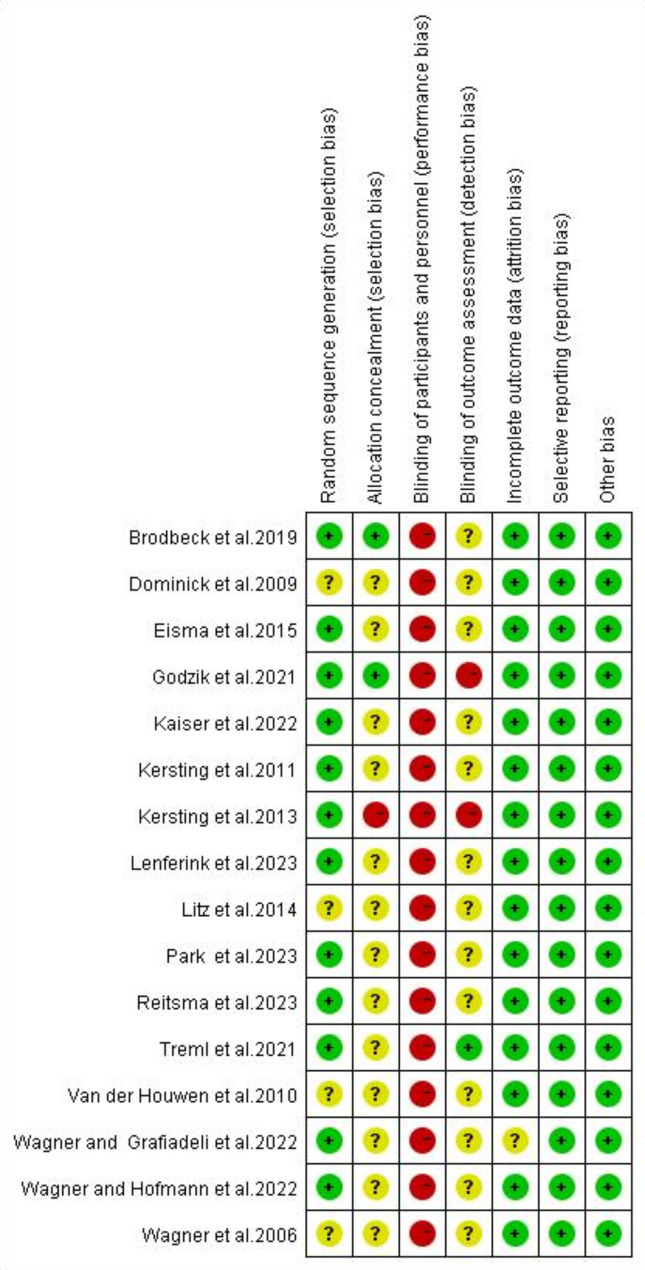
Methods: Randomized controlled trials (RCTs) were retrieved from The Cochrane Library, PubMed, Web of Science, PsycARTICLES, Embase, CINAHL, Medline, and Clinical Trials, with a search time range from database establishment to February 1, 2024, without language limitations. The quality of the included RCTs was evaluated using the Cochrane Risk Assessment Tool, and evaluation was conducted using Review Manager 5.3. PROSPERO Registration: CRD42024506293.
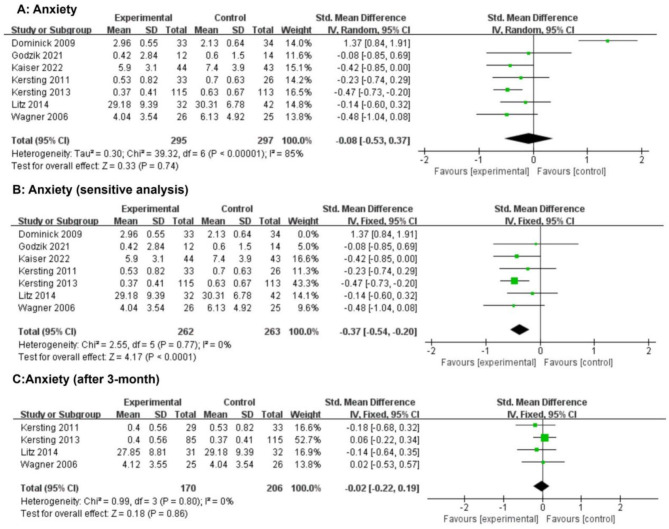
Results: A total of 726 and 771 participants were in the intervention and control groups, respectively. After the implementation of the web-based grief intervention, significant improvements were observed in anxiety (standard mean difference [SMD] = -0.37, 95% CI [-0.54, -0.20] p < 0.0001), posttraumatic stress disorder (SMD = -0.64, 95% CI [-0.78, -0.50], p < 0.00001), depression (SMD = -0.37, 95% CI [-0.47, -0.27], p < 0.00001), and grief (SMD = -0.30, 95% CI [-0.40, -0.19], p < 0.00001) among the bereaved individuals. In the intervention group, after three months of follow-up, significant improvements continued in grief (SMD = -0.19, 95% CI [-0.31, -0.08], p = 0.001), depression (SMD = -0.15, 95% CI [-0.26, -0.04], p = 0.009) and posttraumatic stress disorder (SMD = -0.23, 95% CI [-0.45, -0.01], p = 0.04), whereas no significant improvement was observed in anxiety (SMD = -0.02, 95% CI [-0.22, 0.19], p = 0.86).
Conclusion: Web-based grief interventions have a positive and promising effect on anxiety, depression, grief, and post-traumatic stress disorder in bereaved individuals following the intervention. However, after three months of follow-up, the web-based grief intervention had a lasting positive effect on grief, post-traumatic stress disorder, and depression, but not on anxiety.
期刊介绍:
BMC Palliative Care is an open access journal publishing original peer-reviewed research articles in the clinical, scientific, ethical and policy issues, local and international, regarding all aspects of hospice and palliative care for the dying and for those with profound suffering related to chronic illness.




 京公网安备 11010802042870号
京ICP备2023020795号-1
京公网安备 11010802042870号
京ICP备2023020795号-1

 分享
分享
 求助内容:
求助内容: 应助结果提醒方式:
 扫码关注我们
