Zhuolin Li, Liumei Song, Yuanxing Yang, Yang Zhao, Sharui Ma
{"title":"Mannose enhances anti-tumor effect of PLX4032 in anaplastic thyroid cancer.","authors":"Zhuolin Li, Liumei Song, Yuanxing Yang, Yang Zhao, Sharui Ma","doi":"10.1530/ERC-24-0209","DOIUrl":null,"url":null,"abstract":"<p><p>Anaplastic thyroid cancer represents the most aggressive form of thyroid cancer and harbors BRAF mutations in over 40% of cases. Vemurafenib (PLX4032), a BRAF kinase inhibitor, shows promise in BRAFV600E-positive advanced thyroid cancer but may promote resistance in anaplastic cases. This study investigates whether mannose, known to selectively inhibit thyroid cancer, enhances PLX4032 efficacy. To evaluate whether mannose could enhance the response of anaplastic thyroid cancer cells to vemurafenib, we employed several in vitro assays, including MTT, colony formation, flow cytometry, migration and invasion assays. In addition, we performed in vivo assays using mouse models with subcutaneous xenografts. Our findings demonstrated that vemurafenib and mannose synergistically inhibit anaplastic thyroid cancer cell proliferation. The combined treatment significantly impeded anaplastic thyroid cancer cell migration and invasion while promoting apoptosis. In vivo studies corroborated these observations. The underlying mechanism by which mannose potentiates the antitumor effects of vemurafenib was explored using the Seahorse XFe96 Analyzer to measure glycolysis parameters and Western blotting to assess the expression of associated proteins. Mechanistically, vemurafenib reduced the expression of ZIP10, which in turn decreased the enzyme activity of phosphomannose isomerase. This suppression of ZIP10 enhanced mannose-mediated inhibition of glycolysis and thus its antitumor effect, as confirmed by rescue experiments with ZIP10 overexpression. The resulting decrease in glycolysis led to lower ATP levels, which are essential for the phosphorylation of ERK and AKT. Therefore, the combination of vemurafenib and mannose inhibited the levels of pERK and pAKT, thereby improving the effectiveness of PLX4032 in treating anaplastic thyroid cancer.</p>","PeriodicalId":93989,"journal":{"name":"Endocrine-related cancer","volume":" ","pages":""},"PeriodicalIF":4.6000,"publicationDate":"2025-03-24","publicationTypes":"Journal Article","fieldsOfStudy":null,"isOpenAccess":false,"openAccessPdf":"https://www.ncbi.nlm.nih.gov/pmc/articles/PMC11964477/pdf/","citationCount":"0","resultStr":null,"platform":"Semanticscholar","paperid":null,"PeriodicalName":"Endocrine-related cancer","FirstCategoryId":"1085","ListUrlMain":"https://doi.org/10.1530/ERC-24-0209","RegionNum":0,"RegionCategory":null,"ArticlePicture":[],"TitleCN":null,"AbstractTextCN":null,"PMCID":null,"EPubDate":"2025/5/1 0:00:00","PubModel":"Print","JCR":"","JCRName":"","Score":null,"Total":0}
引用次数: 0
Abstract
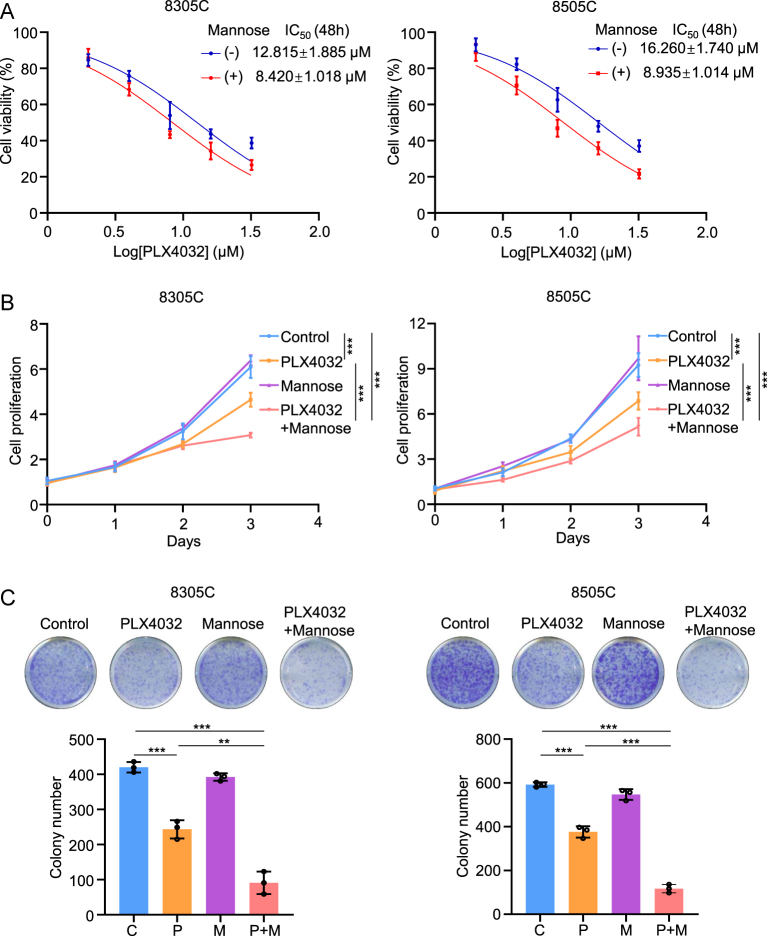
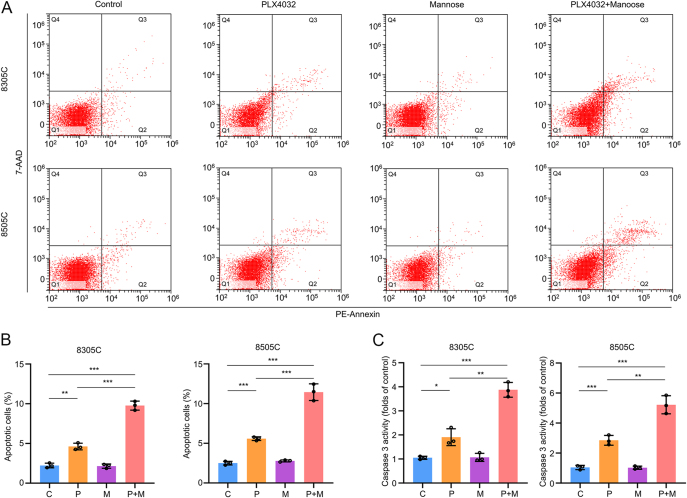
Anaplastic thyroid cancer represents the most aggressive form of thyroid cancer and harbors BRAF mutations in over 40% of cases. Vemurafenib (PLX4032), a BRAF kinase inhibitor, shows promise in BRAFV600E-positive advanced thyroid cancer but may promote resistance in anaplastic cases. This study investigates whether mannose, known to selectively inhibit thyroid cancer, enhances PLX4032 efficacy. To evaluate whether mannose could enhance the response of anaplastic thyroid cancer cells to vemurafenib, we employed several in vitro assays, including MTT, colony formation, flow cytometry, migration and invasion assays. In addition, we performed in vivo assays using mouse models with subcutaneous xenografts. Our findings demonstrated that vemurafenib and mannose synergistically inhibit anaplastic thyroid cancer cell proliferation. The combined treatment significantly impeded anaplastic thyroid cancer cell migration and invasion while promoting apoptosis. In vivo studies corroborated these observations. The underlying mechanism by which mannose potentiates the antitumor effects of vemurafenib was explored using the Seahorse XFe96 Analyzer to measure glycolysis parameters and Western blotting to assess the expression of associated proteins. Mechanistically, vemurafenib reduced the expression of ZIP10, which in turn decreased the enzyme activity of phosphomannose isomerase. This suppression of ZIP10 enhanced mannose-mediated inhibition of glycolysis and thus its antitumor effect, as confirmed by rescue experiments with ZIP10 overexpression. The resulting decrease in glycolysis led to lower ATP levels, which are essential for the phosphorylation of ERK and AKT. Therefore, the combination of vemurafenib and mannose inhibited the levels of pERK and pAKT, thereby improving the effectiveness of PLX4032 in treating anaplastic thyroid cancer.




 京公网安备 11010802042870号
京ICP备2023020795号-1
京公网安备 11010802042870号
京ICP备2023020795号-1

 分享
分享

 求助内容:
求助内容: 应助结果提醒方式:
 扫码关注我们
