{"title":"Building HOPE: Integrating community-based doula care in public hospitals in New York City.","authors":"Sheela Maru, Chanel Porchia-Albert, Karen Lockworth, Cheryl Hall, Natalie Boychuk, Naphtali Calliste, Caroline Cooke, Sherley Gebara, Kanwal Haq, Krupa Harishankar, Rochelle James, Teresa Janevic, Kimberly Mathurin, Sarah Nowlin, Anabel Rivera, Alva Rodriguez, Rachel Schwartz, Victoria St Clair, Stacey Whaley, Alison Whitney","doi":"10.1093/haschl/qxaf033","DOIUrl":null,"url":null,"abstract":"<p><p>Maternal morbidity and mortality in the United States is an urgent public health issue, and there are stark differences by race and ethnicity. Community-based doula care is an evidence-based strategy to improve maternal health through accompaniment, health care engagement, addressing social needs, and promoting respectful care. Yet, there is a gap in access to doula care for people who are low-income or publicly insured, due to cost and availability. New York has recently joined a growing number of states providing Medicaid coverage for doula services. There are many challenges to overcome for this benefit to succeed: limited workforce capacity, minimal integration of doulas into hospitals, and reimbursement challenges. We offer a case study for integrating doula services into hospital-based maternity care: the HOPE Program (Helping Promote Birth-Equity through Community-Based Doula Care). Through community engagement, we have co-designed a model that centers the needs and experiences of birthing people and their care-giving teams. The model illustrates strategies for hospital-community engagement, tailored doula workforce expansion, and integration of doulas into clinical spaces and teams. Investment in these components will lead to a meaningful expansion of doula services to the populations around the state and country who need it most.</p>","PeriodicalId":94025,"journal":{"name":"Health affairs scholar","volume":"3 3","pages":"qxaf033"},"PeriodicalIF":2.7000,"publicationDate":"2025-02-14","publicationTypes":"Journal Article","fieldsOfStudy":null,"isOpenAccess":false,"openAccessPdf":"https://www.ncbi.nlm.nih.gov/pmc/articles/PMC11886845/pdf/","citationCount":"0","resultStr":null,"platform":"Semanticscholar","paperid":null,"PeriodicalName":"Health affairs scholar","FirstCategoryId":"1085","ListUrlMain":"https://doi.org/10.1093/haschl/qxaf033","RegionNum":0,"RegionCategory":null,"ArticlePicture":[],"TitleCN":null,"AbstractTextCN":null,"PMCID":null,"EPubDate":"2025/3/1 0:00:00","PubModel":"eCollection","JCR":"","JCRName":"","Score":null,"Total":0}
引用次数: 0
Abstract
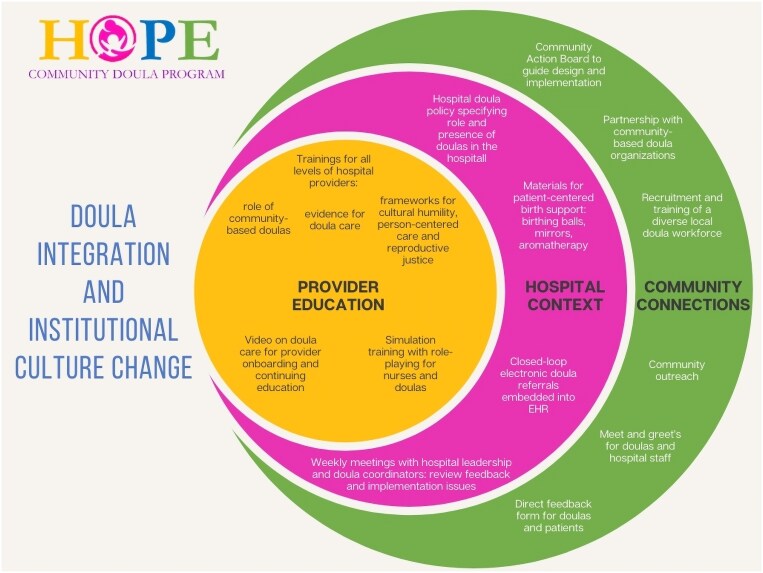
Maternal morbidity and mortality in the United States is an urgent public health issue, and there are stark differences by race and ethnicity. Community-based doula care is an evidence-based strategy to improve maternal health through accompaniment, health care engagement, addressing social needs, and promoting respectful care. Yet, there is a gap in access to doula care for people who are low-income or publicly insured, due to cost and availability. New York has recently joined a growing number of states providing Medicaid coverage for doula services. There are many challenges to overcome for this benefit to succeed: limited workforce capacity, minimal integration of doulas into hospitals, and reimbursement challenges. We offer a case study for integrating doula services into hospital-based maternity care: the HOPE Program (Helping Promote Birth-Equity through Community-Based Doula Care). Through community engagement, we have co-designed a model that centers the needs and experiences of birthing people and their care-giving teams. The model illustrates strategies for hospital-community engagement, tailored doula workforce expansion, and integration of doulas into clinical spaces and teams. Investment in these components will lead to a meaningful expansion of doula services to the populations around the state and country who need it most.





 京公网安备 11010802042870号
京ICP备2023020795号-1
京公网安备 11010802042870号
京ICP备2023020795号-1

 分享
分享

 求助内容:
求助内容: 应助结果提醒方式:
 扫码关注我们
