Identification of different hair dyes in dyed hair using Attenuated Total Reflection Fourier Transform Infrared (ATR FT-IR) and Surface Enhancing Raman Spectroscopy (SERS)
Ali Kocak , Nicholas Lovera , Mircea Alex Comanescu
{"title":"Identification of different hair dyes in dyed hair using Attenuated Total Reflection Fourier Transform Infrared (ATR FT-IR) and Surface Enhancing Raman Spectroscopy (SERS)","authors":"Ali Kocak , Nicholas Lovera , Mircea Alex Comanescu","doi":"10.1016/j.saa.2025.125952","DOIUrl":null,"url":null,"abstract":"<div><div>Forensic analysis of dyed hair by using Attenuated Total Reflectance Fourier Transform Infrared (ATR FT-IR) Spectroscopy and Surface Enhanced Raman Spectroscopy (SERS) was undertaken to differentiate between commercial hair dye brands. Human hair samples across five natural colors were dyed and subsequently analyzed to identify chemical changes induced by the dyeing process. Solvent dye extraction experiments were then conducted to isolate and compare the dye’s chemical makeup against its commercial counterparts.</div><div>Statistically, dye brands could be differentiated by Partial Least Squares Discriminant Analysis (PLSDA), demonstrating the applicability of machine learning in forensic hair dye analysis. While ATR FT-IR showed promising results in identifying characteristic bands and achieving high predictive accuracy, SERS faced limitations in data acquisition, indicating areas for future research.</div><div>Overall, the findings highlight the potential of spectroscopic techniques combined with statistical analysis to enhance forensic investigations of dyed hair. Further exploration into used solvents and nanoparticle types for improved SERS are suggested. This research contributes to the development of forensic methodologies for dyed hair evidence, aiming for integration into forensic databases to support crime laboratory analyses.</div></div>","PeriodicalId":433,"journal":{"name":"Spectrochimica Acta Part A: Molecular and Biomolecular Spectroscopy","volume":"335 ","pages":"Article 125952"},"PeriodicalIF":4.8000,"publicationDate":"2025-07-05","publicationTypes":"Journal Article","fieldsOfStudy":null,"isOpenAccess":false,"openAccessPdf":"","citationCount":"0","resultStr":null,"platform":"Semanticscholar","paperid":null,"PeriodicalName":"Spectrochimica Acta Part A: Molecular and Biomolecular Spectroscopy","FirstCategoryId":"92","ListUrlMain":"https://www.sciencedirect.com/science/article/pii/S1386142525002586","RegionNum":2,"RegionCategory":"化学","ArticlePicture":[],"TitleCN":null,"AbstractTextCN":null,"PMCID":null,"EPubDate":"2025/2/26 0:00:00","PubModel":"Epub","JCR":"Q1","JCRName":"SPECTROSCOPY","Score":null,"Total":0}
引用次数: 0
Abstract
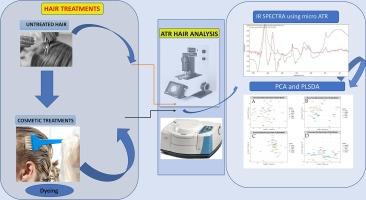
Forensic analysis of dyed hair by using Attenuated Total Reflectance Fourier Transform Infrared (ATR FT-IR) Spectroscopy and Surface Enhanced Raman Spectroscopy (SERS) was undertaken to differentiate between commercial hair dye brands. Human hair samples across five natural colors were dyed and subsequently analyzed to identify chemical changes induced by the dyeing process. Solvent dye extraction experiments were then conducted to isolate and compare the dye’s chemical makeup against its commercial counterparts.
Statistically, dye brands could be differentiated by Partial Least Squares Discriminant Analysis (PLSDA), demonstrating the applicability of machine learning in forensic hair dye analysis. While ATR FT-IR showed promising results in identifying characteristic bands and achieving high predictive accuracy, SERS faced limitations in data acquisition, indicating areas for future research.
Overall, the findings highlight the potential of spectroscopic techniques combined with statistical analysis to enhance forensic investigations of dyed hair. Further exploration into used solvents and nanoparticle types for improved SERS are suggested. This research contributes to the development of forensic methodologies for dyed hair evidence, aiming for integration into forensic databases to support crime laboratory analyses.
期刊介绍:
Spectrochimica Acta, Part A: Molecular and Biomolecular Spectroscopy (SAA) is an interdisciplinary journal which spans from basic to applied aspects of optical spectroscopy in chemistry, medicine, biology, and materials science.
The journal publishes original scientific papers that feature high-quality spectroscopic data and analysis. From the broad range of optical spectroscopies, the emphasis is on electronic, vibrational or rotational spectra of molecules, rather than on spectroscopy based on magnetic moments.
Criteria for publication in SAA are novelty, uniqueness, and outstanding quality. Routine applications of spectroscopic techniques and computational methods are not appropriate.
Topics of particular interest of Spectrochimica Acta Part A include, but are not limited to:
Spectroscopy and dynamics of bioanalytical, biomedical, environmental, and atmospheric sciences,
Novel experimental techniques or instrumentation for molecular spectroscopy,
Novel theoretical and computational methods,
Novel applications in photochemistry and photobiology,
Novel interpretational approaches as well as advances in data analysis based on electronic or vibrational spectroscopy.




 京公网安备 11010802042870号
京ICP备2023020795号-1
京公网安备 11010802042870号
京ICP备2023020795号-1

 分享
分享
 求助内容:
求助内容: 应助结果提醒方式:
 扫码关注我们
