Jaclyn M Eissman, Min Qiao, Vrinda Kalia, Marielba Zerlin-Esteves, Dolly Reyes-Dumeyer, Angel Piriz, Saurabh Dubey, Renu Nandakumar, Annie J Lee, Rafael A Lantigua, Martin Medrano, Diones Rivera Mejia, Lawrence S Honig, Clifton L Dalgard, Gary W Miller, Richard Mayeux, Badri N Vardarajan
{"title":"Genetic Regulation of the Metabolome Differs by Sex, Alzheimer's Disease Stage, and Plasma Biomarker Status.","authors":"Jaclyn M Eissman, Min Qiao, Vrinda Kalia, Marielba Zerlin-Esteves, Dolly Reyes-Dumeyer, Angel Piriz, Saurabh Dubey, Renu Nandakumar, Annie J Lee, Rafael A Lantigua, Martin Medrano, Diones Rivera Mejia, Lawrence S Honig, Clifton L Dalgard, Gary W Miller, Richard Mayeux, Badri N Vardarajan","doi":"10.1101/2025.02.26.25322932","DOIUrl":null,"url":null,"abstract":"<p><p>We investigated genetic regulators of circulating plasma metabolites to identify pathways underlying biochemical changes in clinical and biomarker-assisted diagnosis of Alzheimer's disease (AD). We computed metabolite quantitative trait loci by using whole genome sequencing and small molecule plasma metabolites from 229 older adults with clinical AD and 322 age-matched healthy controls. Unbiased associations between 6,881 metabolites and 332,772 common genetic variants were tested, adjusted for age, sex, and both metabolomic and genomic principal components. We identified 72 novel and known SNP-metabolite associations spanning 66 genes and 12 metabolite classes, including <i>PYROXD2</i> and N6-methyllysine, <i>FAAH</i> and myristoylglycine, as well as <i>FADS2</i> and arachidonic acid. In addition, we found differences in genetic regulation of metabolites among individuals with clinically defined AD compared to AD defined by a published plasma P-tau181 level cut-off. We also found more SNP-metabolite associations among males compared to females. In summary, we identified sex- and disease-specific genetic regulators of plasma metabolites and unique biological mechanisms of genetic perturbations in AD.</p>","PeriodicalId":94281,"journal":{"name":"medRxiv : the preprint server for health sciences","volume":" ","pages":""},"PeriodicalIF":0.0000,"publicationDate":"2025-03-17","publicationTypes":"Journal Article","fieldsOfStudy":null,"isOpenAccess":false,"openAccessPdf":"https://www.ncbi.nlm.nih.gov/pmc/articles/PMC11888523/pdf/","citationCount":"0","resultStr":null,"platform":"Semanticscholar","paperid":null,"PeriodicalName":"medRxiv : the preprint server for health sciences","FirstCategoryId":"1085","ListUrlMain":"https://doi.org/10.1101/2025.02.26.25322932","RegionNum":0,"RegionCategory":null,"ArticlePicture":[],"TitleCN":null,"AbstractTextCN":null,"PMCID":null,"EPubDate":"","PubModel":"","JCR":"","JCRName":"","Score":null,"Total":0}
引用次数: 0
Abstract
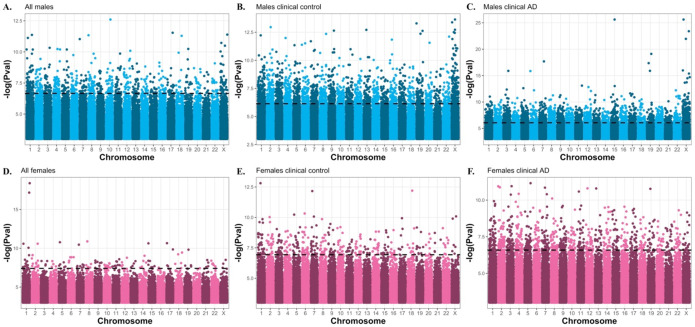
We investigated genetic regulators of circulating plasma metabolites to identify pathways underlying biochemical changes in clinical and biomarker-assisted diagnosis of Alzheimer's disease (AD). We computed metabolite quantitative trait loci by using whole genome sequencing and small molecule plasma metabolites from 229 older adults with clinical AD and 322 age-matched healthy controls. Unbiased associations between 6,881 metabolites and 332,772 common genetic variants were tested, adjusted for age, sex, and both metabolomic and genomic principal components. We identified 72 novel and known SNP-metabolite associations spanning 66 genes and 12 metabolite classes, including PYROXD2 and N6-methyllysine, FAAH and myristoylglycine, as well as FADS2 and arachidonic acid. In addition, we found differences in genetic regulation of metabolites among individuals with clinically defined AD compared to AD defined by a published plasma P-tau181 level cut-off. We also found more SNP-metabolite associations among males compared to females. In summary, we identified sex- and disease-specific genetic regulators of plasma metabolites and unique biological mechanisms of genetic perturbations in AD.





 京公网安备 11010802042870号
京ICP备2023020795号-1
京公网安备 11010802042870号
京ICP备2023020795号-1

 分享
分享

 求助内容:
求助内容: 应助结果提醒方式:
 扫码关注我们
