Shubham Kumar, Narendra N. Hegade, Anne-Maria Visuri, Balaganchi A. Bhargava, Juan F. R. Hernandez, E. Solano, F. Albarrán-Arriagada, G. Alvarado Barrios
{"title":"Digital-analog quantum computing of fermion-boson models in superconducting circuits","authors":"Shubham Kumar, Narendra N. Hegade, Anne-Maria Visuri, Balaganchi A. Bhargava, Juan F. R. Hernandez, E. Solano, F. Albarrán-Arriagada, G. Alvarado Barrios","doi":"10.1038/s41534-025-01001-4","DOIUrl":null,"url":null,"abstract":"<p>High-fidelity quantum simulations demand hardware-software co-design architectures, which are crucial for adapting to complex problems such as strongly correlated dynamics in condensed matter. By leveraging co-design strategies, we can enhance the performance of state-of-the-art quantum devices in the noisy intermediate quantum (NISQ) and early error-correction regimes. In this direction, we propose a digital-analog quantum algorithm for simulating the Hubbard–Holstein model, describing strongly correlated fermion-boson interactions, in a suitable architecture with superconducting circuits. It comprises a linear chain of qubits connected by resonators, emulating electron–electron (e–e) and electron–phonon (e–p) interactions, as well as fermion tunneling. Our approach is adequate for digital-analog quantum computing (DAQC) of fermion-boson models, including those described by the Hubbard–Holstein model. We show the reduction in the circuit depth of the DAQC algorithm, a sequence of digital steps and analog blocks, outperforming the purely digital approach. We exemplify the quantum simulation of a half-filled two-site Hubbard–Holstein model. In this example, we obtain time-dependent state fidelities larger than 0.98, showing that our proposal is suitable for studying the dynamical behavior of solid-state systems. Our proposal opens the door to computing complex systems for chemistry, materials, and high-energy physics.</p>","PeriodicalId":19212,"journal":{"name":"npj Quantum Information","volume":"91 1","pages":""},"PeriodicalIF":8.3000,"publicationDate":"2025-03-11","publicationTypes":"Journal Article","fieldsOfStudy":null,"isOpenAccess":false,"openAccessPdf":"","citationCount":"0","resultStr":null,"platform":"Semanticscholar","paperid":null,"PeriodicalName":"npj Quantum Information","FirstCategoryId":"101","ListUrlMain":"https://doi.org/10.1038/s41534-025-01001-4","RegionNum":1,"RegionCategory":"物理与天体物理","ArticlePicture":[],"TitleCN":null,"AbstractTextCN":null,"PMCID":null,"EPubDate":"","PubModel":"","JCR":"Q1","JCRName":"PHYSICS, APPLIED","Score":null,"Total":0}
引用次数: 0
Abstract
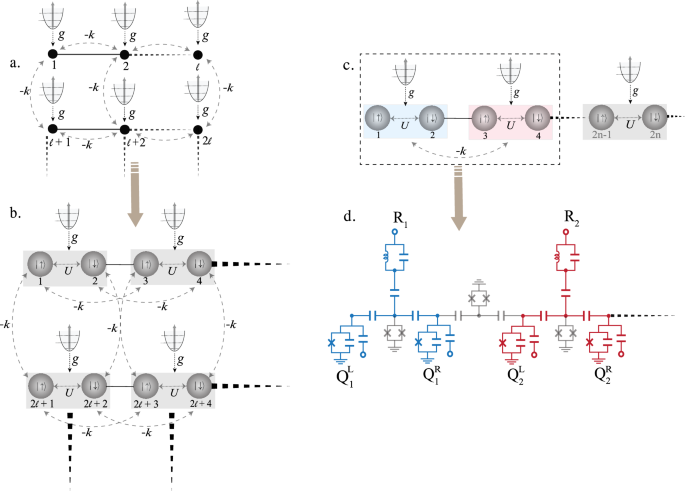
High-fidelity quantum simulations demand hardware-software co-design architectures, which are crucial for adapting to complex problems such as strongly correlated dynamics in condensed matter. By leveraging co-design strategies, we can enhance the performance of state-of-the-art quantum devices in the noisy intermediate quantum (NISQ) and early error-correction regimes. In this direction, we propose a digital-analog quantum algorithm for simulating the Hubbard–Holstein model, describing strongly correlated fermion-boson interactions, in a suitable architecture with superconducting circuits. It comprises a linear chain of qubits connected by resonators, emulating electron–electron (e–e) and electron–phonon (e–p) interactions, as well as fermion tunneling. Our approach is adequate for digital-analog quantum computing (DAQC) of fermion-boson models, including those described by the Hubbard–Holstein model. We show the reduction in the circuit depth of the DAQC algorithm, a sequence of digital steps and analog blocks, outperforming the purely digital approach. We exemplify the quantum simulation of a half-filled two-site Hubbard–Holstein model. In this example, we obtain time-dependent state fidelities larger than 0.98, showing that our proposal is suitable for studying the dynamical behavior of solid-state systems. Our proposal opens the door to computing complex systems for chemistry, materials, and high-energy physics.
期刊介绍:
The scope of npj Quantum Information spans across all relevant disciplines, fields, approaches and levels and so considers outstanding work ranging from fundamental research to applications and technologies.



 京公网安备 11010802042870号
京ICP备2023020795号-1
京公网安备 11010802042870号
京ICP备2023020795号-1

 分享
分享
 求助内容:
求助内容: 应助结果提醒方式:
 扫码关注我们
