Qi Liang, Xiaodong Wang, Hongxiang Li, Huanxiang Jiang, Hao Lu, Yahui Liu, Andong Zhang and Zhishan Bo
{"title":"Suppressing nonradiative energy loss in ternary organic solar cells through elaborate disruption of guest acceptors planarity†","authors":"Qi Liang, Xiaodong Wang, Hongxiang Li, Huanxiang Jiang, Hao Lu, Yahui Liu, Andong Zhang and Zhishan Bo","doi":"10.1039/D5TA00232J","DOIUrl":null,"url":null,"abstract":"<p >The relatively large non-radiative energy loss (Δ<em>E</em><small><sub>nr</sub></small>) in organic solar cells (OSCs) remains a major obstacle for improving the power conversion efficiency (PCE). Therefore, it is imperative to minimize Δ<em>E</em><small><sub>nr</sub></small> through rational molecular design and device engineering. In this work, three small-molecule acceptors with different terminal steric hindrance groups, namely, Y-PH-H, Y-PH-CH<small><sub>3</sub></small>, and Y-PH-2CH<small><sub>3</sub></small>, were designed as the third components to elaborately reduce the π–π interactions in the acceptor phase and improve the photoluminescence quantum yield (PLQY). All the third components effectively improved the fluorescence quantum yield of the acceptor phase and inhibited Δ<em>E</em><small><sub>nr</sub></small>. Among these systems, the Y-PH-CH<small><sub>3</sub></small> ternary system exhibited remarkable suppression of non-radiative energy loss, coupled with refined charge transport capabilities. Consequently, it achieved an impressive power conversion efficiency (PCE) of 18.63%, accompanied by a low non-radiative energy loss of merely 0.178 eV. Moreover, by adopting this third-component design strategy into a D18:L8-BO system, a significantly improved open circuit voltage (<em>V</em><small><sub>OC</sub></small>) of 0.924 V and a high PCE of 19.18% could be achieved. This study confirms that appropriately manipulating the planarity of acceptors by terminal steric hindrance groups is an effective approach for designing third components toward highly efficient ternary OSCs with low Δ<em>E</em><small><sub>nr</sub></small>.</p>","PeriodicalId":82,"journal":{"name":"Journal of Materials Chemistry A","volume":" 17","pages":" 12234-12242"},"PeriodicalIF":9.5000,"publicationDate":"2025-03-11","publicationTypes":"Journal Article","fieldsOfStudy":null,"isOpenAccess":false,"openAccessPdf":"","citationCount":"0","resultStr":null,"platform":"Semanticscholar","paperid":null,"PeriodicalName":"Journal of Materials Chemistry A","FirstCategoryId":"88","ListUrlMain":"https://pubs.rsc.org/en/content/articlelanding/2025/ta/d5ta00232j","RegionNum":2,"RegionCategory":"材料科学","ArticlePicture":[],"TitleCN":null,"AbstractTextCN":null,"PMCID":null,"EPubDate":"","PubModel":"","JCR":"Q1","JCRName":"CHEMISTRY, PHYSICAL","Score":null,"Total":0}
引用次数: 0
Abstract
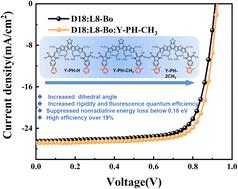
The relatively large non-radiative energy loss (ΔEnr) in organic solar cells (OSCs) remains a major obstacle for improving the power conversion efficiency (PCE). Therefore, it is imperative to minimize ΔEnr through rational molecular design and device engineering. In this work, three small-molecule acceptors with different terminal steric hindrance groups, namely, Y-PH-H, Y-PH-CH3, and Y-PH-2CH3, were designed as the third components to elaborately reduce the π–π interactions in the acceptor phase and improve the photoluminescence quantum yield (PLQY). All the third components effectively improved the fluorescence quantum yield of the acceptor phase and inhibited ΔEnr. Among these systems, the Y-PH-CH3 ternary system exhibited remarkable suppression of non-radiative energy loss, coupled with refined charge transport capabilities. Consequently, it achieved an impressive power conversion efficiency (PCE) of 18.63%, accompanied by a low non-radiative energy loss of merely 0.178 eV. Moreover, by adopting this third-component design strategy into a D18:L8-BO system, a significantly improved open circuit voltage (VOC) of 0.924 V and a high PCE of 19.18% could be achieved. This study confirms that appropriately manipulating the planarity of acceptors by terminal steric hindrance groups is an effective approach for designing third components toward highly efficient ternary OSCs with low ΔEnr.
期刊介绍:
The Journal of Materials Chemistry A, B & C covers a wide range of high-quality studies in the field of materials chemistry, with each section focusing on specific applications of the materials studied. Journal of Materials Chemistry A emphasizes applications in energy and sustainability, including topics such as artificial photosynthesis, batteries, and fuel cells. Journal of Materials Chemistry B focuses on applications in biology and medicine, while Journal of Materials Chemistry C covers applications in optical, magnetic, and electronic devices. Example topic areas within the scope of Journal of Materials Chemistry A include catalysis, green/sustainable materials, sensors, and water treatment, among others.



 京公网安备 11010802042870号
京ICP备2023020795号-1
京公网安备 11010802042870号
京ICP备2023020795号-1

 分享
分享
 求助内容:
求助内容: 应助结果提醒方式:
 扫码关注我们
