{"title":"A data-driven generative strategy to avoid reward hacking in multi-objective molecular design","authors":"Tatsuya Yoshizawa, Shoichi Ishida, Tomohiro Sato, Masateru Ohta, Teruki Honma, Kei Terayama","doi":"10.1038/s41467-025-57582-3","DOIUrl":null,"url":null,"abstract":"<p>Molecular design using data-driven generative models has emerged as a promising technology, impacting various fields such as drug discovery and the development of functional materials. However, this approach is often susceptible to optimization failure due to reward hacking, where prediction models fail to extrapolate, i.e., fail to accurately predict properties for designed molecules that considerably deviate from the training data. While methods for estimating prediction reliability, such as the applicability domain (AD), have been used for mitigating reward hacking, multi-objective optimization makes it challenging. The difficulty arises from the need to determine in advance whether the multiple ADs with some reliability levels overlap in chemical space, and to appropriately adjust the reliability levels for each property prediction. Herein, we propose a reliable design framework to perform multi-objective optimization using generative models while preventing reward hacking. To demonstrate the effectiveness of the proposed framework, we designed candidates for anticancer drugs as a typical example of multi-objective optimization. We successfully designed molecules with high predicted values and reliabilities, including an approved drug. In addition, the reliability levels can be automatically adjusted according to the property prioritization specified by the user without any detailed settings.</p>","PeriodicalId":19066,"journal":{"name":"Nature Communications","volume":"37 1","pages":""},"PeriodicalIF":15.7000,"publicationDate":"2025-03-11","publicationTypes":"Journal Article","fieldsOfStudy":null,"isOpenAccess":false,"openAccessPdf":"","citationCount":"0","resultStr":null,"platform":"Semanticscholar","paperid":null,"PeriodicalName":"Nature Communications","FirstCategoryId":"103","ListUrlMain":"https://doi.org/10.1038/s41467-025-57582-3","RegionNum":1,"RegionCategory":"综合性期刊","ArticlePicture":[],"TitleCN":null,"AbstractTextCN":null,"PMCID":null,"EPubDate":"","PubModel":"","JCR":"Q1","JCRName":"MULTIDISCIPLINARY SCIENCES","Score":null,"Total":0}
引用次数: 0
Abstract
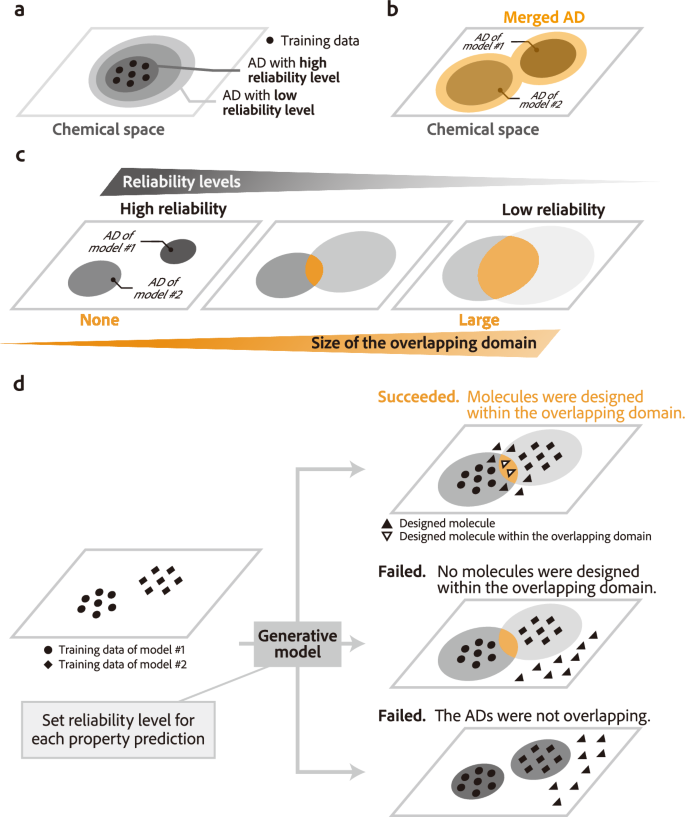
Molecular design using data-driven generative models has emerged as a promising technology, impacting various fields such as drug discovery and the development of functional materials. However, this approach is often susceptible to optimization failure due to reward hacking, where prediction models fail to extrapolate, i.e., fail to accurately predict properties for designed molecules that considerably deviate from the training data. While methods for estimating prediction reliability, such as the applicability domain (AD), have been used for mitigating reward hacking, multi-objective optimization makes it challenging. The difficulty arises from the need to determine in advance whether the multiple ADs with some reliability levels overlap in chemical space, and to appropriately adjust the reliability levels for each property prediction. Herein, we propose a reliable design framework to perform multi-objective optimization using generative models while preventing reward hacking. To demonstrate the effectiveness of the proposed framework, we designed candidates for anticancer drugs as a typical example of multi-objective optimization. We successfully designed molecules with high predicted values and reliabilities, including an approved drug. In addition, the reliability levels can be automatically adjusted according to the property prioritization specified by the user without any detailed settings.
使用数据驱动生成模型进行分子设计已成为一项前景广阔的技术,对药物发现和功能材料开发等多个领域产生了影响。然而,这种方法往往容易因奖励黑客(reward hacking)而导致优化失败,即预测模型无法推断,也就是无法准确预测与训练数据有很大偏差的设计分子的特性。虽然估算预测可靠性的方法(如适用域 (AD))已被用于减少奖励黑客,但多目标优化使其具有挑战性。困难在于需要事先确定具有某些可靠性水平的多个 AD 是否在化学空间中重叠,并适当调整每个属性预测的可靠性水平。在此,我们提出了一种可靠的设计框架,利用生成模型进行多目标优化,同时防止奖励黑客行为。为了证明所提框架的有效性,我们设计了抗癌候选药物,作为多目标优化的一个典型例子。我们成功设计出了预测值和可靠性都很高的分子,其中包括一种已获批准的药物。此外,可靠性水平可根据用户指定的属性优先级自动调整,无需任何详细设置。
期刊介绍:
Nature Communications, an open-access journal, publishes high-quality research spanning all areas of the natural sciences. Papers featured in the journal showcase significant advances relevant to specialists in each respective field. With a 2-year impact factor of 16.6 (2022) and a median time of 8 days from submission to the first editorial decision, Nature Communications is committed to rapid dissemination of research findings. As a multidisciplinary journal, it welcomes contributions from biological, health, physical, chemical, Earth, social, mathematical, applied, and engineering sciences, aiming to highlight important breakthroughs within each domain.



 京公网安备 11010802042870号
京ICP备2023020795号-1
京公网安备 11010802042870号
京ICP备2023020795号-1

 分享
分享
 求助内容:
求助内容: 应助结果提醒方式:
 扫码关注我们
