{"title":"Methane emissions from thermokarst lakes must emphasize the ice-melting impact on the Tibetan Plateau","authors":"Cuicui Mu, Pengsi Lei, Mei Mu, Chunling Zhang, Zhensong Zhou, Jinyue Song, Yunjie Jia, Chenyan Fan, Xiaoqing Peng, Guofei Zhang, Yuanhe Yang, Lei Wang, Dongfeng Li, Chunlin Song, Genxu Wang, Zhen Zhang","doi":"10.1038/s41467-025-57745-2","DOIUrl":null,"url":null,"abstract":"<p>Thermokarst lakes, serving as significant sources of methane (CH<sub>4</sub>), play a crucial role in affecting the feedback of permafrost carbon cycle to global warming. However, accurately assessing CH<sub>4</sub> emissions from these lakes remains challenging due to limited observations during lake ice melting periods. In this study, by integrating field surveys with machine learning modeling, we offer a comprehensive assessment of present and future CH<sub>4</sub> emissions from thermokarst lakes on the Tibetan Plateau. Our results reveal that the previously underestimated CH<sub>4</sub> release from lake ice bubble and water storage during ice melting periods is 11.2 ± 1.6 Gg C of CH<sub>4</sub>, accounting for 17 ± 4% of the annual total release from lakes. Despite thermokarst lakes cover only 0.2% of the permafrost area, they annually emit 65.5 ± 10.0 Gg C of CH<sub>4</sub>, which offsets 6.4% of the net carbon sink in alpine grasslands on the plateau. Considering the loss of lake ice, the expansion of thermokarst lakes is projected to lead to 1.1–1.2 folds increase in CH<sub>4</sub> emissions by 2100. Our study allows foreseeing future CH<sub>4</sub> emissions from the rapid expanding thermokarst lakes and sheds new lights on processes controlling the carbon-climate feedback in alpine permafrost ecosystems.</p>","PeriodicalId":19066,"journal":{"name":"Nature Communications","volume":"4 1","pages":""},"PeriodicalIF":15.7000,"publicationDate":"2025-03-11","publicationTypes":"Journal Article","fieldsOfStudy":null,"isOpenAccess":false,"openAccessPdf":"","citationCount":"0","resultStr":null,"platform":"Semanticscholar","paperid":null,"PeriodicalName":"Nature Communications","FirstCategoryId":"103","ListUrlMain":"https://doi.org/10.1038/s41467-025-57745-2","RegionNum":1,"RegionCategory":"综合性期刊","ArticlePicture":[],"TitleCN":null,"AbstractTextCN":null,"PMCID":null,"EPubDate":"","PubModel":"","JCR":"Q1","JCRName":"MULTIDISCIPLINARY SCIENCES","Score":null,"Total":0}
引用次数: 0
Abstract
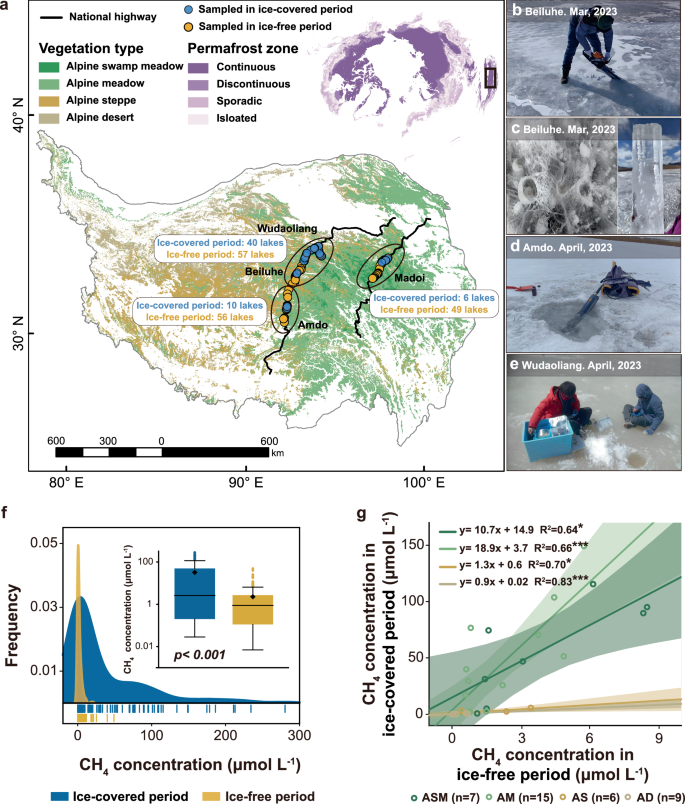
Thermokarst lakes, serving as significant sources of methane (CH4), play a crucial role in affecting the feedback of permafrost carbon cycle to global warming. However, accurately assessing CH4 emissions from these lakes remains challenging due to limited observations during lake ice melting periods. In this study, by integrating field surveys with machine learning modeling, we offer a comprehensive assessment of present and future CH4 emissions from thermokarst lakes on the Tibetan Plateau. Our results reveal that the previously underestimated CH4 release from lake ice bubble and water storage during ice melting periods is 11.2 ± 1.6 Gg C of CH4, accounting for 17 ± 4% of the annual total release from lakes. Despite thermokarst lakes cover only 0.2% of the permafrost area, they annually emit 65.5 ± 10.0 Gg C of CH4, which offsets 6.4% of the net carbon sink in alpine grasslands on the plateau. Considering the loss of lake ice, the expansion of thermokarst lakes is projected to lead to 1.1–1.2 folds increase in CH4 emissions by 2100. Our study allows foreseeing future CH4 emissions from the rapid expanding thermokarst lakes and sheds new lights on processes controlling the carbon-climate feedback in alpine permafrost ecosystems.
期刊介绍:
Nature Communications, an open-access journal, publishes high-quality research spanning all areas of the natural sciences. Papers featured in the journal showcase significant advances relevant to specialists in each respective field. With a 2-year impact factor of 16.6 (2022) and a median time of 8 days from submission to the first editorial decision, Nature Communications is committed to rapid dissemination of research findings. As a multidisciplinary journal, it welcomes contributions from biological, health, physical, chemical, Earth, social, mathematical, applied, and engineering sciences, aiming to highlight important breakthroughs within each domain.



 京公网安备 11010802042870号
京ICP备2023020795号-1
京公网安备 11010802042870号
京ICP备2023020795号-1

 分享
分享
 求助内容:
求助内容: 应助结果提醒方式:
 扫码关注我们
