{"title":"Target-Triggered Enzymatic Cascade LF-NMR Biosensor for the Detection of Circulating Tumor Cells","authors":"Fan Yang, Hao Tan, Tingting Hao, Hongtian Zeng, Lifen Long, Qingqing Zhang, Zhiyong Guo","doi":"10.1021/acs.analchem.4c06901","DOIUrl":null,"url":null,"abstract":"A target-triggered, enzymatic cascade-amplified low-field nuclear magnetic resonance (LF-NMR) sensor was developed for the detection of the circulating tumor cell (CTC) A549. A multifunctional two-dimensional bionanomaterial GDA@GOX&DNA1 was designed as the initiator, with Fe<sub>3</sub>O<sub>4</sub>@DNA2/Apt as the recognition unit and CaO<sub>2</sub>@MnO<sub>2</sub> as the signal unit. When A549 was present, the aptamer (Apt) detached from the recognition unit, allowing the formation of GDA@GOX&DNA1-DNA2@Fe<sub>3</sub>O<sub>4</sub> and triggering the following reactions: (1) glucose oxidase (GOX) catalyzed the reaction between the substrate glucose and oxygen (O<sub>2</sub>) to produce gluconic acid and hydrogen peroxide (H<sub>2</sub>O<sub>2</sub>); (2) the generated acid and H<sub>2</sub>O<sub>2</sub> reacted with MnO<sub>2</sub>, producing signal probes Mn<sup>2+</sup> and O<sub>2</sub>; and (3) CaO<sub>2</sub> reacted with the acid, generating H<sub>2</sub>O<sub>2</sub>. These cyclic reactions brought the generation of massive Mn<sup>2+</sup> and a decrease of the transverse relaxation time (<i>T</i><sub>2</sub>), resulting in a target-triggered, enzymatic cascade-amplified LF-NMR biosensing of CTCs. Under the optimal experimental conditions, the linear range and limit of detection (LOD) were 10–1.0 × 10<sup>6</sup> and 6 cells/mL, respectively. The feasibility and reliability in practical applications were verified by using spiked whole blood samples containing A549 cells. This study represents the first successful demonstration of an LF-NMR biosensor for the detection of intact CTCs, providing a new tool for clinical testing and diagnosis.","PeriodicalId":27,"journal":{"name":"Analytical Chemistry","volume":"1 1","pages":""},"PeriodicalIF":6.7000,"publicationDate":"2025-03-11","publicationTypes":"Journal Article","fieldsOfStudy":null,"isOpenAccess":false,"openAccessPdf":"","citationCount":"0","resultStr":null,"platform":"Semanticscholar","paperid":null,"PeriodicalName":"Analytical Chemistry","FirstCategoryId":"92","ListUrlMain":"https://doi.org/10.1021/acs.analchem.4c06901","RegionNum":1,"RegionCategory":"化学","ArticlePicture":[],"TitleCN":null,"AbstractTextCN":null,"PMCID":null,"EPubDate":"","PubModel":"","JCR":"Q1","JCRName":"CHEMISTRY, ANALYTICAL","Score":null,"Total":0}
引用次数: 0
Abstract
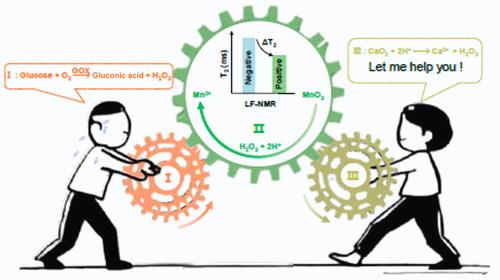
A target-triggered, enzymatic cascade-amplified low-field nuclear magnetic resonance (LF-NMR) sensor was developed for the detection of the circulating tumor cell (CTC) A549. A multifunctional two-dimensional bionanomaterial GDA@GOX&DNA1 was designed as the initiator, with Fe3O4@DNA2/Apt as the recognition unit and CaO2@MnO2 as the signal unit. When A549 was present, the aptamer (Apt) detached from the recognition unit, allowing the formation of GDA@GOX&DNA1-DNA2@Fe3O4 and triggering the following reactions: (1) glucose oxidase (GOX) catalyzed the reaction between the substrate glucose and oxygen (O2) to produce gluconic acid and hydrogen peroxide (H2O2); (2) the generated acid and H2O2 reacted with MnO2, producing signal probes Mn2+ and O2; and (3) CaO2 reacted with the acid, generating H2O2. These cyclic reactions brought the generation of massive Mn2+ and a decrease of the transverse relaxation time (T2), resulting in a target-triggered, enzymatic cascade-amplified LF-NMR biosensing of CTCs. Under the optimal experimental conditions, the linear range and limit of detection (LOD) were 10–1.0 × 10⁶ and 6 cells/mL, respectively. The feasibility and reliability in practical applications were verified by using spiked whole blood samples containing A549 cells. This study represents the first successful demonstration of an LF-NMR biosensor for the detection of intact CTCs, providing a new tool for clinical testing and diagnosis.
期刊介绍:
Analytical Chemistry, a peer-reviewed research journal, focuses on disseminating new and original knowledge across all branches of analytical chemistry. Fundamental articles may explore general principles of chemical measurement science and need not directly address existing or potential analytical methodology. They can be entirely theoretical or report experimental results. Contributions may cover various phases of analytical operations, including sampling, bioanalysis, electrochemistry, mass spectrometry, microscale and nanoscale systems, environmental analysis, separations, spectroscopy, chemical reactions and selectivity, instrumentation, imaging, surface analysis, and data processing. Papers discussing known analytical methods should present a significant, original application of the method, a notable improvement, or results on an important analyte.




 京公网安备 11010802042870号
京ICP备2023020795号-1
京公网安备 11010802042870号
京ICP备2023020795号-1

 分享
分享
 求助内容:
求助内容: 应助结果提醒方式:
 扫码关注我们
