Donglai Tian , Bin Huang , Huanghao Pan , Yanchen Deng , Guiyou Wang , Aiguo Hu
{"title":"Synthesis and crystallization-driven self-assembly of triblock copolymers based on narrowly distributed α,ω-bifunctionalized conjugated polymers†","authors":"Donglai Tian , Bin Huang , Huanghao Pan , Yanchen Deng , Guiyou Wang , Aiguo Hu","doi":"10.1039/d5py00053j","DOIUrl":null,"url":null,"abstract":"<div><div>Despite significant advancements in the synthesis of block copolymers featuring conjugated segments for crystallization-driven self-assembly (CDSA), the effective realization of functional systems remains to be limited to a select number of meticulously engineered conjugated polymers. Current methodologies for controlled/living chain-growth polymerization do not extend to a diverse array of conjugated polymer systems, as most are synthesized through step-growth polymerization techniques. To this end, this research introduces a novel approach for the synthesis of conjugated polymers <em>via</em> controlled step-growth polymerization, facilitating their application in synthesizing narrowly distributed triblock copolymers and further investigation in CDSA. The study demonstrates the formation of rod-like micelles when the conjugated segment exhibits crystallinity, and spherical micelles when the conjugated segment is noncrystalline. This method presents several advantages over traditional techniques, including a broader selection of monomers and streamlined post-processing procedures. Consequently, it holds the potential to incorporate a wider variety of conjugated polymer systems into CDSA, thereby broadening the range of possible applications.</div></div>","PeriodicalId":100,"journal":{"name":"Polymer Chemistry","volume":"16 15","pages":"Pages 1685-1691"},"PeriodicalIF":3.9000,"publicationDate":"2025-03-17","publicationTypes":"Journal Article","fieldsOfStudy":null,"isOpenAccess":false,"openAccessPdf":"","citationCount":"0","resultStr":null,"platform":"Semanticscholar","paperid":null,"PeriodicalName":"Polymer Chemistry","FirstCategoryId":"92","ListUrlMain":"https://www.sciencedirect.com/org/science/article/pii/S1759995425000981","RegionNum":2,"RegionCategory":"化学","ArticlePicture":[],"TitleCN":null,"AbstractTextCN":null,"PMCID":null,"EPubDate":"2025/3/11 0:00:00","PubModel":"Epub","JCR":"Q2","JCRName":"POLYMER SCIENCE","Score":null,"Total":0}
引用次数: 0
Abstract
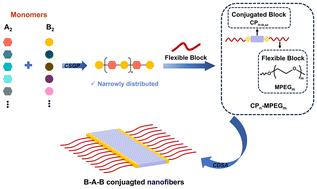
Despite significant advancements in the synthesis of block copolymers featuring conjugated segments for crystallization-driven self-assembly (CDSA), the effective realization of functional systems remains to be limited to a select number of meticulously engineered conjugated polymers. Current methodologies for controlled/living chain-growth polymerization do not extend to a diverse array of conjugated polymer systems, as most are synthesized through step-growth polymerization techniques. To this end, this research introduces a novel approach for the synthesis of conjugated polymers via controlled step-growth polymerization, facilitating their application in synthesizing narrowly distributed triblock copolymers and further investigation in CDSA. The study demonstrates the formation of rod-like micelles when the conjugated segment exhibits crystallinity, and spherical micelles when the conjugated segment is noncrystalline. This method presents several advantages over traditional techniques, including a broader selection of monomers and streamlined post-processing procedures. Consequently, it holds the potential to incorporate a wider variety of conjugated polymer systems into CDSA, thereby broadening the range of possible applications.
期刊介绍:
Polymer Chemistry welcomes submissions in all areas of polymer science that have a strong focus on macromolecular chemistry. Manuscripts may cover a broad range of fields, yet no direct application focus is required.



 京公网安备 11010802042870号
京ICP备2023020795号-1
京公网安备 11010802042870号
京ICP备2023020795号-1

 分享
分享
 求助内容:
求助内容: 应助结果提醒方式:
 扫码关注我们
