Chen-Yang Nie, Li-Jun Xue, Shao-Dan Wang, Meng-Yuan Li, Qian Kang and Li-Li Wen
{"title":"Isomorphic BODIPY-based metal–organic frameworks for high-efficiency photoredox organic transformations†","authors":"Chen-Yang Nie, Li-Jun Xue, Shao-Dan Wang, Meng-Yuan Li, Qian Kang and Li-Li Wen","doi":"10.1039/D4QI03324H","DOIUrl":null,"url":null,"abstract":"<p >Metal–organic frameworks (MOFs) are emerging as promising photocatalysts for effective organic transformation owing to their tunable energy band structures and excellent visible-light absorption ability. In this work, two novel isostructural BODIPY-based MOFs, [Zn<small><sub>2</sub></small>(BODIPY)(TTFTB)] (<strong>1</strong>) and [Co<small><sub>2</sub></small>(BODIPY)(TTFTB)] (<strong>2</strong>), with different center metals were successfully constructed from pyridine-functionalized boron dipyrromethene (BODIPY) and tetrathiafulvalene-3,4,5,6-tetrakis(4-benzoic acid) (H<small><sub>4</sub></small>TTFTB) linkers. Compounds <strong>1</strong> and <strong>2</strong> exhibited excellent light adsorption and were applied as effective heterogeneous photocatalysts toward the dehalogenation of α-bromoacetophenone and oxidation of thiols. In particular, compound <strong>1</strong> exhibited superior performance compared to compound <strong>2</strong> in the photoreductive dehalogenation of α-bromoacetophenone, which could be attributed to the accelerated charge transfer and more negative LUMO potential with a stronger reduction ability. Of note, the TOF of compound <strong>1</strong> for photoreductive dehalogenation of α-bromoacetophenone, 133.33 mmol g<small><sup>−1</sup></small> h<small><sup>−1</sup></small>, up to the highest among reported works. In contrast, owing to its higher HOMO potential, compound <strong>2</strong> achieved enhanced photocatalytic properties for the oxidation of thiols than compound <strong>1</strong>. Further investigation of the underlying mechanism demonstrated that photogenerated electrons and α-carbonyl radicals play vital roles in the photoreductive dehalogenation of α-bromoacetophenone, while the superoxide radical (O<small><sub>2</sub></small>˙<small><sup>−</sup></small>) serves as the main active species for the oxidation of thiols by charge transfer processes. Moreover, this research provides further insights into designing high-efficiency MOFs for photoredox organic transformations through band structure manipulation <em>via</em> a metal center modulation strategy.</p>","PeriodicalId":79,"journal":{"name":"Inorganic Chemistry Frontiers","volume":" 9","pages":" 3521-3530"},"PeriodicalIF":6.4000,"publicationDate":"2025-03-11","publicationTypes":"Journal Article","fieldsOfStudy":null,"isOpenAccess":false,"openAccessPdf":"","citationCount":"0","resultStr":null,"platform":"Semanticscholar","paperid":null,"PeriodicalName":"Inorganic Chemistry Frontiers","FirstCategoryId":"92","ListUrlMain":"https://pubs.rsc.org/en/content/articlelanding/2025/qi/d4qi03324h","RegionNum":1,"RegionCategory":"化学","ArticlePicture":[],"TitleCN":null,"AbstractTextCN":null,"PMCID":null,"EPubDate":"","PubModel":"","JCR":"Q1","JCRName":"CHEMISTRY, INORGANIC & NUCLEAR","Score":null,"Total":0}
引用次数: 0
Abstract
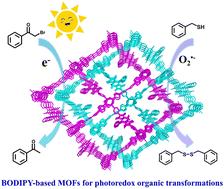
Metal–organic frameworks (MOFs) are emerging as promising photocatalysts for effective organic transformation owing to their tunable energy band structures and excellent visible-light absorption ability. In this work, two novel isostructural BODIPY-based MOFs, [Zn2(BODIPY)(TTFTB)] (1) and [Co2(BODIPY)(TTFTB)] (2), with different center metals were successfully constructed from pyridine-functionalized boron dipyrromethene (BODIPY) and tetrathiafulvalene-3,4,5,6-tetrakis(4-benzoic acid) (H4TTFTB) linkers. Compounds 1 and 2 exhibited excellent light adsorption and were applied as effective heterogeneous photocatalysts toward the dehalogenation of α-bromoacetophenone and oxidation of thiols. In particular, compound 1 exhibited superior performance compared to compound 2 in the photoreductive dehalogenation of α-bromoacetophenone, which could be attributed to the accelerated charge transfer and more negative LUMO potential with a stronger reduction ability. Of note, the TOF of compound 1 for photoreductive dehalogenation of α-bromoacetophenone, 133.33 mmol g−1 h−1, up to the highest among reported works. In contrast, owing to its higher HOMO potential, compound 2 achieved enhanced photocatalytic properties for the oxidation of thiols than compound 1. Further investigation of the underlying mechanism demonstrated that photogenerated electrons and α-carbonyl radicals play vital roles in the photoreductive dehalogenation of α-bromoacetophenone, while the superoxide radical (O2˙−) serves as the main active species for the oxidation of thiols by charge transfer processes. Moreover, this research provides further insights into designing high-efficiency MOFs for photoredox organic transformations through band structure manipulation via a metal center modulation strategy.




 京公网安备 11010802042870号
京ICP备2023020795号-1
京公网安备 11010802042870号
京ICP备2023020795号-1

 分享
分享
 求助内容:
求助内容: 应助结果提醒方式:
 扫码关注我们
