Baptiste Chartier, Alexei Grichine, Lucile Bridou, Adam Nhari, Guillaume Micouin, Akos Banyasz, Didier Boturyn, Jennifer K. Molloy, Sule Erbek, Véronique Martel-Frachet, Olivier Maury and Olivier Sénèque
{"title":"Amido/alkoxy–aryl–aryl–picolinate push–pull antennas for two-photon sensitization of Eu3+ luminescence†","authors":"Baptiste Chartier, Alexei Grichine, Lucile Bridou, Adam Nhari, Guillaume Micouin, Akos Banyasz, Didier Boturyn, Jennifer K. Molloy, Sule Erbek, Véronique Martel-Frachet, Olivier Maury and Olivier Sénèque","doi":"10.1039/D5QI00333D","DOIUrl":null,"url":null,"abstract":"<p >Luminescent two-photon (2P) absorbing lanthanide(<small>III</small>) complexes hold great promise for microsocpy imaging of biological samples. Conjugating such a complex to well-chosen cell penetrating peptides (CPP) allows its controlled delivery to the cytosol of live cells. However, alkoxy–phenyl–ethynyl–picolinate, one of the best antennae for 2P sensitization of Eu<small><sup>3+</sup></small>, undergoes side reactions at its ethynyl group during peptide synthesis or in biological media and thus cannot be used to create such a conjugate. In this article, we evaluate the effect of substituting the ethynyl group by a phenyl one. We describe the synthesis of conjugates of the TAT CPP with Eu<small><sup>3+</sup></small> complexes featuring amido–phenyl–phenyl–picolinamide, alkoxy–phenyl–phenyl–picolinamide and amido–phenyl–phenyl–picolinate ter-aryl antennae and compare their spectroscopic properties to those of analogues with bi-aryl antennae, including the amido–phenyl–picolinamide already used for 2P live cell imaging. The absorption spectrum of the ter-aryl antennae is red-shifted and better covers the active spectral range for 2P excitation by a Ti-sapphire laser. Among compounds with ter-aryl antennae, those with an amido electron donating group are the most interesting, showing brightness <em>ca.</em> 4 times higher than their bi-aryl counterparts, and similar to the ethynyl-containing antenna. 2P microscopy imaging of live cells incubated with the TAT-Eu<small><sup>3+</sup></small> conjugate and dFFLIPTAT, a non-luminescent CPP that promotes cytosolic delivery, showed diffuse cytosolic staining of the Eu<small><sup>3+</sup></small> probe. The ter-aryl-based probes showed superior performances compared to bi-aryl, with <em>ca.</em> 80% of the cells showing Eu<small><sup>3+</sup></small> staining of the cytosol.</p>","PeriodicalId":79,"journal":{"name":"Inorganic Chemistry Frontiers","volume":" 8","pages":" 3313-3323"},"PeriodicalIF":6.4000,"publicationDate":"2025-03-10","publicationTypes":"Journal Article","fieldsOfStudy":null,"isOpenAccess":false,"openAccessPdf":"https://pubs.rsc.org/en/content/articlepdf/2025/qi/d5qi00333d?page=search","citationCount":"0","resultStr":null,"platform":"Semanticscholar","paperid":null,"PeriodicalName":"Inorganic Chemistry Frontiers","FirstCategoryId":"92","ListUrlMain":"https://pubs.rsc.org/en/content/articlelanding/2025/qi/d5qi00333d","RegionNum":1,"RegionCategory":"化学","ArticlePicture":[],"TitleCN":null,"AbstractTextCN":null,"PMCID":null,"EPubDate":"","PubModel":"","JCR":"Q1","JCRName":"CHEMISTRY, INORGANIC & NUCLEAR","Score":null,"Total":0}
引用次数: 0
Abstract
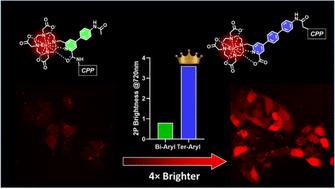
Luminescent two-photon (2P) absorbing lanthanide(III) complexes hold great promise for microsocpy imaging of biological samples. Conjugating such a complex to well-chosen cell penetrating peptides (CPP) allows its controlled delivery to the cytosol of live cells. However, alkoxy–phenyl–ethynyl–picolinate, one of the best antennae for 2P sensitization of Eu3+, undergoes side reactions at its ethynyl group during peptide synthesis or in biological media and thus cannot be used to create such a conjugate. In this article, we evaluate the effect of substituting the ethynyl group by a phenyl one. We describe the synthesis of conjugates of the TAT CPP with Eu3+ complexes featuring amido–phenyl–phenyl–picolinamide, alkoxy–phenyl–phenyl–picolinamide and amido–phenyl–phenyl–picolinate ter-aryl antennae and compare their spectroscopic properties to those of analogues with bi-aryl antennae, including the amido–phenyl–picolinamide already used for 2P live cell imaging. The absorption spectrum of the ter-aryl antennae is red-shifted and better covers the active spectral range for 2P excitation by a Ti-sapphire laser. Among compounds with ter-aryl antennae, those with an amido electron donating group are the most interesting, showing brightness ca. 4 times higher than their bi-aryl counterparts, and similar to the ethynyl-containing antenna. 2P microscopy imaging of live cells incubated with the TAT-Eu3+ conjugate and dFFLIPTAT, a non-luminescent CPP that promotes cytosolic delivery, showed diffuse cytosolic staining of the Eu3+ probe. The ter-aryl-based probes showed superior performances compared to bi-aryl, with ca. 80% of the cells showing Eu3+ staining of the cytosol.




 京公网安备 11010802042870号
京ICP备2023020795号-1
京公网安备 11010802042870号
京ICP备2023020795号-1

 分享
分享
 求助内容:
求助内容: 应助结果提醒方式:
 扫码关注我们
