Xuanchen Liu , Mo Wang , Bin Xu , Xue Ma , Yangzi Jiang , Hai Huang , Zengzeng Shi , Hao Wu , Zhigang Wu , Shuo Guo , Jungang Zhao , Jian Zhao , Xiaokang Li , Li Liang , Zheng Guo , Lei Shi , Chao Sun , Ning Wang
{"title":"Discovery and identification of semaphorin 4D as a bioindicator of high fracture incidence in type 2 diabetic mice with glucose control","authors":"Xuanchen Liu , Mo Wang , Bin Xu , Xue Ma , Yangzi Jiang , Hai Huang , Zengzeng Shi , Hao Wu , Zhigang Wu , Shuo Guo , Jungang Zhao , Jian Zhao , Xiaokang Li , Li Liang , Zheng Guo , Lei Shi , Chao Sun , Ning Wang","doi":"10.1016/j.jare.2025.03.014","DOIUrl":null,"url":null,"abstract":"<div><h3>Introduction</h3><div>Bone fracture is increasing in patients with type 2 diabetes mellitus (T2DM) due to skeletal fragility. Most antidiabetics are expected to reduce the incidence of fracture in patients with T2DM, however the results are disappointing. Metformin and GLP-1 receptor agonists have a neutral or minor positive effect in reducing fractures.</div></div><div><h3>Objectives</h3><div>We aim to reveal the mechanism of fracture in patients with T2DM treated with metformin or exendin-4, explore the key regulators responsible for bone fragility in T2DM.</div></div><div><h3>Methods</h3><div>Trabecular and cortical masses in mice with T2DM were analyzed using micro-computed tomography. Biomechanical strength of bone was determined according to three-point bending, and the expression of bone-associated factors was examined with enzyme-linked immunosorbent assays. Important proteins and miRNAs were identified using proteomics analysis and deep screening analysis. Lastly, immunoprecipitation–mass spectrometry and dual–luciferase reporter analysis were used to identify key molecular signals.</div></div><div><h3>Results</h3><div>We found that sermaphorin 4D (Sema4D) is the key regulator of bone fragility in T2DM. Exendin-4 increased the biomechanical properties of bone by decreasing serum Sema4D levels, and metformin has little effect on Sema4D. Anti-sema4D treatment could improve bone strength in T2DM mice compared with metformin or exendin-4. The biomechanical properties of bone were comparable between anti-Sema 4D and the combination of metformin and exendin-4. Exendin-4 promoted osteogenesis of BMSCs by activating CRMP2 to reverse the effect of sema4D. Metformin increased miR-140-3p levels, which decreased plexin B1 expression in bone mesenchymal stem cells. Metformin increased the effect of exendin-4 with more GLP-1 receptor expression to increase the biomechanical strength of bone via miR-140-3p-STAT3-miR-3657 signaling.</div></div><div><h3>Conclusion</h3><div>Blood glucose level is not the major factor contributing to impairment in bone remodeling. Sema4D is responsible for the increase in the incidence of bone fractures in T2DM. Accordingly, we proposed an effective therapeutic strategy to eliminate the effect of sema4D.</div></div>","PeriodicalId":14952,"journal":{"name":"Journal of Advanced Research","volume":"79 ","pages":"Pages 179-195"},"PeriodicalIF":13.0000,"publicationDate":"2025-03-10","publicationTypes":"Journal Article","fieldsOfStudy":null,"isOpenAccess":false,"openAccessPdf":"","citationCount":"0","resultStr":null,"platform":"Semanticscholar","paperid":null,"PeriodicalName":"Journal of Advanced Research","FirstCategoryId":"103","ListUrlMain":"https://www.sciencedirect.com/science/article/pii/S2090123225001742","RegionNum":1,"RegionCategory":"综合性期刊","ArticlePicture":[],"TitleCN":null,"AbstractTextCN":null,"PMCID":null,"EPubDate":"","PubModel":"","JCR":"Q1","JCRName":"MULTIDISCIPLINARY SCIENCES","Score":null,"Total":0}
引用次数: 0
Abstract
Introduction
Bone fracture is increasing in patients with type 2 diabetes mellitus (T2DM) due to skeletal fragility. Most antidiabetics are expected to reduce the incidence of fracture in patients with T2DM, however the results are disappointing. Metformin and GLP-1 receptor agonists have a neutral or minor positive effect in reducing fractures.
Objectives
We aim to reveal the mechanism of fracture in patients with T2DM treated with metformin or exendin-4, explore the key regulators responsible for bone fragility in T2DM.
Methods
Trabecular and cortical masses in mice with T2DM were analyzed using micro-computed tomography. Biomechanical strength of bone was determined according to three-point bending, and the expression of bone-associated factors was examined with enzyme-linked immunosorbent assays. Important proteins and miRNAs were identified using proteomics analysis and deep screening analysis. Lastly, immunoprecipitation–mass spectrometry and dual–luciferase reporter analysis were used to identify key molecular signals.
Results
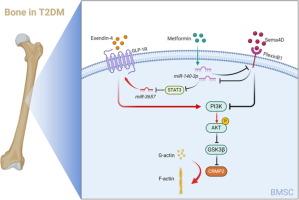
We found that sermaphorin 4D (Sema4D) is the key regulator of bone fragility in T2DM. Exendin-4 increased the biomechanical properties of bone by decreasing serum Sema4D levels, and metformin has little effect on Sema4D. Anti-sema4D treatment could improve bone strength in T2DM mice compared with metformin or exendin-4. The biomechanical properties of bone were comparable between anti-Sema 4D and the combination of metformin and exendin-4. Exendin-4 promoted osteogenesis of BMSCs by activating CRMP2 to reverse the effect of sema4D. Metformin increased miR-140-3p levels, which decreased plexin B1 expression in bone mesenchymal stem cells. Metformin increased the effect of exendin-4 with more GLP-1 receptor expression to increase the biomechanical strength of bone via miR-140-3p-STAT3-miR-3657 signaling.
Conclusion
Blood glucose level is not the major factor contributing to impairment in bone remodeling. Sema4D is responsible for the increase in the incidence of bone fractures in T2DM. Accordingly, we proposed an effective therapeutic strategy to eliminate the effect of sema4D.
期刊介绍:
Journal of Advanced Research (J. Adv. Res.) is an applied/natural sciences, peer-reviewed journal that focuses on interdisciplinary research. The journal aims to contribute to applied research and knowledge worldwide through the publication of original and high-quality research articles in the fields of Medicine, Pharmaceutical Sciences, Dentistry, Physical Therapy, Veterinary Medicine, and Basic and Biological Sciences.
The following abstracting and indexing services cover the Journal of Advanced Research: PubMed/Medline, Essential Science Indicators, Web of Science, Scopus, PubMed Central, PubMed, Science Citation Index Expanded, Directory of Open Access Journals (DOAJ), and INSPEC.



 京公网安备 11010802042870号
京ICP备2023020795号-1
京公网安备 11010802042870号
京ICP备2023020795号-1

 分享
分享
 求助内容:
求助内容: 应助结果提醒方式:
 扫码关注我们
