Ruicheng Li, Keisuke Maeda, Keisuke Kameda, Manabu Ihara and Sergei Manzhos
{"title":"Exploring the electronic properties of carbon nanoflake-based charge transport materials for perovskite solar cells: a computational study†","authors":"Ruicheng Li, Keisuke Maeda, Keisuke Kameda, Manabu Ihara and Sergei Manzhos","doi":"10.1039/D4CP04608K","DOIUrl":null,"url":null,"abstract":"<p >Carbon-based materials, in particular carbon nanoflakes (CNFs) and carbon quantum dots (CQDs), have been increasingly used in charge transport layers and electrodes for perovskite solar cells (PSCs). There are practically limitless possibilities of designing such materials with different sizes, shapes and functional groups, which allow modulating their properties such as band alignment and charge transport. Solid state packing further modifies these properties. However, there is still limited insight into the electronic properties of these types of materials as a function of their chemical composition, structure, and packing. Here, we compute the dependence of band alignment and charge transport characteristics on the size, chemical composition, and structure of commonly accessible types of nanoflakes and functional groups and further consider the effect of their packing. We use a combination of density functional theory (DFT) and density functional-based tight binding (DFTB) to get electronic structure level insight at length scales (nanoflake sizes) relevant to the experiment. We find that CNFs must have sizes as small as 1.3 nm to provide band alignments suitable for their use as hole transport materials in PSCs containing the commonly used methylammonium lead iodide perovskite. We show that both shape and functionalization can significantly modify the band alignment of the CNF, by more than half an electron volt. Inter-flake interactions further modify the band alignment, in some cases by about half an electron volt. CNFs having small sizes possess sufficient inter-flake electronic coupling for efficient hole transport. In contrast, no shape or size of CNFs produces band alignment suitable for their use as electron transport materials.</p>","PeriodicalId":99,"journal":{"name":"Physical Chemistry Chemical Physics","volume":" 15","pages":" 7611-7628"},"PeriodicalIF":2.9000,"publicationDate":"2025-03-11","publicationTypes":"Journal Article","fieldsOfStudy":null,"isOpenAccess":false,"openAccessPdf":"","citationCount":"0","resultStr":null,"platform":"Semanticscholar","paperid":null,"PeriodicalName":"Physical Chemistry Chemical Physics","FirstCategoryId":"92","ListUrlMain":"https://pubs.rsc.org/en/content/articlelanding/2025/cp/d4cp04608k","RegionNum":3,"RegionCategory":"化学","ArticlePicture":[],"TitleCN":null,"AbstractTextCN":null,"PMCID":null,"EPubDate":"","PubModel":"","JCR":"Q3","JCRName":"CHEMISTRY, PHYSICAL","Score":null,"Total":0}
引用次数: 0
Abstract
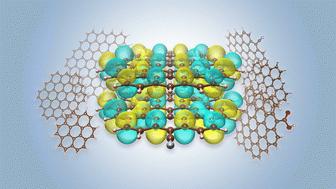
Carbon-based materials, in particular carbon nanoflakes (CNFs) and carbon quantum dots (CQDs), have been increasingly used in charge transport layers and electrodes for perovskite solar cells (PSCs). There are practically limitless possibilities of designing such materials with different sizes, shapes and functional groups, which allow modulating their properties such as band alignment and charge transport. Solid state packing further modifies these properties. However, there is still limited insight into the electronic properties of these types of materials as a function of their chemical composition, structure, and packing. Here, we compute the dependence of band alignment and charge transport characteristics on the size, chemical composition, and structure of commonly accessible types of nanoflakes and functional groups and further consider the effect of their packing. We use a combination of density functional theory (DFT) and density functional-based tight binding (DFTB) to get electronic structure level insight at length scales (nanoflake sizes) relevant to the experiment. We find that CNFs must have sizes as small as 1.3 nm to provide band alignments suitable for their use as hole transport materials in PSCs containing the commonly used methylammonium lead iodide perovskite. We show that both shape and functionalization can significantly modify the band alignment of the CNF, by more than half an electron volt. Inter-flake interactions further modify the band alignment, in some cases by about half an electron volt. CNFs having small sizes possess sufficient inter-flake electronic coupling for efficient hole transport. In contrast, no shape or size of CNFs produces band alignment suitable for their use as electron transport materials.
期刊介绍:
Physical Chemistry Chemical Physics (PCCP) is an international journal co-owned by 19 physical chemistry and physics societies from around the world. This journal publishes original, cutting-edge research in physical chemistry, chemical physics and biophysical chemistry. To be suitable for publication in PCCP, articles must include significant innovation and/or insight into physical chemistry; this is the most important criterion that reviewers and Editors will judge against when evaluating submissions.
The journal has a broad scope and welcomes contributions spanning experiment, theory, computation and data science. Topical coverage includes spectroscopy, dynamics, kinetics, statistical mechanics, thermodynamics, electrochemistry, catalysis, surface science, quantum mechanics, quantum computing and machine learning. Interdisciplinary research areas such as polymers and soft matter, materials, nanoscience, energy, surfaces/interfaces, and biophysical chemistry are welcomed if they demonstrate significant innovation and/or insight into physical chemistry. Joined experimental/theoretical studies are particularly appreciated when complementary and based on up-to-date approaches.




 京公网安备 11010802042870号
京ICP备2023020795号-1
京公网安备 11010802042870号
京ICP备2023020795号-1

 分享
分享
 求助内容:
求助内容: 应助结果提醒方式:
 扫码关注我们
