{"title":"FLZ attenuates Parkinson's disease pathological damage by increasing glycoursodeoxycholic acid production via down-regulating Clostridium innocuum","authors":"Meiyu Shang, Jingwen Ning, Caixia Zang, Jingwei Ma, Yang Yang, Yueqi Jiang, Qiuzhu Chen, Yirong Dong, Jinrong Wang, Fangfang Li, Xiuqi Bao, Dan Zhang","doi":"10.1016/j.apsb.2024.10.011","DOIUrl":null,"url":null,"abstract":"<div><div>Increasing evidence shows that the early lesions of Parkinson's disease (PD) originate from gut, and correction of microbiota dysbiosis is a promising therapy for PD. FLZ is a neuroprotective agent on PD, which has been validated capable of alleviating microbiota dysbiosis in PD mice. However, the detailed mechanisms still need elucidated. Through metabolomics and 16S rRNA analysis, we identified glycoursodeoxycholic acid (GUDCA) was the most affected differential microbial metabolite by FLZ treatment, which was specially and negatively regulated by <em>Clostridium innocuum</em>, a differential microbiota with the strongest correlation to GUDCA production, through inhibiting bile salt hydrolase (BSH) enzyme. The protection of GUDCA on colon and brain were also clarified in PD models, showing that it could activate Nrf2 pathway, further validating that FLZ protected dopaminergic neurons through promoting GUDCA production. Our study uncovered that FLZ improved PD through microbiota–gut–brain axis, and also gave insights into modulation of microbial metabolites may serve as an important strategy for treating PD.</div></div>","PeriodicalId":6906,"journal":{"name":"Acta Pharmaceutica Sinica. B","volume":"15 2","pages":"Pages 973-990"},"PeriodicalIF":14.6000,"publicationDate":"2025-02-01","publicationTypes":"Journal Article","fieldsOfStudy":null,"isOpenAccess":false,"openAccessPdf":"","citationCount":"0","resultStr":null,"platform":"Semanticscholar","paperid":null,"PeriodicalName":"Acta Pharmaceutica Sinica. B","FirstCategoryId":"92","ListUrlMain":"https://www.sciencedirect.com/science/article/pii/S221138352400412X","RegionNum":1,"RegionCategory":"医学","ArticlePicture":[],"TitleCN":null,"AbstractTextCN":null,"PMCID":null,"EPubDate":"2024/10/30 0:00:00","PubModel":"Epub","JCR":"Q1","JCRName":"PHARMACOLOGY & PHARMACY","Score":null,"Total":0}
引用次数: 0
Abstract
Increasing evidence shows that the early lesions of Parkinson's disease (PD) originate from gut, and correction of microbiota dysbiosis is a promising therapy for PD. FLZ is a neuroprotective agent on PD, which has been validated capable of alleviating microbiota dysbiosis in PD mice. However, the detailed mechanisms still need elucidated. Through metabolomics and 16S rRNA analysis, we identified glycoursodeoxycholic acid (GUDCA) was the most affected differential microbial metabolite by FLZ treatment, which was specially and negatively regulated by Clostridium innocuum, a differential microbiota with the strongest correlation to GUDCA production, through inhibiting bile salt hydrolase (BSH) enzyme. The protection of GUDCA on colon and brain were also clarified in PD models, showing that it could activate Nrf2 pathway, further validating that FLZ protected dopaminergic neurons through promoting GUDCA production. Our study uncovered that FLZ improved PD through microbiota–gut–brain axis, and also gave insights into modulation of microbial metabolites may serve as an important strategy for treating PD.
Acta Pharmaceutica Sinica. BPharmacology, Toxicology and Pharmaceutics-General Pharmacology, Toxicology and Pharmaceutics
CiteScore
22.40
自引率
5.50%
发文量
1051
审稿时长
19 weeks
期刊介绍:
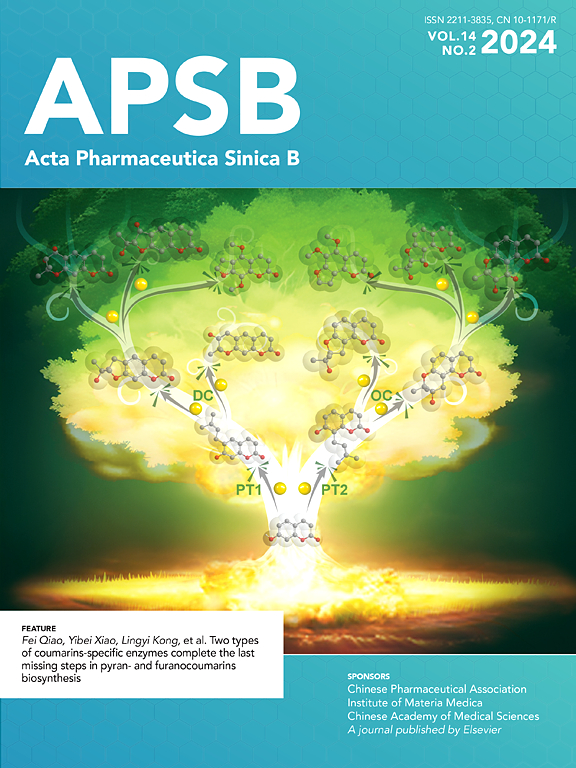
The Journal of the Institute of Materia Medica, Chinese Academy of Medical Sciences, and the Chinese Pharmaceutical Association oversees the peer review process for Acta Pharmaceutica Sinica. B (APSB).
Published monthly in English, APSB is dedicated to disseminating significant original research articles, rapid communications, and high-quality reviews that highlight recent advances across various pharmaceutical sciences domains. These encompass pharmacology, pharmaceutics, medicinal chemistry, natural products, pharmacognosy, pharmaceutical analysis, and pharmacokinetics.
A part of the Acta Pharmaceutica Sinica series, established in 1953 and indexed in prominent databases like Chemical Abstracts, Index Medicus, SciFinder Scholar, Biological Abstracts, International Pharmaceutical Abstracts, Cambridge Scientific Abstracts, and Current Bibliography on Science and Technology, APSB is sponsored by the Institute of Materia Medica, Chinese Academy of Medical Sciences, and the Chinese Pharmaceutical Association. Its production and hosting are facilitated by Elsevier B.V. This collaborative effort ensures APSB's commitment to delivering valuable contributions to the pharmaceutical sciences community.




 京公网安备 11010802042870号
京ICP备2023020795号-1
京公网安备 11010802042870号
京ICP备2023020795号-1

 分享
分享
 求助内容:
求助内容: 应助结果提醒方式:
 扫码关注我们
