Sudip Das, Mackenzie Meyer, Mark J. Kushner and Ryan L. Hartman
{"title":"Ignition of non-equilibrium methane dielectric barrier discharges in a multiphase plasma–liquid microfluidic device†","authors":"Sudip Das, Mackenzie Meyer, Mark J. Kushner and Ryan L. Hartman","doi":"10.1039/D5LC00090D","DOIUrl":null,"url":null,"abstract":"<p >Atmospheric pressure plasma conversion of methane is usually addressed in gas-only systems, such as dry reforming of methane. Introducing a liquid in such a system enables direct utilization of plasma-produced radicals, such as methyl (CH<small><sub>3</sub></small>), as a reactant in the liquid. Methylation of organic liquids by this technique can lead to the sustainable production of high-value products. A dielectric-barrier-discharge (DBD) microfluidic reactor having a 500 μm × 500 μm cross-section was developed to investigate the characteristics of methane-containing atmospheric pressure plasmas in contact with organic solvents. The sensors included optical emission spectroscopy and chip surface temperature measurement to estimate and predict plasma initiation in these methane-containing systems and provide insights into the plasma–liquid interfacial behavior. Fluids having high liquid hold-up, low boiling point, and low dielectric constant have been found to have adverse effects on non-equilibrium DBD methane plasma ignition.</p>","PeriodicalId":85,"journal":{"name":"Lab on a Chip","volume":" 9","pages":" 2182-2192"},"PeriodicalIF":5.4000,"publicationDate":"2025-03-06","publicationTypes":"Journal Article","fieldsOfStudy":null,"isOpenAccess":false,"openAccessPdf":"","citationCount":"0","resultStr":null,"platform":"Semanticscholar","paperid":null,"PeriodicalName":"Lab on a Chip","FirstCategoryId":"5","ListUrlMain":"https://pubs.rsc.org/en/content/articlelanding/2025/lc/d5lc00090d","RegionNum":2,"RegionCategory":"工程技术","ArticlePicture":[],"TitleCN":null,"AbstractTextCN":null,"PMCID":null,"EPubDate":"","PubModel":"","JCR":"Q1","JCRName":"BIOCHEMICAL RESEARCH METHODS","Score":null,"Total":0}
引用次数: 0
Abstract
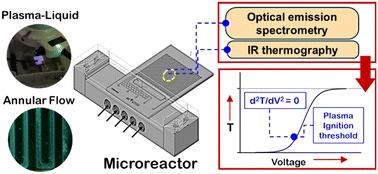
Atmospheric pressure plasma conversion of methane is usually addressed in gas-only systems, such as dry reforming of methane. Introducing a liquid in such a system enables direct utilization of plasma-produced radicals, such as methyl (CH3), as a reactant in the liquid. Methylation of organic liquids by this technique can lead to the sustainable production of high-value products. A dielectric-barrier-discharge (DBD) microfluidic reactor having a 500 μm × 500 μm cross-section was developed to investigate the characteristics of methane-containing atmospheric pressure plasmas in contact with organic solvents. The sensors included optical emission spectroscopy and chip surface temperature measurement to estimate and predict plasma initiation in these methane-containing systems and provide insights into the plasma–liquid interfacial behavior. Fluids having high liquid hold-up, low boiling point, and low dielectric constant have been found to have adverse effects on non-equilibrium DBD methane plasma ignition.
期刊介绍:
Lab on a Chip is the premiere journal that publishes cutting-edge research in the field of miniaturization. By their very nature, microfluidic/nanofluidic/miniaturized systems are at the intersection of disciplines, spanning fundamental research to high-end application, which is reflected by the broad readership of the journal. Lab on a Chip publishes two types of papers on original research: full-length research papers and communications. Papers should demonstrate innovations, which can come from technical advancements or applications addressing pressing needs in globally important areas. The journal also publishes Comments, Reviews, and Perspectives.



 京公网安备 11010802042870号
京ICP备2023020795号-1
京公网安备 11010802042870号
京ICP备2023020795号-1

 分享
分享
 求助内容:
求助内容: 应助结果提醒方式:
 扫码关注我们
