Headspace Injection Method for Intermittent Sampling and Profiling Analyses of Volatile Organic Compounds Using Dielectric Barrier Discharge Ionization (DBDI).
Daniel Heffernan, Frederik Oleinek, Ayla Schueler, Paak Wai Lau, Jürgen Kudermann, Alina Meindl, Mathias O Senge, Nicole Strittmatter
{"title":"Headspace Injection Method for Intermittent Sampling and Profiling Analyses of Volatile Organic Compounds Using Dielectric Barrier Discharge Ionization (DBDI).","authors":"Daniel Heffernan, Frederik Oleinek, Ayla Schueler, Paak Wai Lau, Jürgen Kudermann, Alina Meindl, Mathias O Senge, Nicole Strittmatter","doi":"10.1021/jasms.4c00475","DOIUrl":null,"url":null,"abstract":"<p><p>A direct headspace injection method is presented and optimized for the analysis of volatile organic compounds (VOCs) using dielectric barrier discharge ionization-mass spectrometry (DBDI-MS), incorporating an intermediate vial in which the sample headspace is injected. The setup is built of commonly available, cheap consumable parts and easily enables the incorporation of different gases for generating different ionization atmospheres. The method can be fully automated by using standard GC autosamplers, and its rapid analysis time is suitable for high-throughput applications. We show that this method is suitable for both profiling analysis of complex samples such as biofluids and quantitative measurements for real-time reaction monitoring. Our optimized method demonstrated improved reproducibility and sensitivity, with detection limits for compounds tested in the high nanomolar to the low micromolar range, depending on the compound. Key parameters for method optimization were identified such as sample vial volume, headspace-to-liquid ratio, incubation temperature, and equilibration time. These settings were systematically evaluated to maximize the signal intensity and improve repeatability between measurements. Two use cases are demonstrated: (i) quantitative measurement of ethanol production by a metal-organic framework from CO<sub>2</sub> and (ii) profiling of biofluids following the consumption of asparagus.</p>","PeriodicalId":672,"journal":{"name":"Journal of the American Society for Mass Spectrometry","volume":" ","pages":"801-810"},"PeriodicalIF":2.7000,"publicationDate":"2025-04-02","publicationTypes":"Journal Article","fieldsOfStudy":null,"isOpenAccess":false,"openAccessPdf":"https://www.ncbi.nlm.nih.gov/pmc/articles/PMC11969650/pdf/","citationCount":"0","resultStr":null,"platform":"Semanticscholar","paperid":null,"PeriodicalName":"Journal of the American Society for Mass Spectrometry","FirstCategoryId":"92","ListUrlMain":"https://doi.org/10.1021/jasms.4c00475","RegionNum":2,"RegionCategory":"化学","ArticlePicture":[],"TitleCN":null,"AbstractTextCN":null,"PMCID":null,"EPubDate":"2025/3/10 0:00:00","PubModel":"Epub","JCR":"Q2","JCRName":"BIOCHEMICAL RESEARCH METHODS","Score":null,"Total":0}
引用次数: 0
Abstract
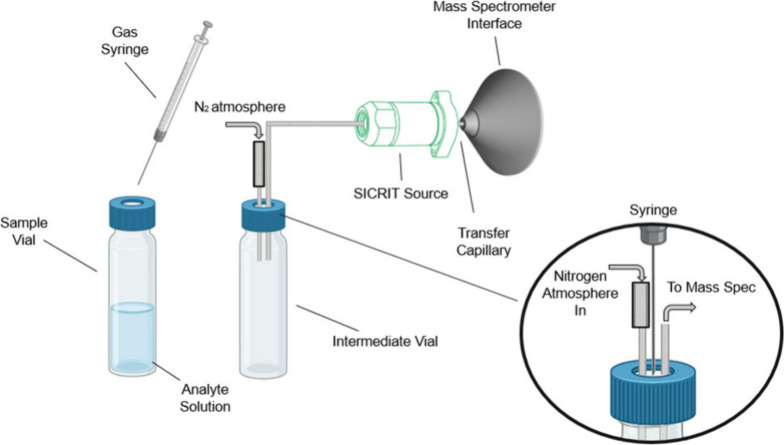
A direct headspace injection method is presented and optimized for the analysis of volatile organic compounds (VOCs) using dielectric barrier discharge ionization-mass spectrometry (DBDI-MS), incorporating an intermediate vial in which the sample headspace is injected. The setup is built of commonly available, cheap consumable parts and easily enables the incorporation of different gases for generating different ionization atmospheres. The method can be fully automated by using standard GC autosamplers, and its rapid analysis time is suitable for high-throughput applications. We show that this method is suitable for both profiling analysis of complex samples such as biofluids and quantitative measurements for real-time reaction monitoring. Our optimized method demonstrated improved reproducibility and sensitivity, with detection limits for compounds tested in the high nanomolar to the low micromolar range, depending on the compound. Key parameters for method optimization were identified such as sample vial volume, headspace-to-liquid ratio, incubation temperature, and equilibration time. These settings were systematically evaluated to maximize the signal intensity and improve repeatability between measurements. Two use cases are demonstrated: (i) quantitative measurement of ethanol production by a metal-organic framework from CO2 and (ii) profiling of biofluids following the consumption of asparagus.
期刊介绍:
The Journal of the American Society for Mass Spectrometry presents research papers covering all aspects of mass spectrometry, incorporating coverage of fields of scientific inquiry in which mass spectrometry can play a role.
Comprehensive in scope, the journal publishes papers on both fundamentals and applications of mass spectrometry. Fundamental subjects include instrumentation principles, design, and demonstration, structures and chemical properties of gas-phase ions, studies of thermodynamic properties, ion spectroscopy, chemical kinetics, mechanisms of ionization, theories of ion fragmentation, cluster ions, and potential energy surfaces. In addition to full papers, the journal offers Communications, Application Notes, and Accounts and Perspectives





 京公网安备 11010802042870号
京ICP备2023020795号-1
京公网安备 11010802042870号
京ICP备2023020795号-1

 分享
分享
 求助内容:
求助内容: 应助结果提醒方式:
 扫码关注我们
