Rizwan Qaisar, Asima Karim, M. Shahid Iqbal, Shaea A. Alkahtani, Firdos Ahmad
{"title":"Associations of plasma Neurofilament light chain with sarcopenia and physical capacity in patients with Alzheimer’s diseases","authors":"Rizwan Qaisar, Asima Karim, M. Shahid Iqbal, Shaea A. Alkahtani, Firdos Ahmad","doi":"10.1007/s13760-025-02759-2","DOIUrl":null,"url":null,"abstract":"<div><h3>Background</h3><p>Despite the close association of Alzheimer’s disease (AD) with muscle decline, the biomarkers of age-related muscle loss, termed sarcopenia, in AD remain elusive.</p><h3>Objectives</h3><p>We investigated the plasma neurofilament light (NfL) chain levels as potential biomarkers of sarcopenia in AD patients.</p><h3>Design setting, participants, measurements</h3><p>We conducted a cross-sectional, observational study on older adults, including controls and patients with AD (n = 38–44/group). We measured the frequency of sarcopenia, body composition, handgrip strength (HGS), gait speed, and short physical performance battery (SPPB) in the study participants. We also measured the plasma NfL levels as marker of neurodegeneration.</p><h3>Results</h3><p>AD was associated with a higher frequency of sarcopenia and reduced HGS, gait speed, and SPPB scores (all p < 0.05). The higher plasma NfL levels in AD patients were correlated with lower HGS, gait speed, and SPPB scores (all p < 0.05). Plasma NfL exhibited moderate accuracy in diagnosing sarcopenia (area under the curve; AUC = 0.701, p < 0.001) and functional dependency (AUC = 0.772, p < 0.001). Among different subgroups of AD, moderate AD was associated with more advanced sarcopenia and functional dependency than early and mild AD. Patients with AD also exhibited heightened inflammation and oxidative stress.</p><h3>Conclusion</h3><p>Altogether, plasma NfL may be a preliminary tool in diagnosing advanced sarcopenia and functional dependency in AD. The study is relevant to non-ambulant and/or comatose AD patients with sarcopenia.</p></div>","PeriodicalId":7042,"journal":{"name":"Acta neurologica Belgica","volume":"125 3","pages":"691 - 698"},"PeriodicalIF":2.1000,"publicationDate":"2025-03-11","publicationTypes":"Journal Article","fieldsOfStudy":null,"isOpenAccess":false,"openAccessPdf":"","citationCount":"0","resultStr":null,"platform":"Semanticscholar","paperid":null,"PeriodicalName":"Acta neurologica Belgica","FirstCategoryId":"3","ListUrlMain":"https://link.springer.com/article/10.1007/s13760-025-02759-2","RegionNum":4,"RegionCategory":"医学","ArticlePicture":[],"TitleCN":null,"AbstractTextCN":null,"PMCID":null,"EPubDate":"","PubModel":"","JCR":"Q3","JCRName":"CLINICAL NEUROLOGY","Score":null,"Total":0}
引用次数: 0
Abstract
Background
Despite the close association of Alzheimer’s disease (AD) with muscle decline, the biomarkers of age-related muscle loss, termed sarcopenia, in AD remain elusive.
Objectives
We investigated the plasma neurofilament light (NfL) chain levels as potential biomarkers of sarcopenia in AD patients.
Design setting, participants, measurements
We conducted a cross-sectional, observational study on older adults, including controls and patients with AD (n = 38–44/group). We measured the frequency of sarcopenia, body composition, handgrip strength (HGS), gait speed, and short physical performance battery (SPPB) in the study participants. We also measured the plasma NfL levels as marker of neurodegeneration.
Results
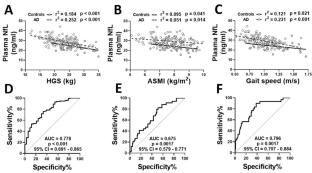
AD was associated with a higher frequency of sarcopenia and reduced HGS, gait speed, and SPPB scores (all p < 0.05). The higher plasma NfL levels in AD patients were correlated with lower HGS, gait speed, and SPPB scores (all p < 0.05). Plasma NfL exhibited moderate accuracy in diagnosing sarcopenia (area under the curve; AUC = 0.701, p < 0.001) and functional dependency (AUC = 0.772, p < 0.001). Among different subgroups of AD, moderate AD was associated with more advanced sarcopenia and functional dependency than early and mild AD. Patients with AD also exhibited heightened inflammation and oxidative stress.
Conclusion
Altogether, plasma NfL may be a preliminary tool in diagnosing advanced sarcopenia and functional dependency in AD. The study is relevant to non-ambulant and/or comatose AD patients with sarcopenia.
期刊介绍:
Peer-reviewed and published quarterly, Acta Neurologica Belgicapresents original articles in the clinical and basic neurosciences, and also reports the proceedings and the abstracts of the scientific meetings of the different partner societies. The contents include commentaries, editorials, review articles, case reports, neuro-images of interest, book reviews and letters to the editor.
Acta Neurologica Belgica is the official journal of the following national societies:
Belgian Neurological Society
Belgian Society for Neuroscience
Belgian Society of Clinical Neurophysiology
Belgian Pediatric Neurology Society
Belgian Study Group of Multiple Sclerosis
Belgian Stroke Council
Belgian Headache Society
Belgian Study Group of Neuropathology



 京公网安备 11010802042870号
京ICP备2023020795号-1
京公网安备 11010802042870号
京ICP备2023020795号-1

 分享
分享
 求助内容:
求助内容: 应助结果提醒方式:
 扫码关注我们
