Yimin Ma, Yufeng Ge, Zhe Guo, Yongbin Su, Chao Wang, Qianqian Wang, Ling Wang, Xiaoguang Cheng, Minghui Yang, Dong Yan
{"title":"Hip structural analysis parameters are not associated with the risk of postmenopausal female second hip fracture: a retrospective study.","authors":"Yimin Ma, Yufeng Ge, Zhe Guo, Yongbin Su, Chao Wang, Qianqian Wang, Ling Wang, Xiaoguang Cheng, Minghui Yang, Dong Yan","doi":"10.1186/s12891-025-08368-7","DOIUrl":null,"url":null,"abstract":"<p><strong>Purpose: </strong>Postmenopausal female patients with a history of a single hip fracture are at higher risk of a second fracture. The poorer clinical outcomes of this patient group warrants evaluating the risk of experiencing a second hip fracture. Therefore, this study aimed to investigate the effectiveness of hip structural analysis (HSA) in assessing the risk of second hip fracture in postmenopausal females.</p><p><strong>Methods: </strong>This retrospective analysis included 188 patients selected from the Chinese Second Hip Fracture Evaluation (ClinicalTrials.gov identifier: NCT03461237, first registration/posted date: 09/03/2018). They were divided into the second hip fracture (35 cases, with a mean age of 79.33 ± 7.70 years) and the control group (153 cases, with a mean age of 73.41 ± 9.56 years). Parker Mobility Score were determined via telephone follow-up, and two computed tomography scanners were used for images acquisition. All HSA and areal bone mineral density (aBMD) parameters were calculated through Mindways QCTPRO software.</p><p><strong>Results: </strong>The refracture group showed increased age, decreased cross-sectional area, total hip aBMD, trochanteric aBMD, and intertrochanteric aBMD (p < 0.05). Total hip and intertrochanteric aBMD have a protective effect on the occurrence of a second hip fracture in postmenopausal women, with odd ratios of 0.61 and 0.57, respectively (p < 0.05). Incorporating HSA parameters into the baseline model (used age, type 2 diabetes mellitus, and the PMS as parameters, AUC = 0.729) does not significantly improve the performance of second hip fracture prediction (AUC = 0.748, p < 0.05 in Delong's test).</p><p><strong>Conclusion: </strong>Based on our findings, HSA does not statistically correlate with the incidence of second hip fracture in postmenopausal women. Incorporating HSA parameters into the (baseline) model does not significantly improve the pridictive capabilities.</p>","PeriodicalId":9189,"journal":{"name":"BMC Musculoskeletal Disorders","volume":"26 1","pages":"233"},"PeriodicalIF":2.4000,"publicationDate":"2025-03-10","publicationTypes":"Journal Article","fieldsOfStudy":null,"isOpenAccess":false,"openAccessPdf":"https://www.ncbi.nlm.nih.gov/pmc/articles/PMC11892275/pdf/","citationCount":"0","resultStr":null,"platform":"Semanticscholar","paperid":null,"PeriodicalName":"BMC Musculoskeletal Disorders","FirstCategoryId":"3","ListUrlMain":"https://doi.org/10.1186/s12891-025-08368-7","RegionNum":3,"RegionCategory":"医学","ArticlePicture":[],"TitleCN":null,"AbstractTextCN":null,"PMCID":null,"EPubDate":"","PubModel":"","JCR":"Q2","JCRName":"ORTHOPEDICS","Score":null,"Total":0}
引用次数: 0
Abstract
Purpose: Postmenopausal female patients with a history of a single hip fracture are at higher risk of a second fracture. The poorer clinical outcomes of this patient group warrants evaluating the risk of experiencing a second hip fracture. Therefore, this study aimed to investigate the effectiveness of hip structural analysis (HSA) in assessing the risk of second hip fracture in postmenopausal females.
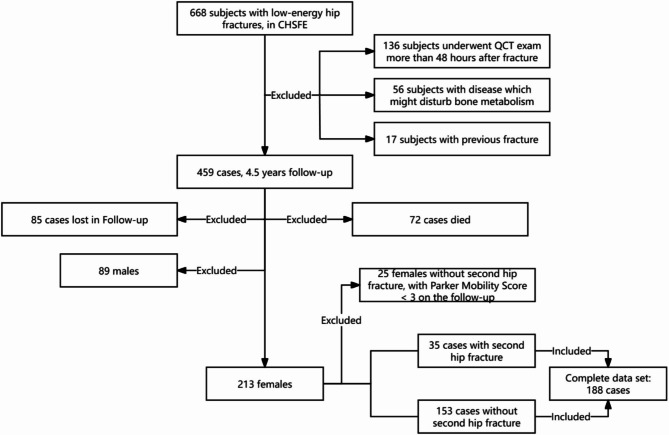
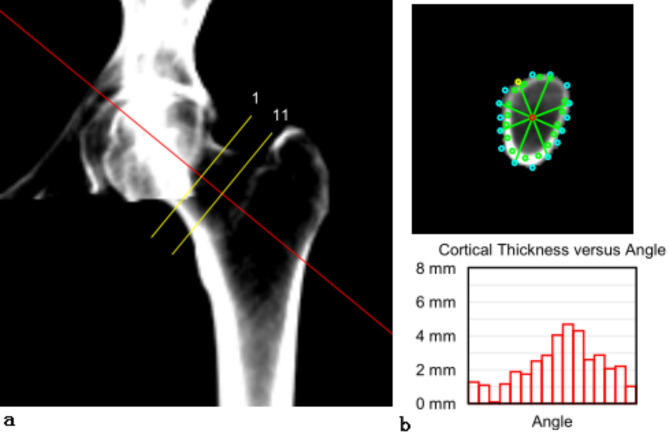
Methods: This retrospective analysis included 188 patients selected from the Chinese Second Hip Fracture Evaluation (ClinicalTrials.gov identifier: NCT03461237, first registration/posted date: 09/03/2018). They were divided into the second hip fracture (35 cases, with a mean age of 79.33 ± 7.70 years) and the control group (153 cases, with a mean age of 73.41 ± 9.56 years). Parker Mobility Score were determined via telephone follow-up, and two computed tomography scanners were used for images acquisition. All HSA and areal bone mineral density (aBMD) parameters were calculated through Mindways QCTPRO software.
Results: The refracture group showed increased age, decreased cross-sectional area, total hip aBMD, trochanteric aBMD, and intertrochanteric aBMD (p < 0.05). Total hip and intertrochanteric aBMD have a protective effect on the occurrence of a second hip fracture in postmenopausal women, with odd ratios of 0.61 and 0.57, respectively (p < 0.05). Incorporating HSA parameters into the baseline model (used age, type 2 diabetes mellitus, and the PMS as parameters, AUC = 0.729) does not significantly improve the performance of second hip fracture prediction (AUC = 0.748, p < 0.05 in Delong's test).
Conclusion: Based on our findings, HSA does not statistically correlate with the incidence of second hip fracture in postmenopausal women. Incorporating HSA parameters into the (baseline) model does not significantly improve the pridictive capabilities.
期刊介绍:
BMC Musculoskeletal Disorders is an open access, peer-reviewed journal that considers articles on all aspects of the prevention, diagnosis and management of musculoskeletal disorders, as well as related molecular genetics, pathophysiology, and epidemiology.
The scope of the Journal covers research into rheumatic diseases where the primary focus relates specifically to a component(s) of the musculoskeletal system.





 京公网安备 11010802042870号
京ICP备2023020795号-1
京公网安备 11010802042870号
京ICP备2023020795号-1

 分享
分享
 求助内容:
求助内容: 应助结果提醒方式:
 扫码关注我们
