{"title":"Emotional intelligence training in health students: a pilot study.","authors":"Manon Dugué, Olivier Sirost, Natacha Heutte, Fabrice Dosseville","doi":"10.3389/fspor.2025.1511851","DOIUrl":null,"url":null,"abstract":"<p><strong>Introduction: </strong>The aim of this study was to test the effectiveness of an emotional intelligence (EI) program based on the tripartite model, combining theory and practical physical activity for health training students.</p><p><strong>Method: </strong>This pilot study was conducted with 68 students between October 2020 and October 2021. One group received the EI training intervention (<i>n</i> = 34) combining 8 h of theory and 10 h of practical exercises with physical activities on different EC based on scientific literature. While the other group served as a control group (<i>n</i> = 34) and received an intervention on a topic other than emotional intelligence (i.e., sociological approach to the body) during 18 h (<i>n</i> = 34) Participants of both groups were required to complete the trait EI questionnaire in the pre and post-test.</p><p><strong>Results: </strong>Results showed a significant increase in emotion expression, emotion identification, stress management, emotional management, emotional abilities, sociability and emotional intelligence. No significant change was observed in the control group.</p><p><strong>Discussion: </strong>These findings suggest that EI can be improved with physical activities and open possibilities to include EI program in health training program.</p>","PeriodicalId":12716,"journal":{"name":"Frontiers in Sports and Active Living","volume":"7 ","pages":"1511851"},"PeriodicalIF":2.6000,"publicationDate":"2025-02-24","publicationTypes":"Journal Article","fieldsOfStudy":null,"isOpenAccess":false,"openAccessPdf":"https://www.ncbi.nlm.nih.gov/pmc/articles/PMC11891197/pdf/","citationCount":"0","resultStr":null,"platform":"Semanticscholar","paperid":null,"PeriodicalName":"Frontiers in Sports and Active Living","FirstCategoryId":"1085","ListUrlMain":"https://doi.org/10.3389/fspor.2025.1511851","RegionNum":0,"RegionCategory":null,"ArticlePicture":[],"TitleCN":null,"AbstractTextCN":null,"PMCID":null,"EPubDate":"2025/1/1 0:00:00","PubModel":"eCollection","JCR":"Q2","JCRName":"SPORT SCIENCES","Score":null,"Total":0}
引用次数: 0
Abstract
Introduction: The aim of this study was to test the effectiveness of an emotional intelligence (EI) program based on the tripartite model, combining theory and practical physical activity for health training students.
Method: This pilot study was conducted with 68 students between October 2020 and October 2021. One group received the EI training intervention (n = 34) combining 8 h of theory and 10 h of practical exercises with physical activities on different EC based on scientific literature. While the other group served as a control group (n = 34) and received an intervention on a topic other than emotional intelligence (i.e., sociological approach to the body) during 18 h (n = 34) Participants of both groups were required to complete the trait EI questionnaire in the pre and post-test.
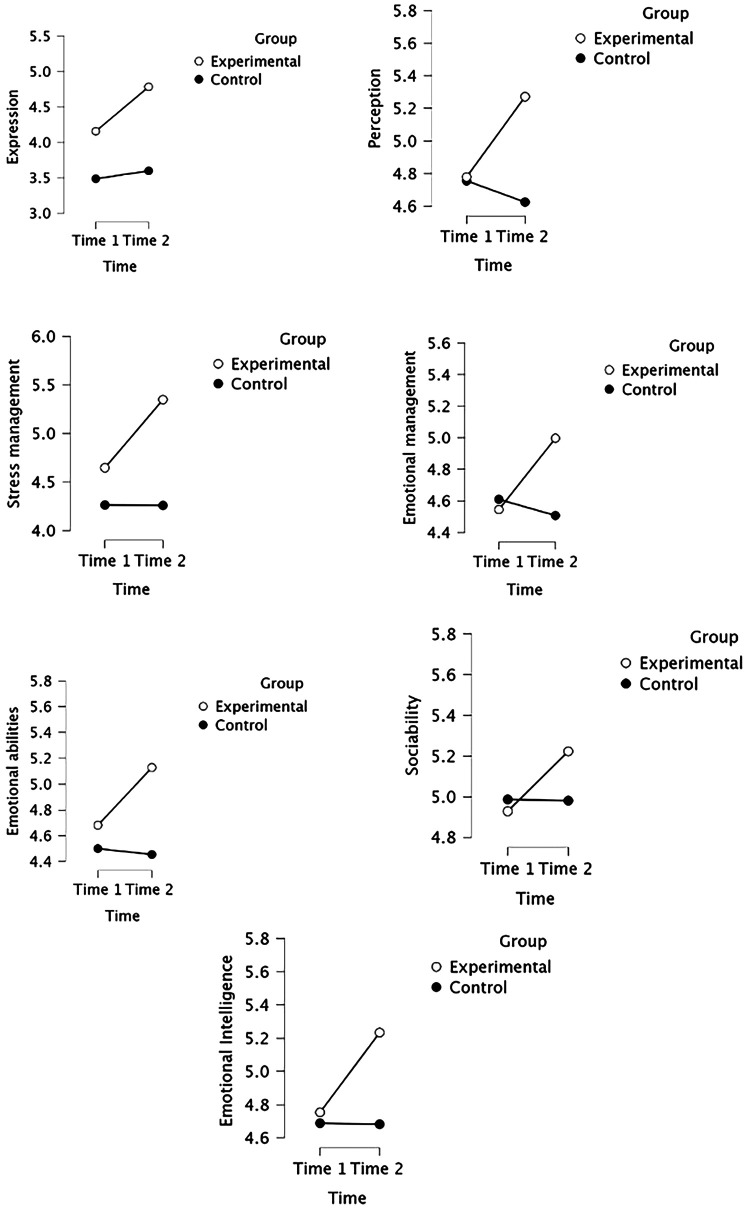
Results: Results showed a significant increase in emotion expression, emotion identification, stress management, emotional management, emotional abilities, sociability and emotional intelligence. No significant change was observed in the control group.
Discussion: These findings suggest that EI can be improved with physical activities and open possibilities to include EI program in health training program.




 京公网安备 11010802042870号
京ICP备2023020795号-1
京公网安备 11010802042870号
京ICP备2023020795号-1

 分享
分享
 求助内容:
求助内容: 应助结果提醒方式:
 扫码关注我们
