Bruce Wallace, Irene Shkolnikov, Collin Kielty, Derek Robinson, Lea Gozdzialski, Joshua Jai, Ava Margolese, Pablo Gonzalez-Nieto, Armin Saatchi, Lucas Abruzzi, Taelor Zarkovic, Chris Gill, Dennis Hore
{"title":"Is fentanyl in everything? Examining the unexpected occurrence of illicit opioids in British Columbia's drug supply.","authors":"Bruce Wallace, Irene Shkolnikov, Collin Kielty, Derek Robinson, Lea Gozdzialski, Joshua Jai, Ava Margolese, Pablo Gonzalez-Nieto, Armin Saatchi, Lucas Abruzzi, Taelor Zarkovic, Chris Gill, Dennis Hore","doi":"10.1186/s12954-025-01189-w","DOIUrl":null,"url":null,"abstract":"<p><strong>Background: </strong>Illicit opioids, including fentanyl, are linked to unprecedented levels of overdose in Canada and elsewhere. The risks associated with illicit opioids can include high potency, unpredictable concentration and the unexpected presence in other drugs. Within this context, we examine drug checking data to better understand the presence of illicit opioids such as fentanyl in other drugs and possible ways to interpret these results.</p><p><strong>Methods: </strong>Three years (2021-2023) of data (18,474 samples) from Substance Drug Checking in British Columbia, Canada were examined to investigate the risks associated with the detection of opioids in other drugs such as cocaine and methamphetamine, as well as in other drug categories. Samples were tested by paper spray mass spectrometry (PS-MS), fentanyl test strips and Fourier-Transform infrared spectroscopy (FTIR). We examine the 8889 samples not expected to include fentanyl to confirm; if the expected drug was detected, if unexpected opioids were detected, and when the unexpected opioids are in trace concentration.</p><p><strong>Results: </strong>Unexpected opioids were rarely detected (2%) in other drugs (189 of 8889 samples) with most (61.4%) detected at trace concentration levels. Unexpected opioids are far more likely to be found in samples that did not contain the expected drug than in samples that were confirmed to contain the expected drug. The least common scenario (below 1%) were substances that included the expected drug plus unexpected opioid above trace concentration. These findings raise questions on how to interpret and communicate the detection of fentanyl and related opioids in other drugs. We present three potential interpretations: (1) mistaken and misrepresented samples where the expected drug was never detected, (2) cross contamination when opioids were at trace concentration levels, or (3) adulteration as the least frequent scenario where opioids were detected above trace concentrations in combination with the expected drug.</p><p><strong>Conclusions: </strong>In a region where fentanyl is associated with extreme rates of overdose, it remains rare to find such opioids in other drugs. However, the risk of fentanyl in other drugs remains an ongoing threat that warrants responses by individuals and public health. We provide possible interpretations to inform such responses. Our data raises questions on how to interpret and communicate the detection of fentanyl and other opioids in other drugs.</p>","PeriodicalId":12922,"journal":{"name":"Harm Reduction Journal","volume":"22 1","pages":"28"},"PeriodicalIF":4.0000,"publicationDate":"2025-03-10","publicationTypes":"Journal Article","fieldsOfStudy":null,"isOpenAccess":false,"openAccessPdf":"https://www.ncbi.nlm.nih.gov/pmc/articles/PMC11892297/pdf/","citationCount":"0","resultStr":null,"platform":"Semanticscholar","paperid":null,"PeriodicalName":"Harm Reduction Journal","FirstCategoryId":"90","ListUrlMain":"https://doi.org/10.1186/s12954-025-01189-w","RegionNum":2,"RegionCategory":"社会学","ArticlePicture":[],"TitleCN":null,"AbstractTextCN":null,"PMCID":null,"EPubDate":"","PubModel":"","JCR":"Q1","JCRName":"SUBSTANCE ABUSE","Score":null,"Total":0}
引用次数: 0
Abstract
Background: Illicit opioids, including fentanyl, are linked to unprecedented levels of overdose in Canada and elsewhere. The risks associated with illicit opioids can include high potency, unpredictable concentration and the unexpected presence in other drugs. Within this context, we examine drug checking data to better understand the presence of illicit opioids such as fentanyl in other drugs and possible ways to interpret these results.
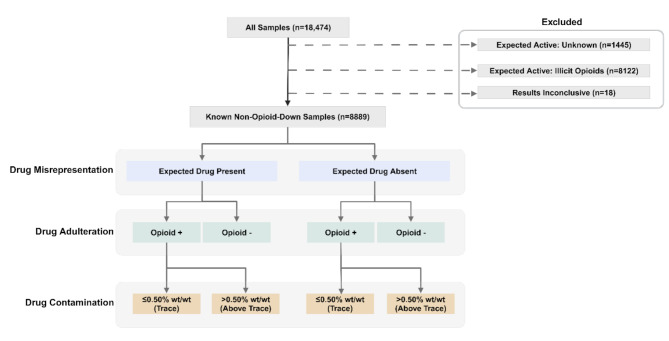
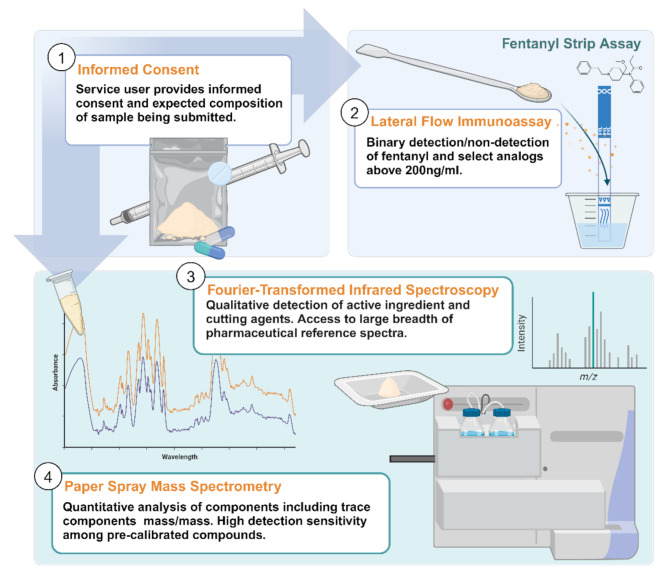
Methods: Three years (2021-2023) of data (18,474 samples) from Substance Drug Checking in British Columbia, Canada were examined to investigate the risks associated with the detection of opioids in other drugs such as cocaine and methamphetamine, as well as in other drug categories. Samples were tested by paper spray mass spectrometry (PS-MS), fentanyl test strips and Fourier-Transform infrared spectroscopy (FTIR). We examine the 8889 samples not expected to include fentanyl to confirm; if the expected drug was detected, if unexpected opioids were detected, and when the unexpected opioids are in trace concentration.
Results: Unexpected opioids were rarely detected (2%) in other drugs (189 of 8889 samples) with most (61.4%) detected at trace concentration levels. Unexpected opioids are far more likely to be found in samples that did not contain the expected drug than in samples that were confirmed to contain the expected drug. The least common scenario (below 1%) were substances that included the expected drug plus unexpected opioid above trace concentration. These findings raise questions on how to interpret and communicate the detection of fentanyl and related opioids in other drugs. We present three potential interpretations: (1) mistaken and misrepresented samples where the expected drug was never detected, (2) cross contamination when opioids were at trace concentration levels, or (3) adulteration as the least frequent scenario where opioids were detected above trace concentrations in combination with the expected drug.
Conclusions: In a region where fentanyl is associated with extreme rates of overdose, it remains rare to find such opioids in other drugs. However, the risk of fentanyl in other drugs remains an ongoing threat that warrants responses by individuals and public health. We provide possible interpretations to inform such responses. Our data raises questions on how to interpret and communicate the detection of fentanyl and other opioids in other drugs.
背景:在加拿大和其他地方,包括芬太尼在内的非法阿片类药物与前所未有的过量服用有关。与非法阿片类药物相关的风险可能包括效力高、浓度不可预测以及意外存在于其他药物中。在此背景下,我们检查药物检查数据,以更好地了解芬太尼等非法阿片类药物在其他药物中的存在以及解释这些结果的可能方法。方法:对加拿大不列颠哥伦比亚省物质药物检查局(Substance Drug Checking)三年(2021-2023年)数据(18474份样本)进行分析,探讨在可卡因和甲基苯丙胺等其他药物以及其他药物类别中检测阿片类药物的风险。采用纸喷雾质谱(PS-MS)、芬太尼试纸条和傅里叶变换红外光谱(FTIR)对样品进行检测。我们检查了8889份不含芬太尼的样本来确认;是否检测到预期的药物,是否检测到意外的阿片类药物,以及当意外的阿片类药物处于微量浓度时。结果:8889份样品中189份在其他药物中检出意外的阿片类药物极少(2%),多数(61.4%)在痕量浓度水平检出。在不含预期药物的样本中发现意外的阿片类药物的可能性远远大于在确认含有预期药物的样本中发现的可能性。最不常见的情况(低于1%)是包括预期药物和超出痕量浓度的意外阿片类药物的物质。这些发现提出了如何解释和交流芬太尼和其他药物中相关阿片类药物的检测的问题。我们提出了三种可能的解释:(1)从未检测到预期药物的错误和歪曲样品,(2)阿片类药物处于痕量浓度水平时的交叉污染,或(3)掺假是最不常见的情况,即阿片类药物与预期药物的混合浓度高于痕量浓度。结论:在芬太尼与极端过量率相关的地区,在其他药物中发现此类阿片类药物仍然很少。然而,其他药物中芬太尼的风险仍然是一个持续的威胁,需要个人和公共卫生部门作出反应。我们提供了可能的解释,为这些回应提供信息。我们的数据提出了如何解释和交流芬太尼和其他阿片类药物在其他药物中的检测的问题。
期刊介绍:
Harm Reduction Journal is an Open Access, peer-reviewed, online journal whose focus is on the prevalent patterns of psychoactive drug use, the public policies meant to control them, and the search for effective methods of reducing the adverse medical, public health, and social consequences associated with both drugs and drug policies. We define "harm reduction" as "policies and programs which aim to reduce the health, social, and economic costs of legal and illegal psychoactive drug use without necessarily reducing drug consumption". We are especially interested in studies of the evolving patterns of drug use around the world, their implications for the spread of HIV/AIDS and other blood-borne pathogens.



 京公网安备 11010802042870号
京ICP备2023020795号-1
京公网安备 11010802042870号
京ICP备2023020795号-1

 分享
分享
 求助内容:
求助内容: 应助结果提醒方式:
 扫码关注我们
