Yongseop Lee, JongHoon Hyun, Je Eun Song, Hyo Won Park, I Ji Yun, Yee Gyung Kwak, Yong Chan Kim
{"title":"Urine Leukocyte Counts for Differentiating Asymptomatic Bacteriuria From Urinary Tract Infection and Predicting Secondary Bacteremia.","authors":"Yongseop Lee, JongHoon Hyun, Je Eun Song, Hyo Won Park, I Ji Yun, Yee Gyung Kwak, Yong Chan Kim","doi":"10.3346/jkms.2025.40.e30","DOIUrl":null,"url":null,"abstract":"<p><strong>Background: </strong>Differentiating between asymptomatic bacteriuria (ASB) and urinary tract infection (UTI) is difficult in patients who have difficulty communicating their symptoms. This study aimed to evaluate the diagnostic accuracy of urine leukocytes in distinguishing between UTI and ASB, and the clinical outcomes of patients with UTI according to the degree of pyuria.</p><p><strong>Methods: </strong>This retrospective cohort study included patients with positive urine cultures between July 2022 and June 2023 at two hospitals. UTI and ASB were diagnosed through a comprehensive review of medical records. We evaluated the differences in urine leukocyte counts between patients with UTI and ASB. The diagnostic performance of urine leukocytes to differentiate between UTI and ASB was evaluated. To investigate the clinical outcomes based on the degree of pyuria, we classified patients with upper UTI according to their urine leukocyte counts.</p><p><strong>Results: </strong>Of the 1,793 eligible patients with bacteriuria included, 1,464 had UTI and 329 had ASB. Patients with UTI had higher urinary leukocytes than patients with ASB did (490.4 vs. 123.5 cells/µL; <i>P</i> < 0.001). The area under the receiver operating characteristic curve was 0.702 for discriminating between ASB and UTI. The optimal urine leukocyte cutoff was 195.35 cells/µL, with a sensitivity and specificity of 0.70 and 0.60, respectively. A sequential rise in secondary bacteremia rate was observed according to an increase in urine leukocytes in patients with upper UTI, whereas in-hospital mortality showed no corresponding trend.</p><p><strong>Conclusion: </strong>Urine leukocyte counts could be used to predict UTI occurrence and bacteremia secondary to UTI. Higher degrees of pyuria were associated with bacteremia but not with mortality. Urine leukocyte counts can provide additive information for patients with bacteriuria with vague symptoms.</p>","PeriodicalId":16249,"journal":{"name":"Journal of Korean Medical Science","volume":"40 9","pages":"e30"},"PeriodicalIF":2.3000,"publicationDate":"2025-03-10","publicationTypes":"Journal Article","fieldsOfStudy":null,"isOpenAccess":false,"openAccessPdf":"https://www.ncbi.nlm.nih.gov/pmc/articles/PMC11893350/pdf/","citationCount":"0","resultStr":null,"platform":"Semanticscholar","paperid":null,"PeriodicalName":"Journal of Korean Medical Science","FirstCategoryId":"3","ListUrlMain":"https://doi.org/10.3346/jkms.2025.40.e30","RegionNum":3,"RegionCategory":"医学","ArticlePicture":[],"TitleCN":null,"AbstractTextCN":null,"PMCID":null,"EPubDate":"","PubModel":"","JCR":"Q1","JCRName":"MEDICINE, GENERAL & INTERNAL","Score":null,"Total":0}
引用次数: 0
Abstract
Background: Differentiating between asymptomatic bacteriuria (ASB) and urinary tract infection (UTI) is difficult in patients who have difficulty communicating their symptoms. This study aimed to evaluate the diagnostic accuracy of urine leukocytes in distinguishing between UTI and ASB, and the clinical outcomes of patients with UTI according to the degree of pyuria.
Methods: This retrospective cohort study included patients with positive urine cultures between July 2022 and June 2023 at two hospitals. UTI and ASB were diagnosed through a comprehensive review of medical records. We evaluated the differences in urine leukocyte counts between patients with UTI and ASB. The diagnostic performance of urine leukocytes to differentiate between UTI and ASB was evaluated. To investigate the clinical outcomes based on the degree of pyuria, we classified patients with upper UTI according to their urine leukocyte counts.
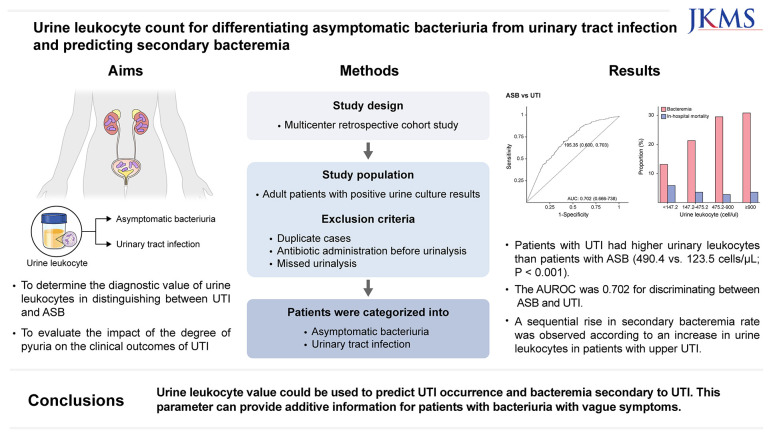
Results: Of the 1,793 eligible patients with bacteriuria included, 1,464 had UTI and 329 had ASB. Patients with UTI had higher urinary leukocytes than patients with ASB did (490.4 vs. 123.5 cells/µL; P < 0.001). The area under the receiver operating characteristic curve was 0.702 for discriminating between ASB and UTI. The optimal urine leukocyte cutoff was 195.35 cells/µL, with a sensitivity and specificity of 0.70 and 0.60, respectively. A sequential rise in secondary bacteremia rate was observed according to an increase in urine leukocytes in patients with upper UTI, whereas in-hospital mortality showed no corresponding trend.
Conclusion: Urine leukocyte counts could be used to predict UTI occurrence and bacteremia secondary to UTI. Higher degrees of pyuria were associated with bacteremia but not with mortality. Urine leukocyte counts can provide additive information for patients with bacteriuria with vague symptoms.
期刊介绍:
The Journal of Korean Medical Science (JKMS) is an international, peer-reviewed Open Access journal of medicine published weekly in English. The Journal’s publisher is the Korean Academy of Medical Sciences (KAMS), Korean Medical Association (KMA). JKMS aims to publish evidence-based, scientific research articles from various disciplines of the medical sciences. The Journal welcomes articles of general interest to medical researchers especially when they contain original information. Articles on the clinical evaluation of drugs and other therapies, epidemiologic studies of the general population, studies on pathogenic organisms and toxic materials, and the toxicities and adverse effects of therapeutics are welcome.





 京公网安备 11010802042870号
京ICP备2023020795号-1
京公网安备 11010802042870号
京ICP备2023020795号-1

 分享
分享
 求助内容:
求助内容: 应助结果提醒方式:
 扫码关注我们
