Analysis of the efficacy of a prophylactic increasing blood pressure before the end of surgery to reduce postoperative bleeding after gastrectomy: a propensity score-matched analysis.
Guangxu Zhu, Shengjie Zhou, Qihang Sun, Xuren Lu, Qingshun Zhu, Xin Yin, Lei Yu, Jianjun Qu, Xiaomin Lang
{"title":"Analysis of the efficacy of a prophylactic increasing blood pressure before the end of surgery to reduce postoperative bleeding after gastrectomy: a propensity score-matched analysis.","authors":"Guangxu Zhu, Shengjie Zhou, Qihang Sun, Xuren Lu, Qingshun Zhu, Xin Yin, Lei Yu, Jianjun Qu, Xiaomin Lang","doi":"10.1186/s12893-025-02826-8","DOIUrl":null,"url":null,"abstract":"<p><strong>Objective: </strong>To investigate the efficacy of reducing post-gastrectomy hemorrhage by increasing blood pressure at the end of gastric surgery and to evaluate whether this clinical intervention affects the stability of patients' postoperative circulatory system.</p><p><strong>Methods: </strong>A retrospective analysis was conducted on 499 patients who underwent radical gastrectomy under general anesthesia at our center between January 2023 and January 2024. After 1:1 propensity score matching, the experimental group comprised 157 patients whose operation cavities were examined after increasing blood pressure before the end of gastrectomy, while the control group included 157 patients whose operation cavities were examined using routine procedures without increasing blood pressure.</p><p><strong>Results: </strong>The incidences of total postoperative bleeding (0% vs. 3.82%, P = 0.013) and early postoperative bleeding (0% vs. 2.55%, P = 0.044) were significantly lower in the experimental group compared to the control group. There were no significant differences between the two groups in delayed bleeding (0% vs. 1.23%, P = 0.156), systolic blood pressure immediately upon returning to the ward (121.02 ± 18.196 vs. 120.34 ± 21.664, P = 0.795), systolic blood pressure 48 h post-surgery (125.04 ± 16.242 vs. 126.23 ± 17.048, P = 0.529), diastolic blood pressure immediately upon returning to the ward (83.83 ± 11.978 vs. 84.75 ± 12.422, P = 0.506), diastolic blood pressure 48 h post-surgery (74.69 ± 9.773 vs. 75.76 ± 10.605, P = 0.353), heart rate immediately upon returning to the ward (74.31 ± 11.610 vs. 75.15 ± 11.660, P = 0.522), or heart rate 48 h post-surgery (80.49 ± 12.267 vs. 79.11 ± 10.969, P = 0.293). Additionally, there were no statistically significant differences between the two groups regarding anastomotic fistula, intestinal obstruction, postoperative pneumonia, reoperation, mortality, combined organ resection, or postoperative hospital stay (P > 0.05).</p><p><strong>Conclusion: </strong>Increasing blood pressure before the end of gastrectomy can effectively reduce the incidence of primary postoperative hemorrhage without affecting the stability of the perioperative circulatory system.</p>","PeriodicalId":49229,"journal":{"name":"BMC Surgery","volume":"25 1","pages":"93"},"PeriodicalIF":1.8000,"publicationDate":"2025-03-10","publicationTypes":"Journal Article","fieldsOfStudy":null,"isOpenAccess":false,"openAccessPdf":"https://www.ncbi.nlm.nih.gov/pmc/articles/PMC11892180/pdf/","citationCount":"0","resultStr":null,"platform":"Semanticscholar","paperid":null,"PeriodicalName":"BMC Surgery","FirstCategoryId":"3","ListUrlMain":"https://doi.org/10.1186/s12893-025-02826-8","RegionNum":3,"RegionCategory":"医学","ArticlePicture":[],"TitleCN":null,"AbstractTextCN":null,"PMCID":null,"EPubDate":"","PubModel":"","JCR":"Q2","JCRName":"SURGERY","Score":null,"Total":0}
引用次数: 0
Abstract
Objective: To investigate the efficacy of reducing post-gastrectomy hemorrhage by increasing blood pressure at the end of gastric surgery and to evaluate whether this clinical intervention affects the stability of patients' postoperative circulatory system.
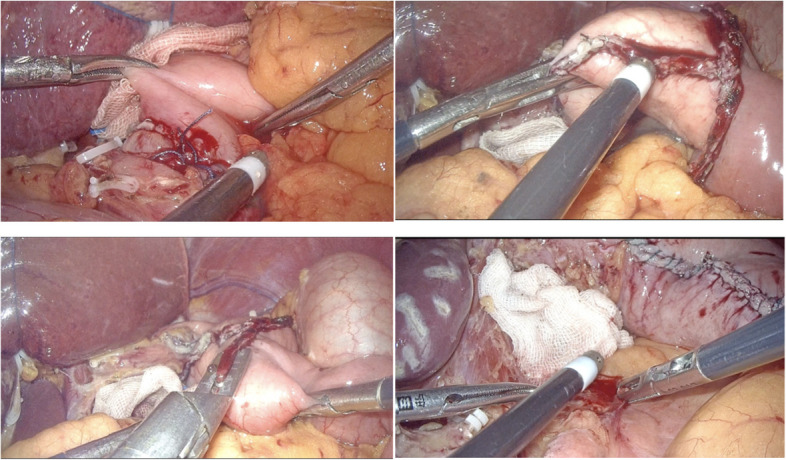
Methods: A retrospective analysis was conducted on 499 patients who underwent radical gastrectomy under general anesthesia at our center between January 2023 and January 2024. After 1:1 propensity score matching, the experimental group comprised 157 patients whose operation cavities were examined after increasing blood pressure before the end of gastrectomy, while the control group included 157 patients whose operation cavities were examined using routine procedures without increasing blood pressure.
Results: The incidences of total postoperative bleeding (0% vs. 3.82%, P = 0.013) and early postoperative bleeding (0% vs. 2.55%, P = 0.044) were significantly lower in the experimental group compared to the control group. There were no significant differences between the two groups in delayed bleeding (0% vs. 1.23%, P = 0.156), systolic blood pressure immediately upon returning to the ward (121.02 ± 18.196 vs. 120.34 ± 21.664, P = 0.795), systolic blood pressure 48 h post-surgery (125.04 ± 16.242 vs. 126.23 ± 17.048, P = 0.529), diastolic blood pressure immediately upon returning to the ward (83.83 ± 11.978 vs. 84.75 ± 12.422, P = 0.506), diastolic blood pressure 48 h post-surgery (74.69 ± 9.773 vs. 75.76 ± 10.605, P = 0.353), heart rate immediately upon returning to the ward (74.31 ± 11.610 vs. 75.15 ± 11.660, P = 0.522), or heart rate 48 h post-surgery (80.49 ± 12.267 vs. 79.11 ± 10.969, P = 0.293). Additionally, there were no statistically significant differences between the two groups regarding anastomotic fistula, intestinal obstruction, postoperative pneumonia, reoperation, mortality, combined organ resection, or postoperative hospital stay (P > 0.05).
Conclusion: Increasing blood pressure before the end of gastrectomy can effectively reduce the incidence of primary postoperative hemorrhage without affecting the stability of the perioperative circulatory system.





 京公网安备 11010802042870号
京ICP备2023020795号-1
京公网安备 11010802042870号
京ICP备2023020795号-1

 分享
分享
 求助内容:
求助内容: 应助结果提醒方式:
 扫码关注我们
