{"title":"Galvanic leaching recycling of spent lithium-ion batteries via low entropy-increasing strategy","authors":"Jiadong Yu, Yanjun Liu, Jinhui Li","doi":"10.1038/s41467-025-57857-9","DOIUrl":null,"url":null,"abstract":"<p>The recycling of spent lithium-ion batteries can effectively mitigate the environmental and resource challenges arising from the escalating generation of battery waste and the soaring demand for battery metals. The existing mixing-then-separating recycling process is confronted with high entropy-increasing procedures, including crushing and leaching, which result in irreversible entropy production due to the decrease in material orderliness or heavy chemical consumption, thereby hindering its thermodynamic efficiency and economic viability of the entire recycling process. Herein, we propose a galvanic leaching strategy that leverages the self-assembly of LiNi<sub>0.6</sub>Co<sub>0.2</sub>Mn<sub>0.2</sub>O<sub>2</sub> particles with their inherent aluminium foil current collectors in spent lithium-ion batteries, creating a primary cell system capable of recovering battery metals without pre-crushing or additional reductants. Under the theoretical potential difference of up to 3.84 V, the electrons flow and charge aggregation effectively achieve the valence state reduction, crystal phase transition and coordination environment change of the hard-to-dissolve metal components, contributing to over 90% battery metals recovery and a nearly 30-fold increase in leaching kinetics. Environmental-economic assessments further indicate that this strategy reduces energy consumption and carbon emissions by 11.36%-21.10% and 5.08%-23.18%, respectively, compared to conventional metallurgical methods, while enhancing economic benefits by 21.14%-49.18%.</p>","PeriodicalId":19066,"journal":{"name":"Nature Communications","volume":"39 1","pages":""},"PeriodicalIF":15.7000,"publicationDate":"2025-03-11","publicationTypes":"Journal Article","fieldsOfStudy":null,"isOpenAccess":false,"openAccessPdf":"","citationCount":"0","resultStr":null,"platform":"Semanticscholar","paperid":null,"PeriodicalName":"Nature Communications","FirstCategoryId":"103","ListUrlMain":"https://doi.org/10.1038/s41467-025-57857-9","RegionNum":1,"RegionCategory":"综合性期刊","ArticlePicture":[],"TitleCN":null,"AbstractTextCN":null,"PMCID":null,"EPubDate":"","PubModel":"","JCR":"Q1","JCRName":"MULTIDISCIPLINARY SCIENCES","Score":null,"Total":0}
引用次数: 0
Abstract
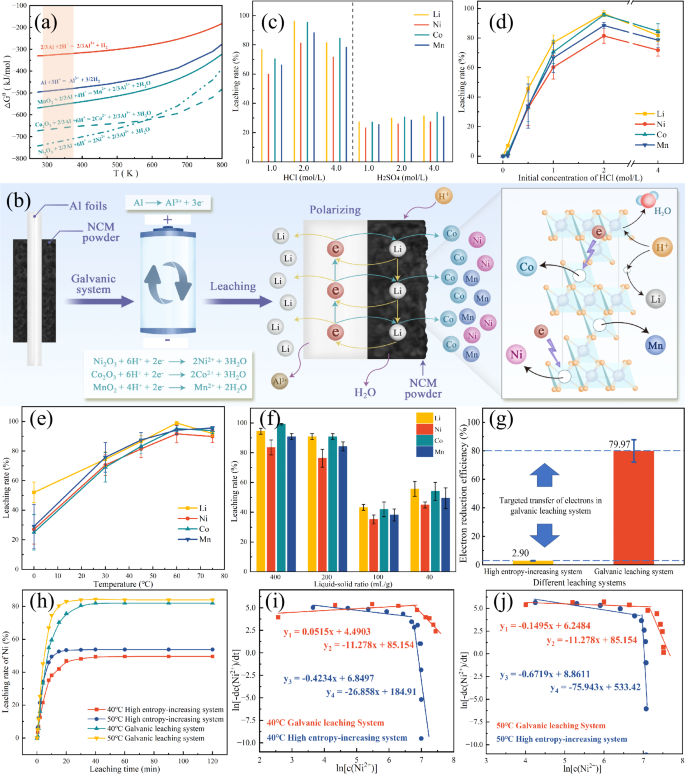
The recycling of spent lithium-ion batteries can effectively mitigate the environmental and resource challenges arising from the escalating generation of battery waste and the soaring demand for battery metals. The existing mixing-then-separating recycling process is confronted with high entropy-increasing procedures, including crushing and leaching, which result in irreversible entropy production due to the decrease in material orderliness or heavy chemical consumption, thereby hindering its thermodynamic efficiency and economic viability of the entire recycling process. Herein, we propose a galvanic leaching strategy that leverages the self-assembly of LiNi0.6Co0.2Mn0.2O2 particles with their inherent aluminium foil current collectors in spent lithium-ion batteries, creating a primary cell system capable of recovering battery metals without pre-crushing or additional reductants. Under the theoretical potential difference of up to 3.84 V, the electrons flow and charge aggregation effectively achieve the valence state reduction, crystal phase transition and coordination environment change of the hard-to-dissolve metal components, contributing to over 90% battery metals recovery and a nearly 30-fold increase in leaching kinetics. Environmental-economic assessments further indicate that this strategy reduces energy consumption and carbon emissions by 11.36%-21.10% and 5.08%-23.18%, respectively, compared to conventional metallurgical methods, while enhancing economic benefits by 21.14%-49.18%.
期刊介绍:
Nature Communications, an open-access journal, publishes high-quality research spanning all areas of the natural sciences. Papers featured in the journal showcase significant advances relevant to specialists in each respective field. With a 2-year impact factor of 16.6 (2022) and a median time of 8 days from submission to the first editorial decision, Nature Communications is committed to rapid dissemination of research findings. As a multidisciplinary journal, it welcomes contributions from biological, health, physical, chemical, Earth, social, mathematical, applied, and engineering sciences, aiming to highlight important breakthroughs within each domain.



 京公网安备 11010802042870号
京ICP备2023020795号-1
京公网安备 11010802042870号
京ICP备2023020795号-1

 分享
分享
 求助内容:
求助内容: 应助结果提醒方式:
 扫码关注我们
