{"title":"Nanoscale Engineering of 3D Intragaps and Compositions in Multimetallic Hollow Superstructures for Enhanced Catalysis","authors":"Qianqian Fu, Jingyi Zhou, Xiaoyuan Wang, Wenying Xu, Xiaoli Chen, Liang Chen, Youju Huang","doi":"10.1021/acs.nanolett.4c05403","DOIUrl":null,"url":null,"abstract":"Designing and synthesizing multishelled metallic hollow nanostructures with intragaps and porous shells have received widespread attention for enhancing optical and catalytic properties. However, significant challenges remain in engineering these structures at the nanometer scale. Herein, we employed the galvanic replacement reaction (GRR) method to prepare multimetallic hollow superstructures with 3D cavities and distinct nanometer intragaps. By precise control of the intragap distances (1–10 nm) and composition distributions within a single entity, libraries of multimetallic hollow superstructures were constructed. Using the 4-nitrophenol reduction as a model reaction, triple-shell Au@Pt–Ag nanoparticles with approximately 1 nm intragaps exhibited a catalytic rate 211.6 times higher than that of commercial Pt/C catalysts. The nanoconfinement environment of multishelled structures not only increases active sites but also promotes electron delocalization of reactants, accelerating the hydrogenation process both thermodynamically and kinetically. Our work advances the rational synthesis of multishelled nanostructures, expanding their potential applications in catalysis, plasmonics, and biosensing.","PeriodicalId":53,"journal":{"name":"Nano Letters","volume":"40 1","pages":""},"PeriodicalIF":9.1000,"publicationDate":"2025-03-11","publicationTypes":"Journal Article","fieldsOfStudy":null,"isOpenAccess":false,"openAccessPdf":"","citationCount":"0","resultStr":null,"platform":"Semanticscholar","paperid":null,"PeriodicalName":"Nano Letters","FirstCategoryId":"88","ListUrlMain":"https://doi.org/10.1021/acs.nanolett.4c05403","RegionNum":1,"RegionCategory":"材料科学","ArticlePicture":[],"TitleCN":null,"AbstractTextCN":null,"PMCID":null,"EPubDate":"","PubModel":"","JCR":"Q1","JCRName":"CHEMISTRY, MULTIDISCIPLINARY","Score":null,"Total":0}
引用次数: 0
Abstract
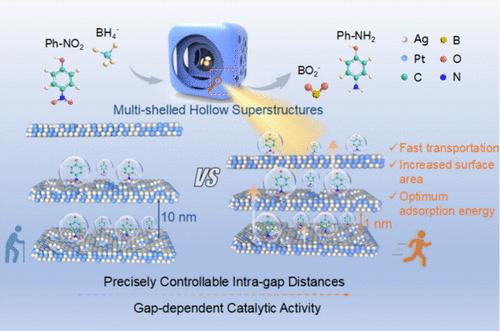
Designing and synthesizing multishelled metallic hollow nanostructures with intragaps and porous shells have received widespread attention for enhancing optical and catalytic properties. However, significant challenges remain in engineering these structures at the nanometer scale. Herein, we employed the galvanic replacement reaction (GRR) method to prepare multimetallic hollow superstructures with 3D cavities and distinct nanometer intragaps. By precise control of the intragap distances (1–10 nm) and composition distributions within a single entity, libraries of multimetallic hollow superstructures were constructed. Using the 4-nitrophenol reduction as a model reaction, triple-shell Au@Pt–Ag nanoparticles with approximately 1 nm intragaps exhibited a catalytic rate 211.6 times higher than that of commercial Pt/C catalysts. The nanoconfinement environment of multishelled structures not only increases active sites but also promotes electron delocalization of reactants, accelerating the hydrogenation process both thermodynamically and kinetically. Our work advances the rational synthesis of multishelled nanostructures, expanding their potential applications in catalysis, plasmonics, and biosensing.
期刊介绍:
Nano Letters serves as a dynamic platform for promptly disseminating original results in fundamental, applied, and emerging research across all facets of nanoscience and nanotechnology. A pivotal criterion for inclusion within Nano Letters is the convergence of at least two different areas or disciplines, ensuring a rich interdisciplinary scope. The journal is dedicated to fostering exploration in diverse areas, including:
- Experimental and theoretical findings on physical, chemical, and biological phenomena at the nanoscale
- Synthesis, characterization, and processing of organic, inorganic, polymer, and hybrid nanomaterials through physical, chemical, and biological methodologies
- Modeling and simulation of synthetic, assembly, and interaction processes
- Realization of integrated nanostructures and nano-engineered devices exhibiting advanced performance
- Applications of nanoscale materials in living and environmental systems
Nano Letters is committed to advancing and showcasing groundbreaking research that intersects various domains, fostering innovation and collaboration in the ever-evolving field of nanoscience and nanotechnology.



 京公网安备 11010802042870号
京ICP备2023020795号-1
京公网安备 11010802042870号
京ICP备2023020795号-1

 分享
分享
 求助内容:
求助内容: 应助结果提醒方式:
 扫码关注我们
