Regulation of nitrogen reduction reaction catalytic performance by varying the sp/sp2 hybrid carbon ratio in graphyne/graphene heterojunction catalysts†
Zexiang Yin, Zijun Yang, Yingmei Bian, Heng Zhao, Beijia Chen, Yuan Liu, Yang Wang, Yida Deng and Haozhi Wang
{"title":"Regulation of nitrogen reduction reaction catalytic performance by varying the sp/sp2 hybrid carbon ratio in graphyne/graphene heterojunction catalysts†","authors":"Zexiang Yin, Zijun Yang, Yingmei Bian, Heng Zhao, Beijia Chen, Yuan Liu, Yang Wang, Yida Deng and Haozhi Wang","doi":"10.1039/D5TA01226K","DOIUrl":null,"url":null,"abstract":"<p >This study investigates the impact of the sp/sp<small><sup>2</sup></small> hybrid carbon ratio on the nitrogen reduction reaction (NRR) catalytic performance of γ-graphyne and graphene-based heterojunction catalysts. Through density of states (DOS) calculations, crystal orbital Hamilton population (COHP) analysis, and charge density difference plots, it is found that the sp/sp<small><sup>2</sup></small> hybrid carbon ratio significantly influences the electronic properties and NRR activity of the catalysts. The Ti@GY1/Gr catalyst exhibits superior performance, attributed to its sensitivity to changes in the sp/sp<small><sup>2</sup></small> hybrid environment, especially when combined with graphene. An increase in the sp/sp<small><sup>2</sup></small> hybrid carbon ratio leads to a decrease in NRR activity, while also modulating the interaction between Ti and the carbon support. The findings highlight the importance of the sp/sp<small><sup>2</sup></small> hybrid carbon ratio in regulating the electronic properties and catalytic performance of heterojunction catalysts, providing insights for the design of more efficient NRR catalysts.</p>","PeriodicalId":82,"journal":{"name":"Journal of Materials Chemistry A","volume":" 14","pages":" 9643-9650"},"PeriodicalIF":9.5000,"publicationDate":"2025-03-12","publicationTypes":"Journal Article","fieldsOfStudy":null,"isOpenAccess":false,"openAccessPdf":"","citationCount":"0","resultStr":null,"platform":"Semanticscholar","paperid":null,"PeriodicalName":"Journal of Materials Chemistry A","FirstCategoryId":"88","ListUrlMain":"https://pubs.rsc.org/en/content/articlelanding/2025/ta/d5ta01226k","RegionNum":2,"RegionCategory":"材料科学","ArticlePicture":[],"TitleCN":null,"AbstractTextCN":null,"PMCID":null,"EPubDate":"","PubModel":"","JCR":"Q1","JCRName":"CHEMISTRY, PHYSICAL","Score":null,"Total":0}
引用次数: 0
Abstract
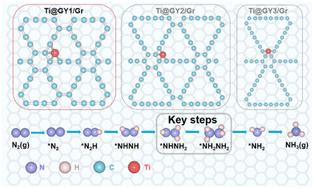
This study investigates the impact of the sp/sp2 hybrid carbon ratio on the nitrogen reduction reaction (NRR) catalytic performance of γ-graphyne and graphene-based heterojunction catalysts. Through density of states (DOS) calculations, crystal orbital Hamilton population (COHP) analysis, and charge density difference plots, it is found that the sp/sp2 hybrid carbon ratio significantly influences the electronic properties and NRR activity of the catalysts. The Ti@GY1/Gr catalyst exhibits superior performance, attributed to its sensitivity to changes in the sp/sp2 hybrid environment, especially when combined with graphene. An increase in the sp/sp2 hybrid carbon ratio leads to a decrease in NRR activity, while also modulating the interaction between Ti and the carbon support. The findings highlight the importance of the sp/sp2 hybrid carbon ratio in regulating the electronic properties and catalytic performance of heterojunction catalysts, providing insights for the design of more efficient NRR catalysts.
期刊介绍:
The Journal of Materials Chemistry A, B & C covers a wide range of high-quality studies in the field of materials chemistry, with each section focusing on specific applications of the materials studied. Journal of Materials Chemistry A emphasizes applications in energy and sustainability, including topics such as artificial photosynthesis, batteries, and fuel cells. Journal of Materials Chemistry B focuses on applications in biology and medicine, while Journal of Materials Chemistry C covers applications in optical, magnetic, and electronic devices. Example topic areas within the scope of Journal of Materials Chemistry A include catalysis, green/sustainable materials, sensors, and water treatment, among others.



 京公网安备 11010802042870号
京ICP备2023020795号-1
京公网安备 11010802042870号
京ICP备2023020795号-1

 分享
分享
 求助内容:
求助内容: 应助结果提醒方式:
 扫码关注我们
