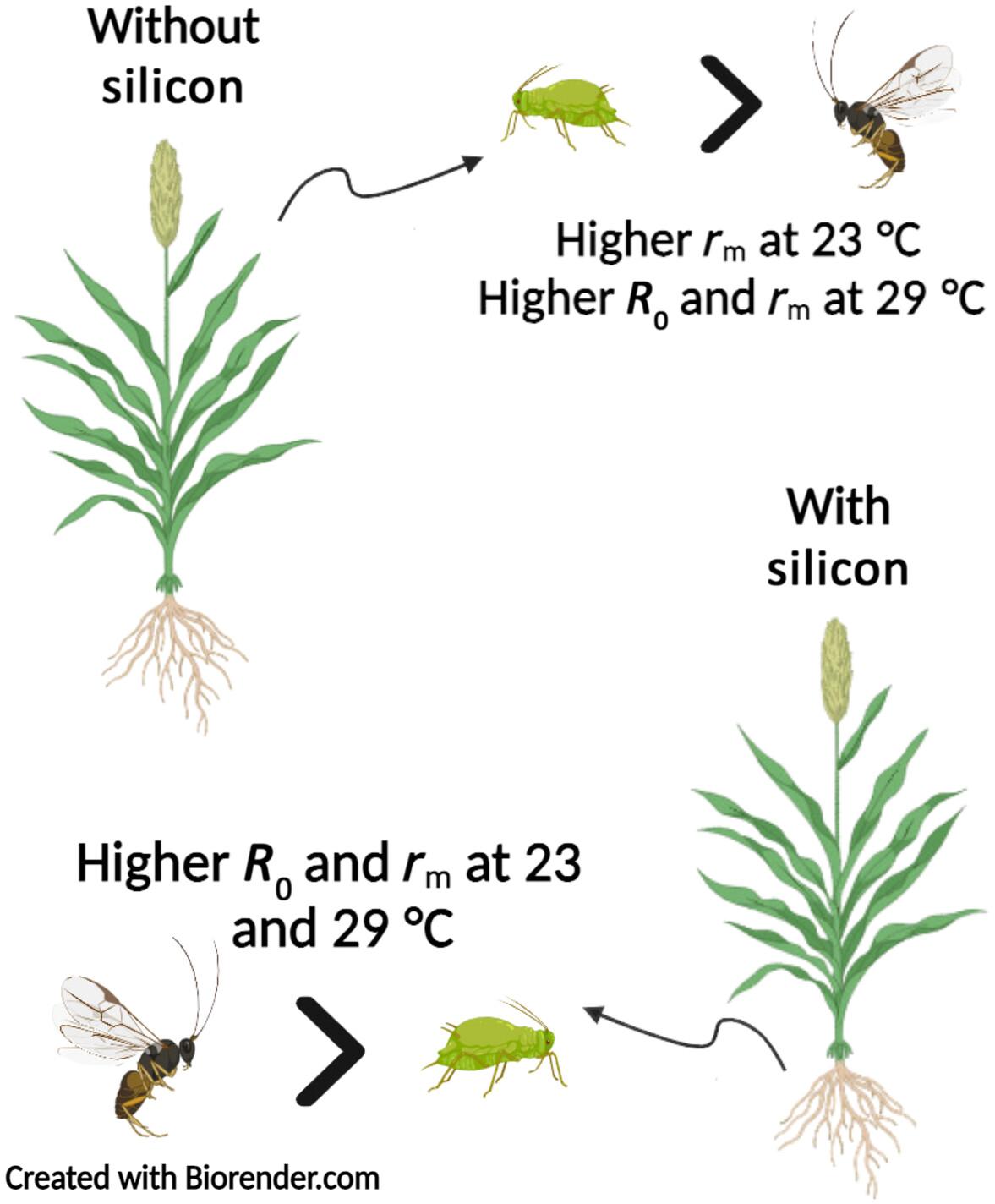
The efficacy of integrated pest management programs can be affected by interactions between different pest control methods. Silicon (Si) amendments increase plant resistance to phytophagous insects; however, such amendments may also affect higher-trophic level species, causing either negative or positive impacts on the biological control of pests in treated crops. To evaluate the effect of Si amendment on the potential for control of the pest aphid Melanaphis sorghi (Theobald) by the parasitoid Aphidius platensis (Bréthes), the key biological parameters and the fertility life tables of both species were assessed in the laboratory at both 23 ± 1 °C and 29 ± 1 °C without Si application and in a greenhouse trial, with the insects reared on plants grown in soil with and without the application of Si (800 kg of Si per hectare).
Without Si, the net reproductive rate (R0) value of the parasitoid at 23 °C was higher than that of the aphid (ratio of R0 of parasitoid/R0 of aphid = 1.2), showing that the aphid can be controlled by the parasitoid at this temperature, but at 29 °C this reversed, with the R0 ratio declining to 0.79, permitting aphid outbreaks. In contrast, with Si, the parasitoid's R0 and rm (intrinsic rate of increase) were both equal or higher than the aphid's at both temperatures, with parasitoid/aphid ratios for R0 and rm ranging from 1.0 to 1.8.
Silicon amendment can increase A. platensis control of M. sorghi, representing its potential use in the integrated management of this pest in sorghum. © 2025 Society of Chemical Industry.





 京公网安备 11010802042870号
京ICP备2023020795号-1
京公网安备 11010802042870号
京ICP备2023020795号-1

 分享
分享
 求助内容:
求助内容: 应助结果提醒方式:
 扫码关注我们
