Enhanced photocatalytic performance of g-C3N4 by introducing gradient energy band structure and activated n–π* electronic transition for visible light hydrogen generation†
{"title":"Enhanced photocatalytic performance of g-C3N4 by introducing gradient energy band structure and activated n–π* electronic transition for visible light hydrogen generation†","authors":"Jiaqiao Hu, Xiongtao Wu, Xingang Kong, Shinobu Uemura, Takafumi Kusunose, Yasuhiro Tanaka and Qi Feng","doi":"10.1039/D4TA08558B","DOIUrl":null,"url":null,"abstract":"<p >The g-C<small><sub>3</sub></small>N<small><sub>4</sub></small>-based materials (CNs) are a promising hydrogen generation photocatalyst for solar energy conversion. To further improve visible light photocatalytic activity of the CN photocatalysts, this study proposes a multi-step thermal decomposition process to design optimized CN photocatalysts. The nanostructure, photoelectric behavior, band energy structure, and corresponding visible light photocatalytic activity of CN photocatalysts were systematically investigated. To enhance the visible light response, the inactive n–π* electronic transitions were activated by breaking the symmetrical planar structure of the heptazine units using a two-step thermal decomposition process. Doping K<small><sup>+</sup></small> into the CN structure resulted in a redshift of π–π* electronic transitions by co-thermal treatment of CN with KCl, which expands the visible light response range by enhancing the planar delocalization of π electrons in the CN structure. A gradient K<small><sup>+</sup></small> doped CN was prepared by controlling the K<small><sup>+</sup></small> doping reaction conditions, which introduces a gradient band energy structure. The gradient band energy structure significantly improves the separation efficiency of photogenerated charge carriers and charge mobility to the photocatalyst surface. Therefore, the optimized photocatalyst was designed by combining the synergistic effect of the activated n–π* electronic transitions, the redshift of π–π* electronic transitions, and the charge separation effect of the gradient band energy structure. An excellent CN photocatalyst with a 70 times higher visible light photocatalytic activity for H<small><sub>2</sub></small> production (382 μmol h<small><sup>−1</sup></small>) than that prepared by the traditional thermal decomposition process was achieved by using the synergistic effect. This study provides a new approach to optimize light absorption and charge carrier separation for CN photocatalysts.</p>","PeriodicalId":82,"journal":{"name":"Journal of Materials Chemistry A","volume":" 16","pages":" 11605-11616"},"PeriodicalIF":9.5000,"publicationDate":"2025-03-13","publicationTypes":"Journal Article","fieldsOfStudy":null,"isOpenAccess":false,"openAccessPdf":"","citationCount":"0","resultStr":null,"platform":"Semanticscholar","paperid":null,"PeriodicalName":"Journal of Materials Chemistry A","FirstCategoryId":"88","ListUrlMain":"https://pubs.rsc.org/en/content/articlelanding/2025/ta/d4ta08558b","RegionNum":2,"RegionCategory":"材料科学","ArticlePicture":[],"TitleCN":null,"AbstractTextCN":null,"PMCID":null,"EPubDate":"","PubModel":"","JCR":"Q1","JCRName":"CHEMISTRY, PHYSICAL","Score":null,"Total":0}
引用次数: 0
Abstract
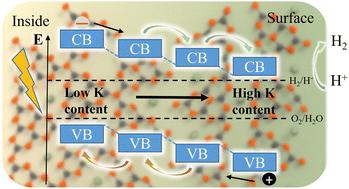
The g-C3N4-based materials (CNs) are a promising hydrogen generation photocatalyst for solar energy conversion. To further improve visible light photocatalytic activity of the CN photocatalysts, this study proposes a multi-step thermal decomposition process to design optimized CN photocatalysts. The nanostructure, photoelectric behavior, band energy structure, and corresponding visible light photocatalytic activity of CN photocatalysts were systematically investigated. To enhance the visible light response, the inactive n–π* electronic transitions were activated by breaking the symmetrical planar structure of the heptazine units using a two-step thermal decomposition process. Doping K+ into the CN structure resulted in a redshift of π–π* electronic transitions by co-thermal treatment of CN with KCl, which expands the visible light response range by enhancing the planar delocalization of π electrons in the CN structure. A gradient K+ doped CN was prepared by controlling the K+ doping reaction conditions, which introduces a gradient band energy structure. The gradient band energy structure significantly improves the separation efficiency of photogenerated charge carriers and charge mobility to the photocatalyst surface. Therefore, the optimized photocatalyst was designed by combining the synergistic effect of the activated n–π* electronic transitions, the redshift of π–π* electronic transitions, and the charge separation effect of the gradient band energy structure. An excellent CN photocatalyst with a 70 times higher visible light photocatalytic activity for H2 production (382 μmol h−1) than that prepared by the traditional thermal decomposition process was achieved by using the synergistic effect. This study provides a new approach to optimize light absorption and charge carrier separation for CN photocatalysts.
期刊介绍:
The Journal of Materials Chemistry A, B & C covers a wide range of high-quality studies in the field of materials chemistry, with each section focusing on specific applications of the materials studied. Journal of Materials Chemistry A emphasizes applications in energy and sustainability, including topics such as artificial photosynthesis, batteries, and fuel cells. Journal of Materials Chemistry B focuses on applications in biology and medicine, while Journal of Materials Chemistry C covers applications in optical, magnetic, and electronic devices. Example topic areas within the scope of Journal of Materials Chemistry A include catalysis, green/sustainable materials, sensors, and water treatment, among others.



 京公网安备 11010802042870号
京ICP备2023020795号-1
京公网安备 11010802042870号
京ICP备2023020795号-1

 分享
分享
 求助内容:
求助内容: 应助结果提醒方式:
 扫码关注我们
