Sarah W Torres, Crystal Lan, Abbigael Harthorn, Zachary Schmitz, Paul L Blanchard, Jon Collins, Benjamin J Hackel
{"title":"Molecular Determinants of Affinity and Isoform Selectivity in Protein─Small Molecule Hybrid Inhibitors of Carbonic Anhydrase.","authors":"Sarah W Torres, Crystal Lan, Abbigael Harthorn, Zachary Schmitz, Paul L Blanchard, Jon Collins, Benjamin J Hackel","doi":"10.1021/acs.bioconjchem.5c00006","DOIUrl":null,"url":null,"abstract":"<p><p>Multiple studies have demonstrated the benefit of engineering hybrid ligands that combine the unique benefits of small molecules and proteins or peptides. However, the molecular complexity of hybrid ligands generates a parameter space so large it cannot be exhaustively explored. We systematically evaluated the impact of one molecular design element, conjugation site, on the discovery of functional protein-small molecule hybrids (PriSMs). We utilized a library of yeast-displayed fibronectin domain variants with amino acid and loop length diversity in the paratope and a single cysteine at one of 18 possible conjugation sites. The protein variants were coupled with maleimide-functionalized acetazolamide and sorted via competitive flow cytometry to discover potent and selective inhibitors of three isoforms of carbonic anhydrase. Deep sequencing of the resultant populations of functional PriSMs revealed an isoform-dependent distribution of conjugation site preferences. The top PriSMs showed potency and selectivity gains up to 23- and 100-fold (in this case, for CA-II vs CA-XII, with a 43-fold selectivity gain for CA-II vs CA-IX) relative to PEG<sub>2</sub>-acetazolamide alone. The presented study expands our fundamental understanding of the role of conjugation site in PriSM function and informs future PriSM engineering efforts by highlighting the benefit of conjugation site diversity in PriSM libraries.</p>","PeriodicalId":29,"journal":{"name":"Bioconjugate Chemistry","volume":" ","pages":"549-562"},"PeriodicalIF":3.9000,"publicationDate":"2025-03-19","publicationTypes":"Journal Article","fieldsOfStudy":null,"isOpenAccess":false,"openAccessPdf":"","citationCount":"0","resultStr":null,"platform":"Semanticscholar","paperid":null,"PeriodicalName":"Bioconjugate Chemistry","FirstCategoryId":"1","ListUrlMain":"https://doi.org/10.1021/acs.bioconjchem.5c00006","RegionNum":2,"RegionCategory":"化学","ArticlePicture":[],"TitleCN":null,"AbstractTextCN":null,"PMCID":null,"EPubDate":"2025/3/3 0:00:00","PubModel":"Epub","JCR":"Q1","JCRName":"BIOCHEMICAL RESEARCH METHODS","Score":null,"Total":0}
引用次数: 0
Abstract
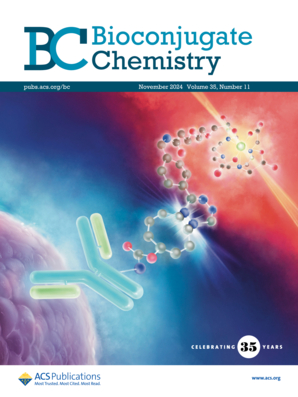
Multiple studies have demonstrated the benefit of engineering hybrid ligands that combine the unique benefits of small molecules and proteins or peptides. However, the molecular complexity of hybrid ligands generates a parameter space so large it cannot be exhaustively explored. We systematically evaluated the impact of one molecular design element, conjugation site, on the discovery of functional protein-small molecule hybrids (PriSMs). We utilized a library of yeast-displayed fibronectin domain variants with amino acid and loop length diversity in the paratope and a single cysteine at one of 18 possible conjugation sites. The protein variants were coupled with maleimide-functionalized acetazolamide and sorted via competitive flow cytometry to discover potent and selective inhibitors of three isoforms of carbonic anhydrase. Deep sequencing of the resultant populations of functional PriSMs revealed an isoform-dependent distribution of conjugation site preferences. The top PriSMs showed potency and selectivity gains up to 23- and 100-fold (in this case, for CA-II vs CA-XII, with a 43-fold selectivity gain for CA-II vs CA-IX) relative to PEG2-acetazolamide alone. The presented study expands our fundamental understanding of the role of conjugation site in PriSM function and informs future PriSM engineering efforts by highlighting the benefit of conjugation site diversity in PriSM libraries.
期刊介绍:
Bioconjugate Chemistry invites original contributions on all research at the interface between man-made and biological materials. The mission of the journal is to communicate to advances in fields including therapeutic delivery, imaging, bionanotechnology, and synthetic biology. Bioconjugate Chemistry is intended to provide a forum for presentation of research relevant to all aspects of bioconjugates, including the preparation, properties and applications of biomolecular conjugates.



 京公网安备 11010802042870号
京ICP备2023020795号-1
京公网安备 11010802042870号
京ICP备2023020795号-1

 分享
分享
 求助内容:
求助内容: 应助结果提醒方式:
 扫码关注我们
