Chengkun Dong, Xiaowen Gu, Yiyun He, Ziwei Zhou, Jiayi Wang, Zhihai Wu, Wenqi Wang, Tangsheng Chen, Jun Wu, Tong Qiu and Jun Xia
{"title":"An ultra-compact integrated phase shifter via electrically tunable meta-waveguides†","authors":"Chengkun Dong, Xiaowen Gu, Yiyun He, Ziwei Zhou, Jiayi Wang, Zhihai Wu, Wenqi Wang, Tangsheng Chen, Jun Wu, Tong Qiu and Jun Xia","doi":"10.1039/D4NH00592A","DOIUrl":null,"url":null,"abstract":"<p >Integrated photonics has emerged as a pivotal technology in the advancement of next-generation computing and communication devices. Thermal optical phase shifters (OPSs) have been widely used to realize a tunable Mach–Zehnder interferometer (MZI) and a micro-ring resonator (MRR), which are the building bricks for the LSI/VLSI photonic integrated circuits. Due to the thermal crosstalk and the low modulation efficiency, thermal OPSs have large-scale size and high power consumption. In this work, we embed a Mie resonant metasurface into a waveguide and use the liquid crystal to tune the phase of the propagated light, which could realize a novel integrated phase shifter based on LC meta-waveguides. We use nanofabrication to prepare the meta-waveguide integrated MZI and MRR. By applying voltage, the output of the waveguide's intensity can be changed. Compared with thermo OPSs, this new modulator has the advantages of small size (20 μm × 0.35 μm), no thermal crosstalk, low power consumption (<10 nW), and easy large-scale integration. Additionally, we apply it to the convolutional architecture and verify that it has the potential to accelerate neural network computation.</p>","PeriodicalId":93,"journal":{"name":"Nanoscale Horizons","volume":" 5","pages":" 933-943"},"PeriodicalIF":6.6000,"publicationDate":"2025-03-11","publicationTypes":"Journal Article","fieldsOfStudy":null,"isOpenAccess":false,"openAccessPdf":"https://pubs.rsc.org/en/content/articlepdf/2025/nh/d4nh00592a?page=search","citationCount":"0","resultStr":null,"platform":"Semanticscholar","paperid":null,"PeriodicalName":"Nanoscale Horizons","FirstCategoryId":"88","ListUrlMain":"https://pubs.rsc.org/en/content/articlelanding/2025/nh/d4nh00592a","RegionNum":2,"RegionCategory":"材料科学","ArticlePicture":[],"TitleCN":null,"AbstractTextCN":null,"PMCID":null,"EPubDate":"","PubModel":"","JCR":"Q1","JCRName":"CHEMISTRY, PHYSICAL","Score":null,"Total":0}
引用次数: 0
Abstract
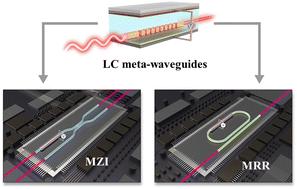
Integrated photonics has emerged as a pivotal technology in the advancement of next-generation computing and communication devices. Thermal optical phase shifters (OPSs) have been widely used to realize a tunable Mach–Zehnder interferometer (MZI) and a micro-ring resonator (MRR), which are the building bricks for the LSI/VLSI photonic integrated circuits. Due to the thermal crosstalk and the low modulation efficiency, thermal OPSs have large-scale size and high power consumption. In this work, we embed a Mie resonant metasurface into a waveguide and use the liquid crystal to tune the phase of the propagated light, which could realize a novel integrated phase shifter based on LC meta-waveguides. We use nanofabrication to prepare the meta-waveguide integrated MZI and MRR. By applying voltage, the output of the waveguide's intensity can be changed. Compared with thermo OPSs, this new modulator has the advantages of small size (20 μm × 0.35 μm), no thermal crosstalk, low power consumption (<10 nW), and easy large-scale integration. Additionally, we apply it to the convolutional architecture and verify that it has the potential to accelerate neural network computation.
期刊介绍:
Nanoscale Horizons stands out as a premier journal for publishing exceptionally high-quality and innovative nanoscience and nanotechnology. The emphasis lies on original research that introduces a new concept or a novel perspective (a conceptual advance), prioritizing this over reporting technological improvements. Nevertheless, outstanding articles showcasing truly groundbreaking developments, including record-breaking performance, may also find a place in the journal. Published work must be of substantial general interest to our broad and diverse readership across the nanoscience and nanotechnology community.



 京公网安备 11010802042870号
京ICP备2023020795号-1
京公网安备 11010802042870号
京ICP备2023020795号-1

 分享
分享
 求助内容:
求助内容: 应助结果提醒方式:
 扫码关注我们
