Garima Sharma, Yeon Hee Lee, Jin-Chul Kim, Ashish Ranjan Sharma, Sang-Soo Lee
{"title":"Bone Regeneration Enhanced by Quercetin-Capped Selenium Nanoparticles via miR206/Connexin43, WNT, and BMP signaling pathways.","authors":"Garima Sharma, Yeon Hee Lee, Jin-Chul Kim, Ashish Ranjan Sharma, Sang-Soo Lee","doi":"10.14336/AD.2025.0025","DOIUrl":null,"url":null,"abstract":"<p><p>Age-related alterations in the skeletal system are linked to decreased bone mass, a reduction in bone strength and density, and an increased risk of fractures and osteoporosis. Therapeutics are desired to stimulate bone regeneration and restore imbalance in the bone remodeling process. Quercetin (Qu), a naturally occurring flavonoid, induces osteogenesis; however, its solubility, stability, and bioavailability limit its therapeutic use. Nanoformulation can improve the physical properties of Qu and enhance its bioactivity and bioavailability. Further, localized delivery of Qu nanoformulations at the site of bone defects could ensure high local concentration, augmenting its osteogenic properties. Thus, this study aims to synthesize selenium nanoparticles-based Qu nanoformulation (Qu-SeNPs) and evaluate their osteogenic stimulation ability along with localized bone regeneration ability. Here, the spontaneously synthesized Qu-SeNPs showed uniform size distribution and rough flower-shaped morphology. The confocal images indicate improved cellular uptake and even cellular distribution of Qu-SeNPs in osteoblasts, resulting in increased osteogenic activity as indicated by enhanced expression of early and late osteoprogenitor differentiation markers. Qu-SeNPs also decreased osteoblasts' RANKL/OPG ratio and inhibited osteoclast formation. Mechanistically, Qu-SeNPs activate critical signaling pathways, including WNT and BMP, and utilize the miR-206/Connexin43 pathway to enhance osteogenesis. In vivo, experiments utilizing a drill-hole bone defect model in mice indicate that hydrogel-mediated localized delivery of Qu-SeNPs significantly accelerates bone defect healing. Thus, well-characterized and mechanistic, detailed synthesized Qu-SeNPs can restore bone remodeling, and Qu-SeNPs embedded in hydrogels may improve Qu cellular uptake and bioavailability in clinical settings, enabling innovative orthopedic and regenerative therapies for bone loss/defects.</p>","PeriodicalId":7434,"journal":{"name":"Aging and Disease","volume":" ","pages":""},"PeriodicalIF":6.9000,"publicationDate":"2025-03-11","publicationTypes":"Journal Article","fieldsOfStudy":null,"isOpenAccess":false,"openAccessPdf":"https://www.ncbi.nlm.nih.gov/pmc/articles/PMC12727087/pdf/","citationCount":"0","resultStr":null,"platform":"Semanticscholar","paperid":null,"PeriodicalName":"Aging and Disease","FirstCategoryId":"3","ListUrlMain":"https://doi.org/10.14336/AD.2025.0025","RegionNum":2,"RegionCategory":"医学","ArticlePicture":[],"TitleCN":null,"AbstractTextCN":null,"PMCID":null,"EPubDate":"","PubModel":"","JCR":"Q1","JCRName":"GERIATRICS & GERONTOLOGY","Score":null,"Total":0}
引用次数: 0
Abstract
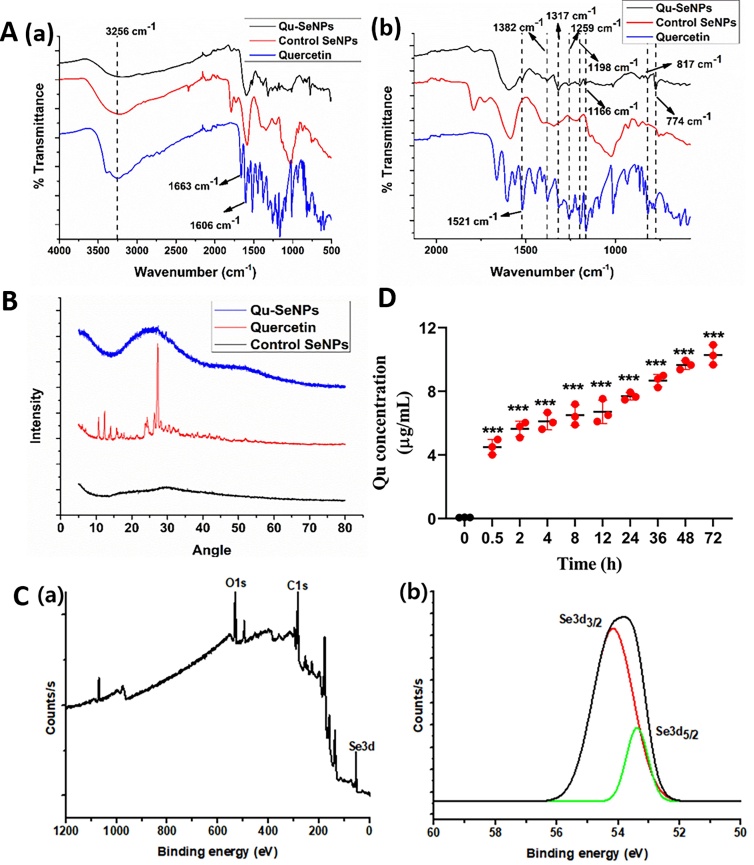
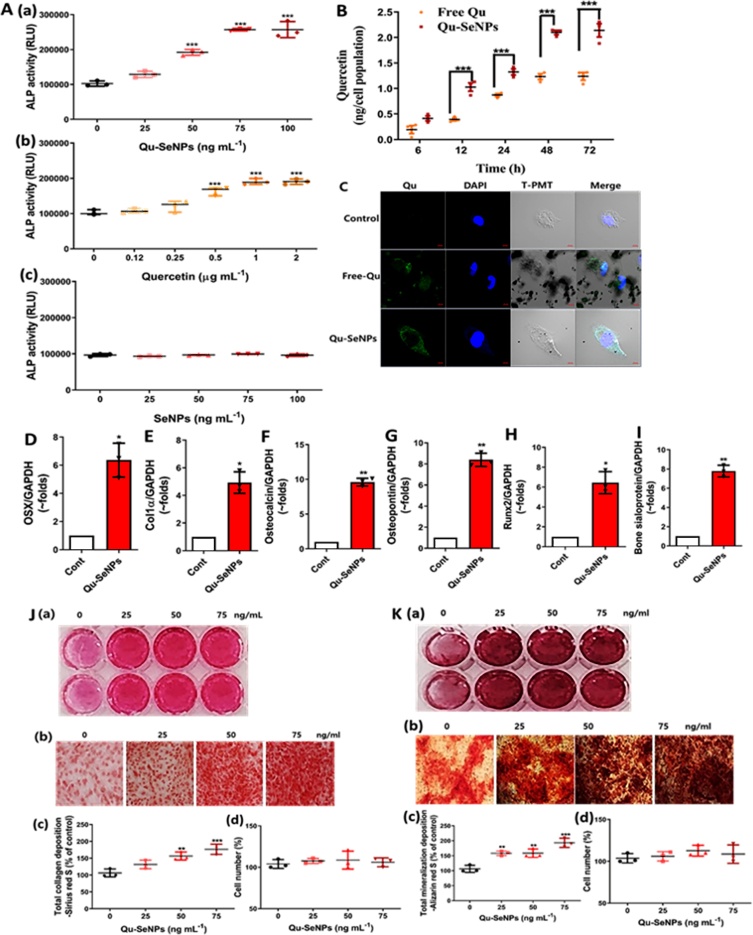
Age-related alterations in the skeletal system are linked to decreased bone mass, a reduction in bone strength and density, and an increased risk of fractures and osteoporosis. Therapeutics are desired to stimulate bone regeneration and restore imbalance in the bone remodeling process. Quercetin (Qu), a naturally occurring flavonoid, induces osteogenesis; however, its solubility, stability, and bioavailability limit its therapeutic use. Nanoformulation can improve the physical properties of Qu and enhance its bioactivity and bioavailability. Further, localized delivery of Qu nanoformulations at the site of bone defects could ensure high local concentration, augmenting its osteogenic properties. Thus, this study aims to synthesize selenium nanoparticles-based Qu nanoformulation (Qu-SeNPs) and evaluate their osteogenic stimulation ability along with localized bone regeneration ability. Here, the spontaneously synthesized Qu-SeNPs showed uniform size distribution and rough flower-shaped morphology. The confocal images indicate improved cellular uptake and even cellular distribution of Qu-SeNPs in osteoblasts, resulting in increased osteogenic activity as indicated by enhanced expression of early and late osteoprogenitor differentiation markers. Qu-SeNPs also decreased osteoblasts' RANKL/OPG ratio and inhibited osteoclast formation. Mechanistically, Qu-SeNPs activate critical signaling pathways, including WNT and BMP, and utilize the miR-206/Connexin43 pathway to enhance osteogenesis. In vivo, experiments utilizing a drill-hole bone defect model in mice indicate that hydrogel-mediated localized delivery of Qu-SeNPs significantly accelerates bone defect healing. Thus, well-characterized and mechanistic, detailed synthesized Qu-SeNPs can restore bone remodeling, and Qu-SeNPs embedded in hydrogels may improve Qu cellular uptake and bioavailability in clinical settings, enabling innovative orthopedic and regenerative therapies for bone loss/defects.
期刊介绍:
Aging & Disease (A&D) is an open-access online journal dedicated to publishing groundbreaking research on the biology of aging, the pathophysiology of age-related diseases, and innovative therapies for conditions affecting the elderly. The scope encompasses various diseases such as Stroke, Alzheimer's disease, Parkinson’s disease, Epilepsy, Dementia, Depression, Cardiovascular Disease, Cancer, Arthritis, Cataract, Osteoporosis, Diabetes, and Hypertension. The journal welcomes studies involving animal models as well as human tissues or cells.




 京公网安备 11010802042870号
京ICP备2023020795号-1
京公网安备 11010802042870号
京ICP备2023020795号-1

 分享
分享
 求助内容:
求助内容: 应助结果提醒方式:
 扫码关注我们
