{"title":"Long-term cost-effectiveness of health behaviour intervention to manage type 2 diabetes in Nepal.","authors":"Padam Kanta Dahal, Corneel Vandelanotte, Lal Rawal, Rashidul Alam Mahumud, Grish Paudel, Melanie Lloyd, Yeji Baek, Biraj Karmacharya, Tomohiko Sugishita, Zanfina Ademi","doi":"10.1186/s12916-025-03981-8","DOIUrl":null,"url":null,"abstract":"<p><strong>Background: </strong>Long-term cost-effectiveness analyses of health behaviour interventions to effectively manage type 2 diabetes mellitus (T2DM) in low-income countries are crucial for minimising economic burden and optimising resource allocation. Therefore, this study aimed to estimate the long-term cost-effectiveness of implementing a health behaviour intervention to manage T2DM in Nepal.</p><p><strong>Methods: </strong>A Markov model in combination with a decision tree was developed to compare the costs and outcomes of the health behaviour intervention against usual care among 481 (238-intervention and 243-control) participants from healthcare system and societal perspectives. The model integrates empirical trial data, with published data to inform parameters not collected during the trial. The model estimated costs, quality-adjusted life years (QALYs) and cost-effectiveness over 5 years, 10 years, 20 years, 30 years and a lifetime time horizons with 3% annual discounting. Sub-group, scenarios, both one-way and two-way analyses and probabilistic sensitivity analyses (PSA) were performed to assess the impact of uncertainty in the model under the threshold of 3 times gross domestic product (GDP) per capita (i.e., US $4140) for Nepal.</p><p><strong>Results: </strong>Base-case analysis with lifetime horizon showed that the health behaviour intervention compared to usual care improved QALYs by 3.88 and increased costs by US $4293 per patient, with an incremental cost-effectiveness ratio (ICER) of US $1106 per QALY gained from a healthcare system perspective. From a societal perspective, QALYs also improved by 3.88 and costs increased by US $4550, with an ICER of US $1173 per QALY gained. Furthermore, the intervention demonstrated ICERs of US $636, US $678, US $637, and US $632 per QALY gained over 5-, 10-, 20-, and 30-year time horizons, respectively, from a healthcare system perspective, and US $719, US $766, US $659, and US $716 per QALY gained from a societal perspective. In the PSA, the probability of the health behaviour intervention being cost-effective was over 57%.</p><p><strong>Conclusions: </strong>The health behaviour intervention for managing T2DM was cost-effective over a lifetime horizon compared to usual care. To maximise its impact, this intervention should be scaled up nationwide, and future research is warranted to assess the long-term cost-effectiveness across diverse settings in low-income countries.</p><p><strong>Trial registration: </strong>Australia and New Zealand Clinical Trial Registry (ACTRN12621000531819).</p>","PeriodicalId":9188,"journal":{"name":"BMC Medicine","volume":"23 1","pages":"153"},"PeriodicalIF":8.3000,"publicationDate":"2025-03-11","publicationTypes":"Journal Article","fieldsOfStudy":null,"isOpenAccess":false,"openAccessPdf":"https://www.ncbi.nlm.nih.gov/pmc/articles/PMC11900644/pdf/","citationCount":"0","resultStr":null,"platform":"Semanticscholar","paperid":null,"PeriodicalName":"BMC Medicine","FirstCategoryId":"3","ListUrlMain":"https://doi.org/10.1186/s12916-025-03981-8","RegionNum":1,"RegionCategory":"医学","ArticlePicture":[],"TitleCN":null,"AbstractTextCN":null,"PMCID":null,"EPubDate":"","PubModel":"","JCR":"Q1","JCRName":"MEDICINE, GENERAL & INTERNAL","Score":null,"Total":0}
引用次数: 0
Abstract
Background: Long-term cost-effectiveness analyses of health behaviour interventions to effectively manage type 2 diabetes mellitus (T2DM) in low-income countries are crucial for minimising economic burden and optimising resource allocation. Therefore, this study aimed to estimate the long-term cost-effectiveness of implementing a health behaviour intervention to manage T2DM in Nepal.
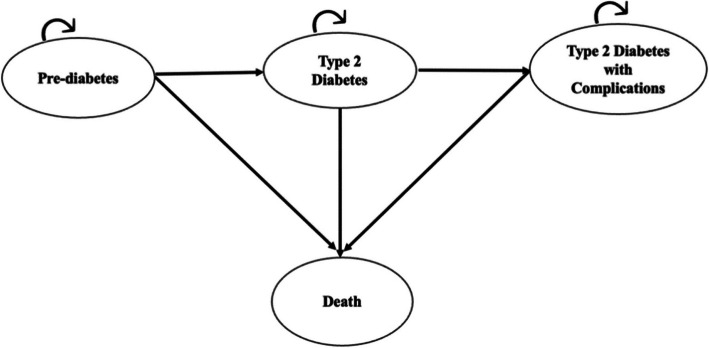
Methods: A Markov model in combination with a decision tree was developed to compare the costs and outcomes of the health behaviour intervention against usual care among 481 (238-intervention and 243-control) participants from healthcare system and societal perspectives. The model integrates empirical trial data, with published data to inform parameters not collected during the trial. The model estimated costs, quality-adjusted life years (QALYs) and cost-effectiveness over 5 years, 10 years, 20 years, 30 years and a lifetime time horizons with 3% annual discounting. Sub-group, scenarios, both one-way and two-way analyses and probabilistic sensitivity analyses (PSA) were performed to assess the impact of uncertainty in the model under the threshold of 3 times gross domestic product (GDP) per capita (i.e., US $4140) for Nepal.
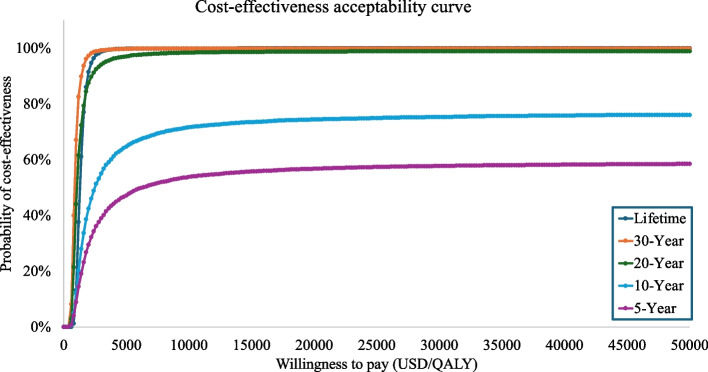
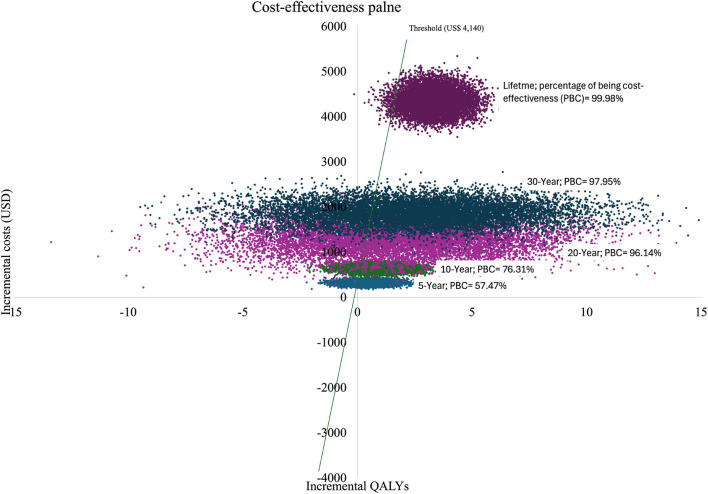
Results: Base-case analysis with lifetime horizon showed that the health behaviour intervention compared to usual care improved QALYs by 3.88 and increased costs by US $4293 per patient, with an incremental cost-effectiveness ratio (ICER) of US $1106 per QALY gained from a healthcare system perspective. From a societal perspective, QALYs also improved by 3.88 and costs increased by US $4550, with an ICER of US $1173 per QALY gained. Furthermore, the intervention demonstrated ICERs of US $636, US $678, US $637, and US $632 per QALY gained over 5-, 10-, 20-, and 30-year time horizons, respectively, from a healthcare system perspective, and US $719, US $766, US $659, and US $716 per QALY gained from a societal perspective. In the PSA, the probability of the health behaviour intervention being cost-effective was over 57%.
Conclusions: The health behaviour intervention for managing T2DM was cost-effective over a lifetime horizon compared to usual care. To maximise its impact, this intervention should be scaled up nationwide, and future research is warranted to assess the long-term cost-effectiveness across diverse settings in low-income countries.
Trial registration: Australia and New Zealand Clinical Trial Registry (ACTRN12621000531819).
期刊介绍:
BMC Medicine is an open access, transparent peer-reviewed general medical journal. It is the flagship journal of the BMC series and publishes outstanding and influential research in various areas including clinical practice, translational medicine, medical and health advances, public health, global health, policy, and general topics of interest to the biomedical and sociomedical professional communities. In addition to research articles, the journal also publishes stimulating debates, reviews, unique forum articles, and concise tutorials. All articles published in BMC Medicine are included in various databases such as Biological Abstracts, BIOSIS, CAS, Citebase, Current contents, DOAJ, Embase, MEDLINE, PubMed, Science Citation Index Expanded, OAIster, SCImago, Scopus, SOCOLAR, and Zetoc.



 京公网安备 11010802042870号
京ICP备2023020795号-1
京公网安备 11010802042870号
京ICP备2023020795号-1

 分享
分享
 求助内容:
求助内容: 应助结果提醒方式:
 扫码关注我们
